
Aston Martin’s AMR26 crisis turns dangerous ahead of 2026 Australian Grand Prix

Written by Kavi Khandelwal
The arrival of Formula One’s new technical era was supposed to be the moment the "Newey-Aston-Honda" era announced itself as a championship powerhouse. Instead, as the paddock settles into Albert Park for the Australian Grand Prix, the mood within the Silverstone-based team has shifted from ambitious to apocalyptic.

What was initially reported as a "reliability crisis" has morphed into a genuine medical and safety emergency that could leave its drivers with permanent physical injuries.
The 25-Lap Limit: A Race Against Permanent Injury
The most harrowing revelation to emerge from the team’s pre-race briefings involves the sheer physical toll the AMR26 is taking on its drivers. The Honda power unit is producing "extreme" vibrations that are being transmitted directly through the carbon fiber chassis—a material Adrian Newey notes is naturally stiff with almost zero damping—into the steering column.
The result is a sensation Lance Stroll has reportedly compared to "electrocuting yourself in a chair." It isn't just uncomfortable; it is dangerous. The team has been forced to implement a hard cap on stint lengths because the high-frequency vibration threatens to cause permanent nerve damage to the drivers' hands.

Fernando Alonso has stated he cannot safely exceed 25 consecutive laps, while Stroll—already wary of his history of wrist injuries—has set his personal limit at just 15 laps.
In a sport where a Grand Prix typically runs 58 laps, Aston Martin is entering Sunday with the mathematical certainty that they cannot finish the race without risking the long-term health of their world-class driver lineup.
A "Self-Fulfilling Downward Spiral"
The technical briefing led by Adrian Newey and HRC President Koji Watanabe painted a picture of a power unit that is not just unreliable, but fundamentally misunderstood.
While the team has worked feverishly on a "dyno-tested" fix to prevent the vibrations from shattering the battery pack—the issue that decimated their spare parts supply in Bahrain—the root cause remains a mystery.

Newey, in an uncharacteristically blunt assessment, described a "self-fulfilling downward spiral" regarding the car's performance. The Honda internal combustion engine (ICE) is reportedly lacking roughly 80hp compared to the frontrunners.
In the 2026 regulations, a deficit in ICE power forces the car to lean more heavily on its electrical deployment to stay competitive on the straights. This drains the battery prematurely, leaving the driver "flat" and defenseless.
The gap is visible on the stopwatch: during testing, the Aston Martin was a staggering four seconds off the pace. While Newey believes the chassis itself is roughly the fifth-best on the grid (about 0.75s to 1s off the benchmark), the "amplifier" effect of the failing engine has rendered the car nearly undriveable at the limit.
The "Token" Grand Prix
The crisis reached such a peak that the team explored invoking force majeure to skip the Australian Grand Prix entirely. The logistical reality is that the team is essentially out of parts; the vibrations are so violent they are literally shaking the car to pieces, with mirrors and taillights falling off during low-speed installation laps.
However, the legal weight of the Concorde Agreement and the optics of a flagship "works" team missing the season opener have forced a "start-and-park" strategy. The plan is now purely transactional: qualify within the 107% margin to satisfy the FIA, run long enough to appease global sponsors, and retire the cars before the vibration-induced nerve damage sets in for Alonso and Stroll.
The Crisis Unit: A Race for Survival
At the Silverstone factory and Honda’s Sakura headquarters, the "crisis unit" is working 24-hour shifts. Chief Strategy Officer Andy Cowell, the architect of the Mercedes V6 turbo-hybrid dominance, has been dispatched to Japan to oversee what is being described as an emergency heart transplant for the AMR26 project.
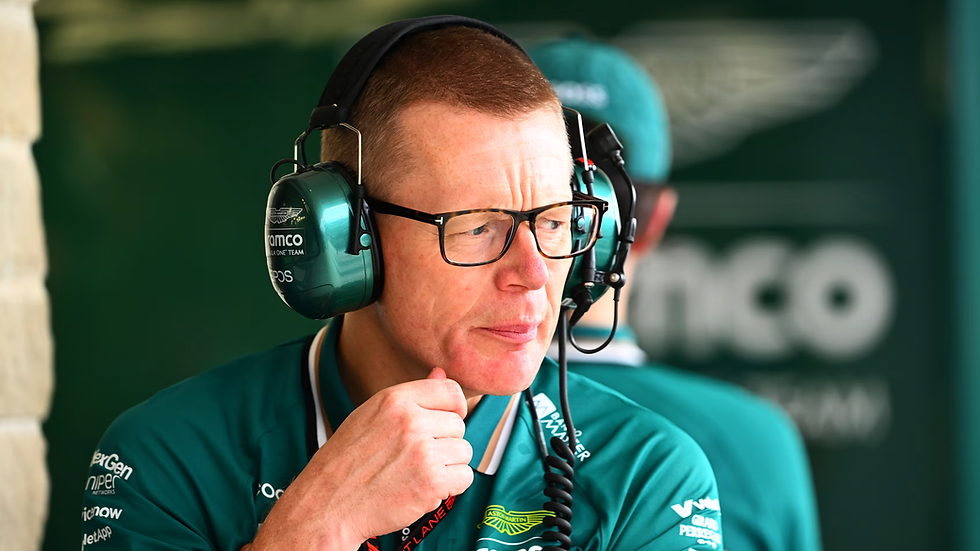
For billionaire owner Lawrence Stroll, this is a humiliation of the highest order. He has built a state-of-the-art wind tunnel and recruited the greatest technical minds in the history of the sport, only to find himself presiding over a team that is physically incapable of completing a race distance.
As the lights go out in Melbourne, the eyes of the world won't be on the podium battle. They will be on the green cars, watching the lap counter, and waiting for the moment the drivers' hands can no longer take the punishment. In 2026, Aston Martin isn't racing for points; they are racing to ensure their drivers can still feel their fingers by Monday morning.



Comments