
Linus Lundqvist exclusive: Rebuilding an IndyCar career that fell apart


Tyresö, Sweden.
A relatively modest Scandinavian municipality of less than 50,000 people. One of fairly temperate summers and not immune to harsher winter days. A spot of snow is not unusual during the colder months in Stockholm County.
The setting is idyllic - just as you would picture in the Nordic region.
The surrounding is that of sprawling lakes and seaside views of the Stockholm archipelago as islands aplenty litter Sweden’s central eastern coast. The grand Tyresö Palace overlooks one of many of these vast expanses of water and forestry.
The neighbouring Tyresta National Park is a blanket of greenery. Towering pines and spruce trees layer southern Sweden’s largest area of ancient forest, complete with the soundtrack of woodpeckers knocking, toads croaking and the occasional deer grunting.
It is a peaceful and soothing corner of the world.
But in quite the contrast to that tranquility, one of Tyresö’s most notable inhabitants has built his name for competing in one of the world’s most high-octane professions.
The relaxation of the setting has long been offset by the graft and grind that the Lundqvist family have had to endure for son Linus to reach the position he has. From very early on in his career, he has been front and centre of working to build a name for himself.
At the tender age of 14 or 15 years old, he recalls sitting down with his mother to create a sponsorship folder and pitch - all with the bid to build enough funding to pursue his dream.
The dream of becoming a professional racing driver.
Lundqvist was committed to doing whatever it would take to reach that goal - as brutal and tiring as the road there would be. Sponsorship folder in hand, he would get driven around to the whole range of companies in the local Tyresö area.
“Hey, my name is Linus,” he would say, knocking on every door. “Could I have five minutes?”
He and his mother would research the CEO or owner of each company, visiting their location with the hope that they would be willing to converse. There was no noted motorsport heritage in the small Swedish municipality but Lundqvist was determined to earn their support.

“I think I went to over a hundred companies,” he remembers. “I think I got like less than five ‘yes’ so there’s a lot of nos and turn downs and closed doors and: ‘Stop wasting my time.’ But that’s where you start learning on dealing with these people and what they want to hear and what they don’t want to hear and what works.”
Lundqvist has been switched-on from the very start. It has been an entirely conscious decision - from his junior days and formative years in racing - to have been at the forefront of discussions with potential partners.
“Without me, there’s no product to sell,” he insists. “So that’s been the only way to do it. I’ve been very fortunate where I’ve had a family that’s been very, very, very supportive since day one [too].
“I look back at it now like: ‘Alright, that was not a good presentation and whatever I said was probably not good.’ But obviously the more you talk to these people, the more you learn. At the end of it, I was pretty hands-on and helping my own career to even go racing.”
Down the line, these would prove invaluable lessons for Lundqvist. While on an increasing scale, the process has long remained the same. As a driver without inherent masses of funding, being able to attract sponsors has been career-defining.
Many times in the years subsequent, he has found himself in must-win situations. Through a junior career spanning his native Nordic nations, a switch to the United Kingdom and ultimately residence stateside, even when fighting for the British F3, Formula Regional Americas or Indy Lights titles, there were no guarantees.
“Without those supporters and sponsors that I had from almost going back 10 years now, I would not be in the position I am right now,” he says. “But we knew that we would never really have the funding to go into a top-level series like IndyCar and find a seat that way.
“So we’ve just had to hope that the results were good enough along the way and hopefully a team would see that and appreciate it.”

The crescendo of this harsh reality of racing came in 2022, when Lundqvist was running for the Indy NXT title with HMD Motorsports.
He had impressed as a rookie the year prior, losing out only to two now-proven IndyCar drivers, Kyle Kirkwood and David Malukas, and managing to return for a second season. But with every race that went by, the next was thrown into question.
Even with Lundqvist hurtling towards winning the championship.
“I got money to pay for another race and then I’m like: ‘Alright, I’m out of money. What are we going to do?’” he recalls. “I was very lucky I was in a great team that helped me keep going. And then I had some great sponsors and investors as well that said: ‘Alright, well you won the last race so we’re going to keep you going here. We’ll put money for another race.’”
Five race wins and a total of nine podiums at the conclusion of the 14-race season saw the faith of Lundqvist’s partners pay off as he was crowned champion. But making that next step to IndyCar is not straightforward - no matter the reward from the series.
So despite a dominant 92-point victory in the Indy Lights championship, there was no seat for Lundqvist in the top series for 2023.
But he did not panic. And the best part of a decade on from that door-knocking in his homeland, that education and relentless work ethic - developed by experience over time - paid off and earned him a three-race stint at Meyer Shank Racing.
Again though, two years later, he finds himself in that same searching spot. Another brief stint as a substitute to boot. But not first-choice.
On this occasion, decked out in Arrow McLaren gear as a one-race reserve in Toronto, there was no driving opportunity. And this time he has been in and out of full-time IndyCar - as Rookie of the Year in 2024, no less.
But at the end of it all, a form of square one again.

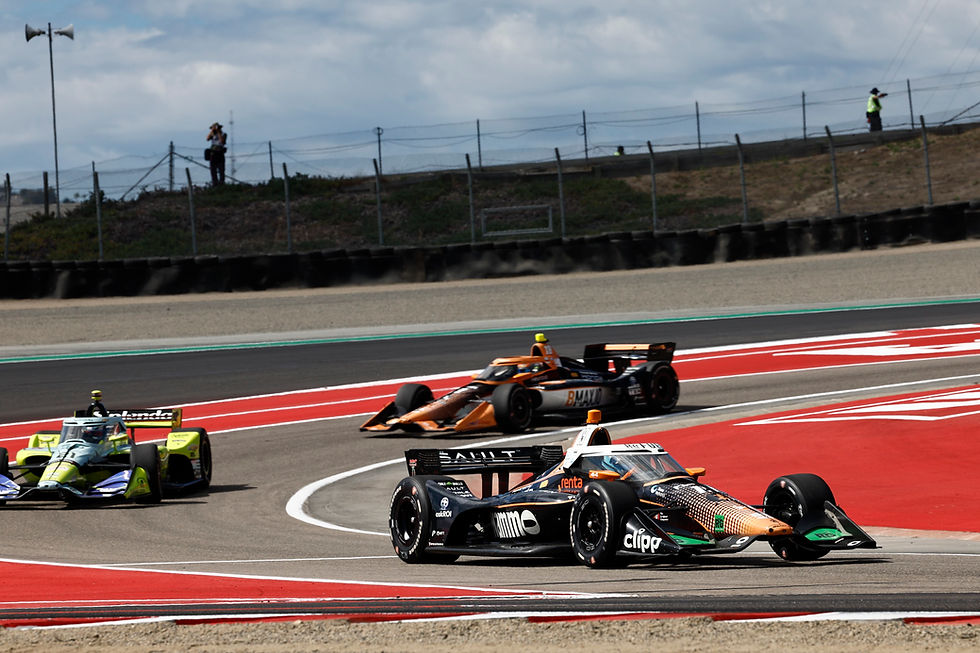
When Lundqvist gained his dream drive at Chip Ganassi Racing as part of their five-car lineup for the 2024 season, the intention was for it to be the first of many. There were ups and downs but Lundqvist took rookie honours by a resounding 97 points ahead of young teammate Kyffin Simpson.
But cornered by IndyCar’s charter system, Ganassi were forced to cut two cars for 2025. And again bruised by his lack of innate funding, Lundqvist was cut.
His dream was snatched.
Simpson took over the reins of Lundqvist’s No.8 car and Marcus Armstrong landed at Meyer Shank amid their new technical alliance with Ganassi. Through no fault of his own - simply burned by the brutal business of motorsport - Lundqvist had nothing.
“It’s hard,” he admits of the harsh reality of racing. “And sometimes it can be difficult to wake up in the morning knowing that, to go racing…”
He pauses.
“We all know how this business works. I can really see both sides because a racing team, it’s a company; they need to pay their employees, they have expenses. And if they don’t have sponsors or any other means to pay it, then it needs to come from the driver.
“But that doesn’t mean that it doesn’t hurt where not just myself but other drivers as well lose out on opportunities because the teams need to find funding elsewhere. But the way that I look at it as well, it just means that those drivers might be better at finding sponsors than I am. So obviously I’m trying my best as well to work on that.”
For many months, the airwaves went silent around Lundqvist.
Finally in late February, he took to social media to confirm that his contract with Ganassi - a multi-year agreement - had been terminated in January. He expressed his hopes that a resolution could be found through provisions in his Ganassi contract, allowing him to find another landing spot in IndyCar.
It was an incredibly difficult situation to see his career fall apart before his eyes in that way. But Lundqvist also knows you cannot hold grudges in this industry.

“It’s always tough when you leave a team, especially when the idea and the hope from both sides was that it was supposed to be long term,” he says. “But these things happen and the way that I look at it, it’s like: ‘Who knows what’s going to happen in the future?’
“The only thing I know is that I want to do everything I can for my career to still be in IndyCar. I feel like we did well enough to at least get another shot for another year.”
It was not a total surprise to him when it came to light that he would not be remaining with Ganassi given reports swirling about stipulations under IndyCar’s first-ever charter system. It was something Lundqvist had been trying to keep on top of.
He prides himself on being able to focus on what he can control, so immediately after being let go, his goal shifted straight to finding a ride for 2025.
“I went through my old playbook of 2023 where I just started calling,” he says. “And the good thing about the IndyCar paddock and all the owners and team managers is that it’s pretty closely knit. From what I did in ‘22 and ‘23 and ‘24, I’ve built a relationship with all the teams up and down the paddock so it wasn’t like I was cold calling these guys.
“You talk among drivers and teams and you had an understanding of the lay of the land and where possibilities may or may not be so I knew most of the guys already had their lineup done for this year. Obviously I was hammering those guys, trying to put myself in a position.
“But it didn’t end up happening for many different reasons.”
Unfortunately, by the time the charter agreement was formalised and Lundqvist was officially informed that he would not be in Ganassi’s third car alongside the great Scott Dixon and Álex Palou, it was very late in the driver market. Seats were at a premium - particularly those not requiring funding - and other drivers were much further in front in their conversations.

Another season on the sidelines beckoned. The dreaded outcome.
“I went through all of the feelings - with a sense of familiarity because I’d been through the same thing just one or two years prior,” he concedes. “But obviously sad because I’m a driver and I want to drive. I was sad to see that amazing opportunity not continue.”
Lundqvist searched for alternatives - just so he could continue driving somewhere rather than being sidelined and simply waiting. Sports car racing, particularly IMSA, appealed.
“But even that, when you’re a little bit late coming into the season, it’s very hard to find a ride. So I did everything I could to do that. That didn’t happen. ‘Okay, new goal: stay on top of people’s minds and try and keep race fit and stay ready.’”
Indeed, it was a familiar feeling for Lundqvist. When he did not make the step up to IndyCar having won North America’s premier open-wheel feeder series championship, it felt unjust. And again after finishing top rookie in his first IndyCar season last year, it felt unfair for him to be sidelined the following campaign.
It would be very easy to drown in his sorrows. It would be very easy to feel hard done by. And deep down, Lundqvist probably does feel that way.
But he also has a knack to try and find the positives in a situation and not get unhelpfully downcast. There is a steel and resilience about the now-26-year-old - built throughout the many years of unwarranted jeopardy in his career to date.
“I had a recipe for what I did in ‘23, which turned out to be pretty successful,” he says. “So during the course of the early days of this year, I told myself that my job will be to stay on top of people’s minds. And if something were to happen - a driver gets sick or hurt or whatever it might be, misses a race - then I’ll be the person that they would call to step in.
“I’ve been keeping my face in the IndyCar paddock and reminding team bosses again that I am here and what we did last year.”

If you have been to an IndyCar race this year, you may well have seen Lundqvist doing the rounds of the grounds. Any race he has been able to drive himself to, he has made sure to be there. Off the top of Lundqvist’s head, that equates to nine or 10 races attended.
One would imagine there could be anguish watching his peers live out the dream that was so cruelly and abruptly taken from him. But Lundqvist knows the importance of staying relevant. And for himself too, he wants to stay in the zone - hence he has even been preparing for race weekends as though he is driving, despite having no drive.
“The first thing is try to stay physically in shape,” he discloses. “So obviously still going to the gym, working out as much as I can. There’s nothing quite as good as actually driving a car, so I know that if I were to do a race, I will probably hurt the next day. But I’m as good of a shape as I was pre-season in 2024. So that feels good. I feel confident on that level.
“[It is important to] stay ready physically, because the first race I did in Nashville, it was so tiring. It was so hard. So I know that aspect as well about staying ready. It really makes a big difference in your performance.”
It goes far beyond just keeping himself physically in-check too; Lundqvist still dedicates time to his race preparation specific to the upcoming weekend. For one, this helps him be as prepared as possible if he needs to be called upon to deputise on any given weekend.
“It’s like preparing almost as I am racing,” he explains. “So I’m going through all the videos, all the notes that I did last year, going through what I wanted to do different last year and things that I wanted to try.

“I go into that every single weekend, knowing that most likely I won’t drive. But I also know that all it takes is for one call or one text to say: ‘Hey, we need you in the car.’ And then I need to be ready.
“Because I know in this sport, you don’t get many chances. You’re lucky if you get one. Two? It’s not unheard of but it’s tough, which means that you’ve got to take every opportunity you can get. So that’s what I tell myself: ‘This is my job this year, just to stay ready. In case something happens, you need to go in and deliver.’”
Dedicating all of this time and effort could easily be deflating when, as Lundqvist says, he is doing so knowing it will likely amount to nothing in terms of actually driving a car.
But there is a wider point to that. Rather than taking a back seat, he is able to stay in a rhythm, keep himself in a racing zone and remain in tune with what a race week entails. And should he find a seat for 2026, his craft from 2024 will not be such a distant memory.
“I know that I want to be racing next year and I hope that I can be, which also means that I couldn’t really afford myself to just sit home on the couch and do whatever,” he agrees. “Because then I’d just be cold for a year, not thinking about it, not being around.
“But now, obviously I’m not driving but everything else still feels normal around it, which I hope will help next year. Obviously nothing is as good as driving but this is like the second-best thing at least. I’m still around and feeling everything and going through the emotions and going through my notes and trying to learn as much as I can.”
Unlike when he is within a team, Lundqvist does not have the financial support when it comes to travelling to and putting himself up at events. He is having to fund his endeavours himself this season.

But it only speaks to his commitment and dedication to the cause of getting back into IndyCar. His belief in his work is entirely unwavering.
“For me, it’s always worth it because this is my Plan A, B, C, D, E,” he declares. “There’s no backup. I’ve got to make this work somehow. Some might call it foolish and stupid not to have a Plan B. But for me, it’s the only way through.
“Because if I had a Plan B, then I would have reverted back to that years and years and years ago. There were so many years that this was supposed to end. But because there is no Plan B means that you’ve got to find a way through.
“If I had a solid plan B that I could go back and rest upon, then I would not be here today. That’s what I believe is going to happen in the future as well because I know I will find a way.”
During this enforced hiatus, he has ensured to take every opportunity that has arisen to get back in the saddle to test cars, including driving LMP2 and GT machinery, as well as doing laps in old Formula 3 and Formula 4 cars. This has helped to keep some sharpness.
His personal simulator - given how advanced the modern technology is - has also been beneficial in keeping on top of the racecraft side.
But the biggest thing that Lundqvist has longed for while on the sidelines is something to appease his competitive side. So without a race seat, he has turned to fighting - specifically Muay Thai - and has an arranged fight coming up in September.
“I miss this adrenaline feeling because I think all drivers are adrenaline junkies at the end of the day, otherwise we wouldn’t be doing this,” he describes. “I’ve always been a competitive guy, even from a very young age - playing cards with your friends and family.
“So I knew that I had to replace the racing with something, just to calm my competitive side. And fighting, I’ve been doing that for many years on and off.

“Obviously when you race, you’ve got to be a little bit careful. So I thought; ‘Okay, well this year, I might have an opportunity to actually do a fight.’ So hopefully I can do that. It calmed those nerves down and that itch for me a little bit.”
All in all, Lundqvist has kept himself occupied so as not to get himself down about being off the grid. Yes, he has not been as busy as if he was driving. But where he would have spent a lot of time at a team’s shop if he did have a seat, he has been preoccupied with his own preparations and the significant planning he is having to do weekend to weekend.
When he turns up to the paddock for races, he still wants to have certain goals for each weekend in a bid to help his future. The primary aim is to have as many different conversations with as many different people, which takes a lot of work to arrange.
“Obviously it’s very different to when you’re driving [when] you have a very strict schedule,” he acknowledges. “Now I do my own schedules, usually before a weekend if it’s not something that I’ve done the previous weekend… because sometimes it can be like, alright, I sat down with teams last weekend: ‘Let’s sit down again this weekend.’
“And they’re like: ‘Alright, what do you want to chat about?’ I’m like: ‘Alright, well you know what I want to talk about. We talked about it five days ago.’ So that’s one of the things that I noticed was you’ve got to space out your meetings a little bit.”
When he is not in pre-arranged meetings, Lundqvist is still doing his utmost to remain in the eyeline of all the necessary people when at the race track. In doing so, he makes sure as many people of interest as possible know he is on hand on any given weekend but also keen in the longer term.
From that, more meetings. More calls. More pitches. Like the good old days in Tyresö.

“I do my laps around the paddock, bumping into people and reminding people that I am here and chatting,” Lundqvist explains. “Some of the best conversations you have are the ones that happen randomly and naturally - just happen to bump into people walking across the paddock, having a bit of a chat, scheduling a meeting for later or they might know somebody.
“Then I’m at the races helmet in the car - so not literally in hand but figuratively in hand - ready to go. I know how these things work and I know how quickly things can change. As we’ve seen in the past, all it takes is one crash and one guy didn’t release the steering wheel in time and he snatches his thumb and there’s a qualifying session three hours later…
“‘We need somebody in the car.’ I want to be that guy that they call.”
There has been some method to who Lundqvist seeks out but any conversation with anyone is a worthwhile exercise. Of course, there is an element of prioritising speaking to those with more immediate openings; after all, he wants to be back in the field as soon as possible.
But there is no harm in harbouring a relationship that could also prove fruitful further down the line.
“I don’t know what their contracts look like, but obviously from an outside perspective, whatever they say to the media and whatnot, you can get a lay of the land, seeing what possibly could have opportunities,” Lundqvist details. “And obviously you try to maybe target them more directly.
“But at the same time, I want to be in this sport for many, many years to come, which means: ‘Okay, maybe if you don’t have an opening next year but five years down the line and we have a good relationship, then maybe something will happen.’ So I try to sit down with every team up and down the paddock and just have a good relationship with them.”

In many ways, mastering the art of being annoying is key.
You have to somehow separate yourself from the countless other drivers chasing the same dream and the level of determination and persistence that Lundqvist is showing makes him memorable. He is showing teams he really wants it.
In Lundqvist’s case, showing the wherewithal to be at races - and making sacrifices to be there - makes him even more unique. He is leaving no stone unturned in making sure he can be seen and able to put his case forward.
“Absolutely [it is about] being annoying because these guys, they’re extremely busy, especially during on-season,” he says. “They’ve got hundreds of drivers calling and texting them, basically saying the same thing. There are not that many people showing up though.
“So I do think that I have an advantage that way. I know that most likely they’re not going to pick up the first time you call them. But if you call them three or four times and leave a text, usually they’ll get back to you at some point. And if not, then I’ll run into them outside of their trailer because I just happened to be passing by or whatever.
“So I just make sure that they remember me because I also know that people in this industry, in this business, they seem to have a short memory. So I just try to keep reminding them of what we’ve done in the past and what we did last year.”
It remains to be seen whether Lundqvist’s perseverance will pay off in terms of his long-term future. But he can draw encouragement from the fact Arrow McLaren called upon him in Toronto last month after Nolan Siegel suffered a concussion in a crash at Iowa Speedway.
Ultimately, Siegel was passed fit to race and Lundqvist remained sidelined, albeit able to spend a weekend in team colours at long last. Regardless, being the driver who one of IndyCar’s leading teams turned to offered encouragement.

Lundqvist had actually run into Arrow McLaren team principal Tony Kanaan at Mid-Ohio the week before Iowa. He was already one of many people who Lundqvist had obtained contact details for and got in touch with ahead of the season.
“Hey, I’ll be at the races, ready with my helmet. Wish you all the best.”
He had bumped into Kanaan sporadically throughout the season. But come Mid-Ohio, the pair spoke in-person for five or six minutes. Enough time for Lundqvist to reiterate his points.
“I was just like: ‘Hey, I’m here. Just so you know, still in shape, still doing everything I can.’ He was just like: ‘It’s good to see,’” Lundqvist recalls. “And then obviously when Iowa came around, I was there that weekend. And then obviously when they weren’t sure about Nolan being cleared for Toronto, they said: ‘Hey, we might need somebody just in case.’
“I was on top of his mind and [he] said: ‘Hey, I know a guy that’s been at every single race.’ I was happy that they called me first.”
For the first time all year, Lundqvist’s race week was not a case of preparing alone and for the near-guarantee of nothing. Siegel was not cleared until late in the week, meaning the team prepared Lundqvist as though he was going to be driving.
But even though he never ended up getting that chance to drive the car, he was appreciative of the team allowing him to tag along for the weekend - afforded the opportunity to partake in debriefs and perch, headset on and decked out in papaya, on the timings stands.
“It felt good being back in some team clothing again, even if it was just for the weekend,” he says. “Even with the reserve driver role, I was like: ‘Alright, obviously I want to drive. But if not, this is a great opportunity.’ Because I got to listen in on the engineering meetings and whatnot. I tried to learn as much as I can and then hopefully put it to test next year.

“The Arrow McLaren guys are a great group… I don’t think I realised how much I missed it. Obviously driving, I think it’s obvious I miss that every day. But just being with the team, being in team colours, listening in on engineering meetings and whatnot, it’s fun.”
Lundqvist feels his experience from 2023, showing the same sort of tenacity to put him in a position to deputise for Meyer Shank when Simon Pagenaud was injured in his Mid-Ohio practice crash, helped in securing him his weekend with Arrow McLaren.
He knows all too well that if he spent the year sitting on his sofa at home, there is next to no chance teams would come calling him. Proactivity is critical.
They likely will not pick up on the first dial. Probably not the second either. But you cannot be a quitter in this industry. Lundqvist knows to keep trying and trying, even if it takes you being - in the most positive way - somewhat irritating.
“Eventually they will [pick up]. And if not, then make sure to find out their home address or something, standing outside, wanting a conversation.”
It was something of a strange feeling for Lundqvist when he was given the chance to make his IndyCar debut in place of the injured Pagenaud at the Nashville street course in 2023.
There is naturally the joy of finally getting your shot. But in those circumstances, especially knowing Pagenaud has not raced since? There is a somewhat uncomfortable side to it.
“It’s a tough situation because nobody wants their opportunity to come into IndyCar like that,” Lundqvist admits. “I had the same feeling when Nolan had his crash in Iowa with the concussion because the concussion and the brain thing is scary to me. If it’s a wrist or a thumb, it’s a little bit different. But those things are a little scary.”
The mindset Lundqvist has tried to maintain, though, is that the opportunity came from his work prior to Pagenaud’s accident and not simply capitalising on his misfortune.

“I like to think that the work that you’ve put in up to that point, that will give you the opportunity,” he adds. “Because you almost feel like a vulture if as soon as you see something happen, you text or call the team boss being like: ‘Hey, I’m ready to step in.’ Which I don’t think necessarily is wrong - it just feels a little bit funny.
“If the first time ever that I reached out to [team owner] Mike Shank and said: ‘Hey, I want to drive for you,’ was after the Pagenaud accident, I don’t think I would have gotten the drive. But the difference was that I’ve been harassing that man for years prior to it.”
Once the opportunity did come about, Lundqvist knew it may be his one shot to secure a future in IndyCar. But with all of the jeopardy he had faced throughout his career, there had become a sense of immunity to that sort of career-on-the-line pressure.
He was well aware of what was at stake in the Music City that weekend. But while with more eyes on him and finally in the big league, there was again familiarity to his situation.
“I’m not blind. I’m not stupid,” he insists. “I knew that those were my opportunities. And realistically, if I didn’t perform well then my IndyCar career would have probably ended after that.
“Apart from maybe one or two years of my career, it was almost a race-by-race basis. So in a sense, I knew throughout my career it’s always been like: ‘Hey, if you don’t win, there’s no next race.’ And I just had the same mindset for this one.
“‘If I don’t perform well, there’s not going to be another race and it might end here.’”
Lundqvist ended the race in the wall after a crash late on. Driving back home, he was sporting a brace on an injured wrist. He thought the worst.
“I blew my shot. That’s it. Career over. You had your shot. It’s over.”

But as these thoughts swirled and his mind replayed the crash, his phone started to ring.
“Hey, you did a great job. What are you doing for next year?”
Lundqvist could scarcely believe it. Hard to think back to after ending the weekend in an unceremonious fashion, he had qualified 11th for his debut race on one of IndyCar’s trickiest, most technical and most punishing tracks. He was running just as well in the race.
Teams had seen that and taken notice. The ending did not matter to them; the raw pace and confidence shown on debut was what caught their eye.
“For the first time ever driving back, teams started to call me,” Lundqvist remembers with a glint in his eye. “And I said: ‘Woah, roles reversed here!’”
First off, Lundqvist earned a drive for the next two races with the Meyer Shank team. He qualified inside the top 12 for both - on the Indianapolis Motor Speedway road course and the Gateway oval - and converted a best race result of 12th at the former. Impressing across three vastly different tracks, it was a massive success.
At worst, teams were now picking up Lundqvist’s calls at the first ring.
With that came his opportunity with Ganassi for 2024. It is a shame to reflect back on that on a somewhat sour note, but looking towards the future, Lundqvist knows he only has to continue to be persistent and put himself in the right places at the right times.
He holds an unfaltering belief that he still deserves his place in the field.
“There’s an element of luck in this too but I also believe that you can expose yourself to luck,” he says. “[If] I’m like: ‘Alright, it’s not going to happen,’ I tell myself: ‘Alright, that’s what you thought in ‘23. But you kept going and it actually happened. So keep on pushing.’
“It worked out last time so it’s got to work out this time too. Because I strongly believe I’m a better driver today than I was in ‘23. So I know that if I have an opportunity to go at it again, I’m going to do even better than I did back then.”

Lundqvist ended the 2024 season 16th in the standings but with a pair of podiums - third places at Barber in only his third race and later in the season at Gateway - and an impressive pole position in a testing wet/dry qualifying session at Road America.
He reflects back on the year as one of highs and lows.
“But I think that’s sometimes how rookie seasons go. On our day when everything comes together, we really showed that we have the pace to be running up front, which felt amazing.
“But then obviously I made some mistakes and some decisions that now thinking back, I would have done differently. Without a doubt, I would have been a better and faster driver this year than I would have been last year.”
Lundqvist would rather have had that inconsistent rookie year but learned lessons to set himself up for quicker development in future seasons than having been conservative but not gained the education that can be so essential for rookies.
One of his biggest takeaways was the pressure that he placed upon himself being a little excessive given the calibre of his more experienced teammates.
But without that sort of belief, there is an argument that you set yourself up to fail anyway.
“I was disappointed because I’m a racing driver - I want to win,” he assesses. “The expectations that I put on myself were a lot higher and I didn’t really see myself as a rookie, which honestly got to me a little bit - just pressure wise and psychologically - especially when you’re going up against teammates like Scott Dixon and Álex Palou.
“You’re comparing yourself towards the best. And my expectation a little bit on myself was like: ‘Alright, you’re going to mix it in with those guys straight away.’ And when I wasn’t, I was like: ‘Alright, you’re s**t. What’s wrong?’
“That’s something that I learned, especially towards the end of the year, taking a step back and being like: ‘Alright, chill. Step by step.’ [But] if you went in with any other mindset, you wouldn’t really win anything, would you?

“But you also need to manage your expectations accordingly when it is your first year. And obviously it’s almost silly now, looking back at it, why I didn’t do that. Sometimes I feel like I got ahead of myself.”
As much as there is a hint of disappointment looking back at his season given the high standards he holds himself to, there was enough encouragement for Lundqvist to feel that he belongs.
“When everything comes together, I have the belief in myself that I can mix it up with the best.”
But will he have that opportunity?
As has been his focus since not securing a seat on the IndyCar grid for 2025, talks with teams about possibilities for 2026 are ongoing. It has been a less active driver market than usual this time around but Lundqvist is still searching hard for openings.
“I’m happy to say that there are conversations,” he reveals. “At least they’re not turning down my calls and don’t want to hear from me anymore, which again keeps me at the races because I know that it looks like I could have a future here.”
As much as IndyCar is his unquestionable priority, he knows it is unwise not to look elsewhere. It is better to be driving somewhere than sidelined for another year; that is where being out of a seat and racing rhythm starts to become more problematic.
A two-time Daytona 24 Hours starter in the GTD category, IMSA is on Lundqvist’s radar. He is also looking wider than that and outside of just the United States.
But this is all a simple matter of ‘just in case’ because all but one or two of his proverbial eggs are in the IndyCar basket. If he was going to settle for anything else, he would have long abandoned his relentless fight to stay relevant in the IndyCar paddock.
It is hard to say for certain whether he will be in the field next year given the standoffish ‘silly season’ so far. But he has got some positive indications from his plenty of discussions.

“I’m fighting tooth and nail to stay in IndyCar,” Lundqvist says. “I’d like to think that my chances, they’re good - some better, some worse than some other drivers. But let’s put it this way: if teams were saying that there’s no shot, not responding, not wanting to talk to me, I’d probably run out of motivation pretty damn fast going to these races.
“But they’re not. They’re all very positive.
“They’re all saying the right things and conversations are ongoing for next year. I still believe my chances of being on the grid are pretty good. I’m doing everything I can to be on there. But some things are out of your control too so you’ve just got to make sure to stay on top of the things that are in your control.
“I know the best thing I can do myself is to be around, be ready, show people that I still want this. And we hopefully have a little bit of lady luck on our side.”
Any luck that does come Lundqvist’s way, he has engineered it all for himself. At so many junctures this year and far beyond, he could have given in and had enough of tirelessly trying for, too frequently, little reward.
But that is not in his character. The boy who would spend day upon day knocking on doors in Tyresö knows nothing but to keep on plugging away in pursuit of his dream.
“I know I will find a way.”
He has done many times before. And he will not stop until he does it again.







Comments