
Drivers of Pride: Queer people of motorsport


It takes a certain courage to be your true self in today’s world, no matter the place. To be queer is to navigate spaces that were not built for you. It is to read rooms before you enter them just so you know whether you’re welcome there or not. It is a thousand small calculations every day about how much of yourself is safe to show.
Being queer is to experience the joy of community and the grief of exclusion all in one breath. It is the knowledge that visibility – real, sustained, unapologetic visibility – matters in ways that are literally life-saving. For a young person who has never seen themselves reflected anywhere that felt like home, a moment of recognition can shift something fundamental.
Pride Month exists for that moment. It is loud and colourful, and often commercially complicated. At its core, it is simple: a reminder that queer people are here, have always been here and are not going anywhere.
Motorsport did not make that easy. It is a sport that has always worshipped at the altar of a very specific kind of man – fearless, physical and unshakable. The paddock is a closed world with its own hierarchies, codes and silences.
Sponsorship deals, team politics, media scrutiny and the relentless performance of invulnerability results in it being an environment one might not think to look for queer history.
But it is there. It has always been there.
The pioneer nobody remembers

Mike Beuttler arrived in Formula One in 1971 driving a privately entered March, funded by a consortium of London stockbrokers who believed in him enough to back him with their own money.
His car earned the nickname the “Stockbroker Special.” It was a fitting label for a man who existed always slightly outside the frame – present, and visible on the circuit, but defined by what surrounded him rather than who he was.
Beuttler was good. He was tenacious, ferocious in defence of his position and earned the nickname “Blocker” for his obstinate refusal to yield to faster cars.
A friend of his later said that when Beuttler was in the same machinery as Niki Lauda and Ronnie Peterson, he was not significantly slower. He competed in 28 Grands prix across three seasons, achieving six top-ten finishes in results that, under today’s points system, would have put him on the board.
Under the rules of his era, he left without a single championship point. He was, in some ways, the sport’s forgotten man before he had even left it.
What Beuttler kept quiet was that he was gay. Of course those close to him knew, or at the very least suspected it. However, he brought a female companion to races as a necessary performance for an era in which homosexuality had not only been decriminalised in the United Kingdom in 1967, and only “in private.”
Being gay in the F1 paddock of the early 1970s, in the era of James Hunt and the hard-living mythology of the travelling circus, was not something a man announced. People in those days did not come out. Not in motor racing.
When his backers lost their appetite in the wake of the 1973 oil crisis, Beuttler’s F1 career ended. He was 33. He moved to the United States shortly after, settling eventually in Los Angeles. It was a city that offered him something Britain’s paddocks never had: the freedom to live as himself.
The friend who knew him speculated, later, that this was the whole point. That California was not a consolation prize for the end of racing. It was an escape from a life that required him to be someone he was not.
He died in Los Angeles on 29 December 1988, aged 48, of complications from AIDS. The sport did not mourn him. It barely mentioned him at all.
The woman who simply lived

Two years after Beuttler left F1, a 34-year-old Italian woman arrived. She had grown up in Frugarolo, a small town in the Piedmont region, the youngest child of a butcher who did not own a car.
She had learned to drive by running deliveries for the family shop, graduated to trucks and then to racing cars – Formula Monza, Formula 3, Formula 5000. She climbed through each category on determination, skill and the patronage of a well-connected count named Vittorio Zanon, who had also helped fund the early careers of Ronnie Peterson and Michele Alboreto.
Her name was Maria Grazia Lombardi, though the Italian press called her the “Tigress from Turin.” She preferred Lella.
At the 1975 Spanish Grand Prix at Montjuic Park, Lombardi finished sixth in a race cut short by tragedy – a barrier failure sent Rolf Stommelen’s car into the crowd, killing spectators. Since the race had not reached 75% distance, only half points were awarded.
Lombardi scored 0.5 of a championship point. It remains, over 50 years later, the only F1 championship point ever scored by a woman.
The achievement was extraordinary. What surrounded it was uglier. Male drivers tampered with her car. The paddock was hostile in ways both overt and insidious. She called it out afterwards – one of the first women in F1 to publicly name the discrimination she faced.
She also refused to let it define her. When a journalist asked whether she thought women belonged in motors racing, she answered without hesitation: “I really think that there are too many women who perhaps feel that motor racing is essentially a masculine affair. Well, I don’t agree at all.”
And through it all, she brought Fiorenza. Her partner travelled with her to every race, was known in the paddock and was simply part of the picture. Lombardi never made a speech about her sexuality. She never needed to. She lived her life and the racing world – largely – accepted her as she was, because her talent left it no other option.
She died on 3rd March 1992, aged 50, of breast cancer. Fiorenza was by side.
Lombardi’s mode of survival was not the same as Beuttler’s. Though, it came from the same impossible conditions. She had learned, early, that the world would only make space for so much difference at once. She chose to be a racing driver first. Everything else, she simply refused to hide.
The one who waited a lifetime

Mário de Araújo Cabral was born in Cedofeita, Portugal in 1934. By the late 1950s, he was regarded as the finest racing driver his country had ever produced. He carried that distinction alone – Portugal had never put a driver on an F1 grid before him.
When he lined up at the Circuito de Monsanto for the 1959 Portuguese Grand Prix in a Scuderia Centro Sud Cooper-Maserati, he made history simply by being there.
His F1 career was brief and peripatetic. Five Grands Prix across six years, no championship points, a career interrupted by National Service as a paratrooper in Angola and then by a serious crash at a Formula 2 race in Rouen in 1965 that kept him out of racing for three years.
He returned in 1968, competed in sportscars and occasionally F2 and finally retired in 1975. History knows him as Portugal’s first F1 driver, competent, brave and largely forgotten.
What history does not know – because Cabral never said – was that he was bisexual.
He said it in 2009 when he was 75 years old. Cabral came out in his autobiography as a man accounting for the full truth of his life before it was over. He had raced through the 1950s and 1960s, survived a war zone and a near-fatal crash. He spent 50 years carrying something he did not feel able to name in public.
He died on 17 August 2020, aged 86. His coming out had changed nothing about his legacy in the record books and everything about its meaning. In that act, he became the third F1 driver in history to publicly identify as LGBTQIA+ – a list so short it barely qualifies as such.
He did it at 75, because that was when he finally could. There is no version of that which is not heartbreaking.
The name everyone knew

On 15 July 2024, Ralf Schumacher posted a photograph on Instagram. He was standing with a man named Etienne Bousquet-Cassagne, the two of them looking out at a sunset. The caption read: “The most beautiful thing in life is when you have the right partner by your side with whom you can share everything.”
The post was seen by millions.
Ralf Schumacher is the younger brother of Michael Schumacher, seven-time world champion and the most famous racing driver in history. The younger Schumacher was no footnote – in his own right, he won six Grands Prix across an eleven-year career with Jordan, Williams and Toyota.
He finished third in the World Championship twice and was one of the most recognisable names in the sport. When he came out, it made front pages across Europe.
His son David’s response appeared in the comments almost immediately. He was, David wrote, very happy that his father had finally found someone with whom he felt truly comfortable and secure. “I am 100% behind you, Dad.”
A close friend described Schumacher’s coming out as “an act of liberation and self-acceptance” that had matured him for a long time.
The younger Schumacher had retired from F1 in 2007. 17 years had passed between the end of his racing career and the moment he felt able to say, publicly, who he was. 17 years in which the sport had continued – races run, championships won, generations of new drivers – and the question of whether a gay man could exist openly within it had remained unanswered.
He was, at that moment, only the fourth F1 driver in the sport’s history to come out publicly. The sport was 74 years old.
The one who decided not to wait
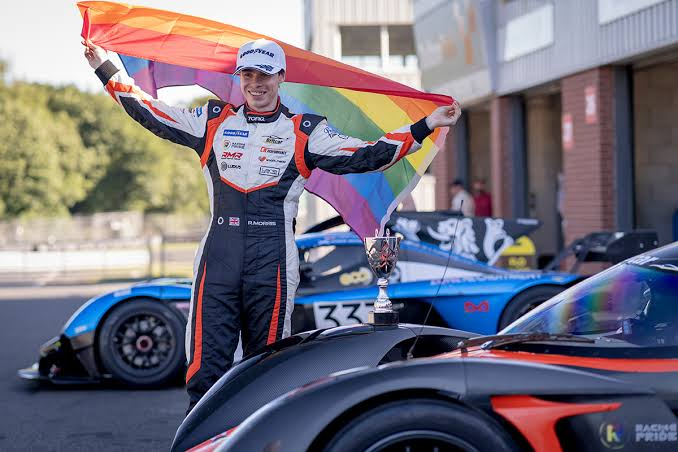
Richard Morris wanted two things in life: race and be himself while he did it. He wanted those two things to coexist without him having to choose between them or pretend that one did not exist.
Morris is a Cambridge PhD, a former international fencer for England and Great Britain and a racing driver who has competed at Le Mans and won the European Sports Prototype Cup.
He is also one of the most important people in British motorsport because of what he built when the paddock told him, in so many words, that his identity was something to be managed rather than acknowledged.
“That’s okay,” he was told, early in his career when he told people in motorsport that he was gay. “But we’re never talking about this again.”
In 2019, Morris co-founded Racing Pride. Inspired by football’s Rainbow Laces campaign and developed with the support of Stonewall UK, it set out to do something simple and radical: make space for LGBTQIA+ people in motorsport, openly and without apology.
Within two years, it was working with Aston Martin’s F1 team. Sebastian Vettel wore rainbow shoes at the Hungarian Grand Prix. The Aston Martin cars carried Racing Pride logos. Williams launched an LGBTQIA+ inclusion workstream.
“I often felt isolated as a gay driver because I didn’t know of other LGBTQ+ people in the paddock,” Morris has said. “But since I started Racing Pride, I’ve realised a lot of the LGBTQ+ community is involved in motorsport and they’re having great careers and doing exciting things.”
It is because of Morris that the sport is slowly learning that these things can be true at the same time.
The dream that is not finished yet

Charlie Martin started racing at 23 with £500 saved from a summer job. She came from no motorsport family, had no karting background and no money. What she had was the thing that every driver on this list has had, in one form or another: a love for this sport that refused to be argued out of her, no matter how many reasons the sport gave her to leave.
By her late 20s, she had another battle entirely. She had known since the age of seven that she was a transgender woman. By 2011, the weight of living in the wrong body, in a sport that was already one of the most aggressively masculine environments in professional athletics had become unbearable.
She experienced severe depression and became suicidal. She stepped away from racing because she could not see how she could be both a transgender woman and a racing driver. She chose, rightly, to save herself first.
She transitioned in 2012, documenting it on YouTube, openly and bravely. She reached people who had never seen anyone like themselves doing something like. Then, in 2018, she came back to racing.
In 2020, at the Nürburgring 24 Hours, Martin made history as the first transgender driver to compete in a 24-hour race, finishing fourth in class. In 2024, she stood on the podium at a Lamborghini Super Trofeo support race at Le Mans – second in class, Pride flag in her hands.
She was closer than any transgender driver had ever been to the race she has wanted her whole career.
“People will say it shouldn’t be a big deal that a driver is transgender,” she has said. “But I think it’s important that people in those positions should be visible.”
She is right. And she is visible. The motorsport world is ready for her.
The seat that is still empty
F1 has never had an openly queer driver on its grid. Not one, in 75 years, while the racing was happening. And the calendar itself tells part of that story – races in countries where homosexuality remains criminalised is not one that makes it easy for a queer driver to exist openly.
What it has had is Beuttler, who died far from home. Lombardi, who brought Fiorenza to every race and never said a word. Cabral, who waited until 75 to say who he was. Schumacher, who waited until his career was over. Morris, who decided not to wait at all. Martin, who put the race suit back on after the hardest years of her life and drove.
The sport will catch up eventually. Hopefully. Even if it is reluctantly. When it does, it will be because of the people who were here before it was safe – who were here, always, whether the sport knew it or not.
Edited by Marit Everett




Comments