
Home, one last time: What Zandvoort has meant to Verstappen


99% of the crowd wears orange at Zandvoort. Not for McLaren, but for Max Verstappen. 200,000 people over a weekend, a country’s flag worn, a king in the grandstand and a driver who is expected to win. That number comes from Verstappen himself, describing the scene after his first home win in 2021. Five years on, it still holds.
For most athletes, that is the kind of pressure that gets written about in cautious tones. For the four-time world champion at Zandvoort, it has mostly read the other way. He has spent five years describing the support of one of the loudest, most passionate crowds in Formula One as a standard to hit, not as a pressure to withstand. It is fuel for the Dutch driver, and this weekend gives that its last test.
How the race came back at all
Zandvoort had not held a championship round since 1985 when it returned in 2021. Why and how did it come back? The honest reason is Verstappen.
Bernie Ecclestone has called him the real reason the race exists in its modern form. By the time the paddock arrived that August, the build-up had already taken on a strange, almost civic significance.
Prince Bernhard of the Netherlands, who had lobbied behind the scenes for the race’s revival, reportedly welled up watching the F1 truck roll in. This was more than a normal home race. It was a homecoming built specifically around one driver’s rise, and the pressure of that was obvious before a wheel had turned.

Verstappen won it. Pole to flag, his 17th career victory, in front of a crowd that adored him just as much as he adored them. When asked years afterwards to name his best Zandvoort memory, he said, “The wins obviously, but also the party with the public and everything in orange”.
He added: “My best memory is the first win in 2021. The first time always stays with you.”
It was unguarded, the way he spoke of Zandvoort. This was a driver in the thick of the closest title fight of his career, and the thing most dear to him about this track was the party.
Three wins, one unbroken run
What followed was as close to total dominance as any driver has managed at a single circuit in the modern era. He won again in 2022, and then 2023, each time from pole. The 2023 edition in particular has become the defining image of his Zandvoort years: rain, chaos, a wet track turning the race into a lottery for everyone except him and a result that equalled Sebastian Vettel’s long-standing record of nine consecutive F1 wins.
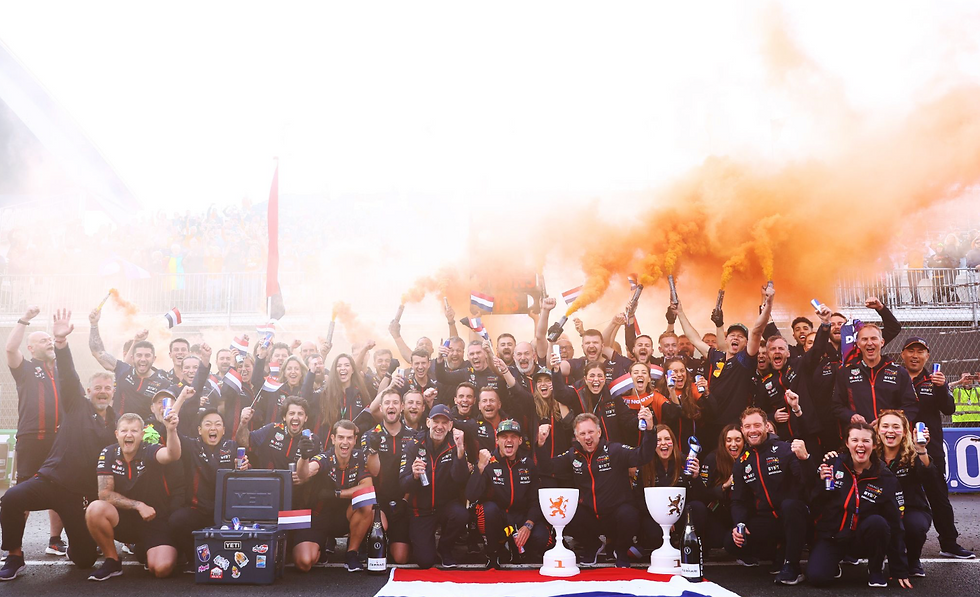
It was his 11th win of that season, and it stretched his championship lead to 138 points on the way to a third consecutive title. He described goosebumps during the national anthem before the race had even begun.
Three home races, three wins, three poles. It’s the kind of run that would ordinarily raise the stakes of every subsequent visit, and yet the tone of what he said about it never shifted into anything defensive.
Losing the wins, keeping the podium
The run of victories ended in 2024, when reigning world champion Lando Norris beat him at Zandvoort, and again in 2025, when Oscar Piastri did the same. On paper, two defeats in a row at the track most associated with his identity as a driver could have been framed as a crack in the story. However, it was not, mostly because the results themselves did not support that reading.
He finished second both times.
Across all five runnings of the modern Dutch Grand Prix, Verstappen has stood on the podium every single time, an average finishing position of 1.4 that is bettered at only one other circuit on the calendar. Losing the win while never losing the result is, in its own way, the clearest evidence that whatever pressure this race carries has not cracked him.
It has simply, consistently, been met.
Pressure as fuel
Verstappen’s words matter most in his interpretation of what it’s like to have grandstands filled with his fans. He has been remarkably consistent about it, long before this race became a farewell.
Back in 2020, before Zandvoort had even returned to the calendar, he was asked whether a future home race would add extra stress. “The pressure will be the same as in every Grand Prix,” he had said back then.
Ahead of this year’s edition, asked again, he went further, and arguably closer to the heart of it: “I never have any extra motivation because that would be bad. Then it means I’m not motivated enough for the other ones to do well, so I always just want to do a good job. I love driving there.”
It is a small but telling piece of logic. Treating Zandvoort as uniquely pressured would mean admitting the other 23 weekends matter less. That has never been how he has chosen to talk about his job.

Even so, back in 2021 he did admit, candidly, that the expectation at Zandvoort felt heavier even than winning a title in Abu Dhabi. Read alongside everything he has said since, that is not a contradiction to explain away.
It is closer to the clearest evidence available of what is actually happening. There is a well-documented distinction in performance psychology between threat appraisal, where a demanding situation is read as exceeding one’s ability to cope, and challenge appraisal, where the same situation is read as difficult but within reach, given the right resources.
The two produce very different physiological and behavioural responses, even under identical external conditions. Verstappen’s own account fits the second far better than the first. He named the pressure as real and, in the same breath, treated it as something to be met rather than escaped.
That is not the absence of pressure. It is pressure processed as a challenge instead of a threat, and is a more precise account of his mentality than ‘he doesn’t feel pressure’ ever was.
A last lap around the dunes
There is a genuine sadness sitting alongside all of this. Zandvoort’s contract runs out after this weekend, and Verstappen has called it a shame that the race will not continue while also framing his part in its return as something he is proud of.
“When I started in F1, I would have never imagined that we would go back to Zandvoort,” he said at the end of last season, once the news had settled.

For his final edition, he has commissioned a one-off Delftware-inspired helmet, white and navy with floral detailing. He shared the special helmet on Instagram with the caption: “For my last home race, dankjewel Zandvoort.”
His father, Jos Verstappen, put it more plainly, “It is a shame, certainly for the Dutch fans. But I think we should already be grateful that the event came here.”
Whatever happens during Sunday’s race, the deeper story of Verstappen at Zandvoort was never really about the results, even though they were extraordinary. It was about a driver who had every reason to find this weekend suffocating and instead, year after year, chose to describe it as fuel.
The dunes will not host a Grand Prix again after this one. The version of pressure he built here, one that motivates rather than crushes, is the part of this race that was always going to outlast the calendar slot.
Edited by Meghana Sree






Comments