
How a technological failure affected the Hungarian Grand Prix


In Formula One, each flag waved plays an important part in the race running as smoothly as possible. It is a way for drivers to understand what is going on at the track around them, whether that is hazards, warnings or a driver ready to lap another. In the digital age, where light panels and the advanced technology on a driver’s steering dash can give you all the information you need, it is so easy for things to go wrong. And that is exactly what led to the controversial chaos in Hungary.
When the blue flag is waved in an F1 race, it means that a lapped driver is about to be overtaken by a faster driver, and indicates the lapped driver to allow the faster car to pass at the earliest opportunity. If they receive three warnings for ignoring this request, they will be penalised.
In 2009, the Federation Internationale de l’Automobile (FIA) introduced light panels at some tracks. In 2022, it became mandatory for all host circuits to have these light panels installed, with FIA Grade 1 circuits to have the highest T1-spec panels. This requirement was implemented as part of the safety act between the FIA and Federation Internationale de Motocyclisme (FIM).
These digital light panels show flags such as yellow, double waved yellows, red, green and blue to name a few. This is in addition to the trackside marshals waving physical flags, and to keep both the drivers and marshals safe and aware of what is going on around them.

In recent years, when lapped drivers get shown the blue flag, it connects to their steering dash with the blue flag and the number of the car that is ready to overtake them.
This past Sunday in Hungary, there was an incident where the technology showing the driver number did not appear in the steering dash or light panels, with the only thing showing being the blue flag which appears for most of the lap.
Esteban Ocon explained it as: “We didn't have any feedback on the dash, on the cars, So, we only had the blue flag panels, but not with our numbers.
“For example, I was racing Isack [Hadjar] exit of the pitlane, but I was a lap down, I didn't know. So, I might have blocked him for three corners. But by the time the engineers told me, ‘Well, you're not racing him’, you don't know because the blue flag is always flashing the whole lap. So, yeah, it's not really clear.”
Most notably in the race was the incident between Oscar Piastri and Carlos Sainz. On Lap 32 of the race, Piastri managed to reclaim the lead of the race from Lando Norris as the two were battling for the win. McLaren decided to pit Piastri before Norris since he was in the lead, dropping him down to fourth for the time being after the stop.

However, shortly after his pitstop, Piastri had a slight clash with Sainz which knocked some time off his lap. Sainz tried to go round the outside of Fernando Alonso, but didn’t see Piastri behind to his right when he was trying to lap Sainz.
Blue flags were showing on the light panels, but due to the issues with the steering dash technology, Sainz wasn’t aware and ultimately caused a collision with Piastri. Piastri would’ve seen this as Sainz not letting him pass, however, the McLaren was in the blindspot of the Spaniard, and the situation from his point of view was unavoidable.
On Lap 56 with only 14 left to go, Piastri had to pull over to the side of the track due to a gearbox issue, an unfortunate way to exit the race when he was in contention for the win.
Although stewards found Piastri to be in Sainz’s blind spot, and that the blue flag issue contributed to the incident, they still judged Sainz to be predominantly at fault and handed him a five-second time penalty for causing a collision.
Of course, the issue with the blue flag warning system was confusing for many of the drivers, but questions have been raised about the use of mirrors and team radios, with many arguing that the drivers’ engineers should have been more aware of the issue and communicated with their drivers better.
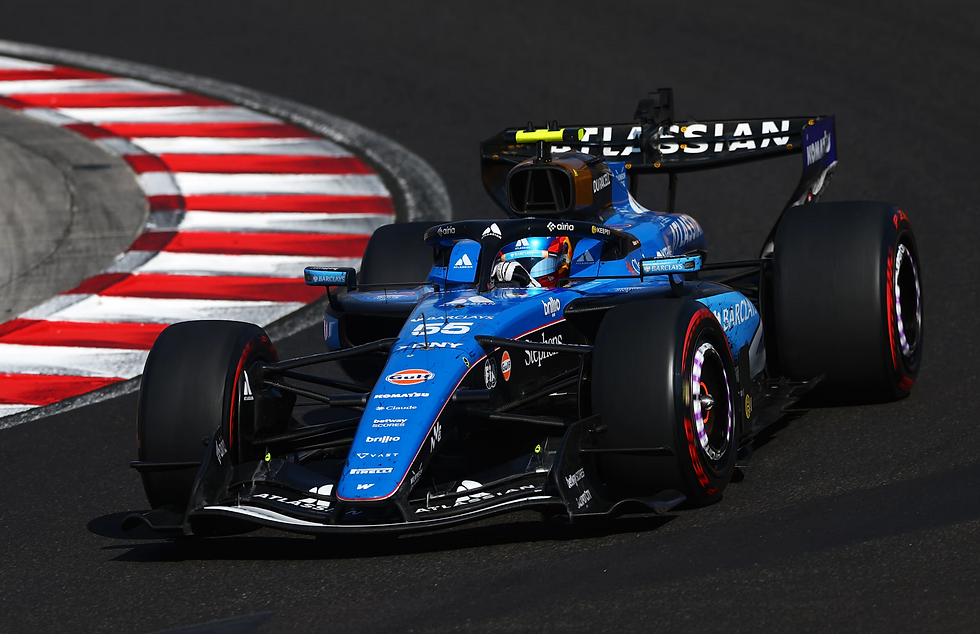
The difference in this situation was, Sainz had been warned by his team of his race position, and it was an unlucky part of the race for this to occur. With Sainz in a battle with Alonso, his angle in that moment at the outside of a 180 degree turn made it impossible for him to see Piastri on his inside mirrors.
Following the race, the Williams driver admitted: "The incident with Piastri, that could have been avoided with a bit better communication and a bit of bad luck with the dead angle in my mirror,
"I just didn't know he was there, so I had no clue he was lapping us. He was in my dead spot in the mirror."
Piastri on the other hand wasn’t best pleased, and rightfully so. He explained: "I knew there were blue flags, but there were blue flags on all the marshal signals. I was right behind him for a sector. I couldn't believe what happened.
"Getting crashed into by a lapped car is never one of the things you expect that can go wrong in your race. Today, it was. I don't really care if he didn't see me,” he remarked. "The fact that he didn't and no one told him or there was a lack of complete awareness, is unacceptable."

Whether there was a fair way to penalise Sainz is debatable. Moreover, this situation has exposed a weakness when it comes to F1’s reliance on modern technology. Although the blue flag was showing on the track’s light panels, the drivers instinctively rely on their steering dash to identify when a car is approaching to lap them. In a sport where decisions are made in fractions of a second, a problem like this inevitably creates confusion.
This situation has possibly revealed another weakness in terms of F1’s communication systems. Information on driver safety shouldn’t rely on a single piece of technology. When tools like this fail, teams should be given direct confirmation from Race Control and drivers should be informed when a faster car is approaching to pass by.
F1 has spent years adapting their manual systems to move to digital ones in the name of safety and efficiency. The likes of virtual safety cars and automated marshaling panels have generally improved race control. However, Hungary served as a reminder that technological advancements also create another potential point of failure.







Comments