
Mercedes Mid-Season Review: Dominant on pace, undone by reliability


2026 marks the first season under the new technical regulations, featuring active aero and a 50/50 power unit split. Perhaps a bit unsurprisingly, Mercedes adapted to the new rules the quickest, evident by their eight victories and 10 pole positions from 11 races so far.
George Russell converted pole into victory at the season-opening Australian Grand Prix, with Kimi Antonelli coming in second, delivering an early signal of the silver arrows having nailed the current regulation set.
How has Mercedes fared so far?
Heading into the summer break, Antonelli leads on 219 points with Lewis Hamilton from Ferrari second on 169. The championship favourite at the start of the year, Russell sits third with 160 points. The Italian teenager has a points cushion of 50 and 59 points respectively against both drivers.
In the Constructors’ Championship, Mercedes leads Ferrari by 72 points and McLaren by 159. There is a 170-point difference in the Silver Arrows’ performance when comparing the team standings from 2025 and 2026 after 11 rounds, once again highlighting the adaptability of the Mercedes outfit to the regulation change as compared to the rest.
Drivers’ Head-to-Head Performance
If Mercedes coming up at the top for this new regulation was unsurprising, Antonelli’s pace certainly wasn’t. In these 11 races, the Italian youngster has had six wins, six poles and nine podiums. He converted five of those poles into wins, the exception being his victory from second on the grid in Canada.
On the other hand, Russell won two races this year, with four poles and five podiums across 11 rounds. It certainly is a far cry from what was expected of the British driver coming into this season, after an excellent showing in 2025.
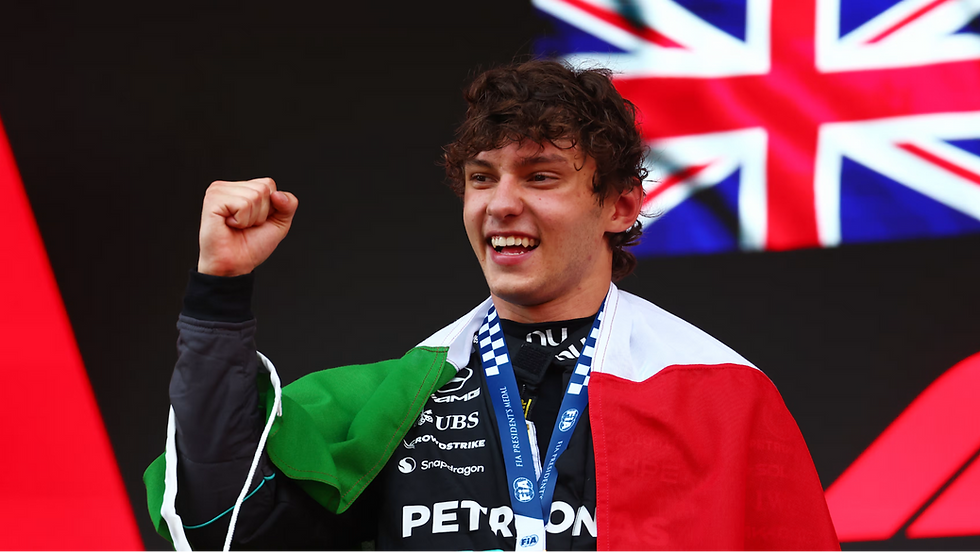
Antonelli became the youngest-ever winner around Monaco, on a weekend featuring multiple safety cars and a late red flag after the Turn 19 surface broke up. He became the first driver in F1 history to win his first three races from his first three poles earlier, though, in Miami.
Russell, on his account of the swing in form through the year said, “I felt some good momentum coming out of Austria and Barcelona, especially after Monaco.
“Monaco was a very low point for me in my season and coming back in Barcelona, getting the pole, the P2 [in the race], getting the pole in Austria and getting the win, I felt a real good momentum building, which was halted in Silverstone and Spa. I hope I can continue from where we were in Austria.”
Separately, on his run through Barcelona and Austria, Russell said, “Every weekend I’m learning something new… I think Barcelona and Austria were two really great weekends for me, and I was hoping to build on that momentum.”
In the intra-team rivalry, Team Principal Toto Wolff has permitted Russell and Antonelli to race each other on track, with team interests taking priority when the two come into conflict. This has produced some of the season’s closest wheel-to-wheel moments, notably in Canada.
Best Moments
The Silver Arrows opened the season with a 1-2, with Russell winning the Australian Grand Prix from pole and Antonelli behind him. This moved on to Miami, where Antonelli achieved his historic three-from-three pole-to-win record, fighting through wheel-to-wheel exchanges with Leclerc and Norris after early Turn 1 incidents.

The Italian driver’s name was etched in history after his win at the Japanese Grand Prix, putting him above Russell in the championship standings. This made him F1’s youngest-ever championship leader, eclipsing Sebastian Vettel’s record.
Antonelli’s stellar pole lap and the victory in Monaco also stand out as noteworthy moments. Canada brought forward a closely fought battle for the lead between the two Mercedes drivers. Their wheel-to-wheel racing has been considered the best of the season so far.
After winning the season opener, Russell finally got his next win at Austria. However, he could not hold onto any streak as Antonelli won his sixth win of the season at Belgium. He recovered the lead after losing it under a VSC.
“It’s great to be back on the top step after a few difficult rounds. It was a hard-fought race. We lost first place with the VSC, but then we managed to make our way back.” Antonelli said after the race.
Worst Moments
For Mercedes, the worst moments have seemed to plague Russell more than Antonelli this season.

Russell’s struggles began in Canada. Despite having seen the best wheel-to-wheel racing this season, Russell retired from the race lead with a power unit failure that cost him a near-certain win.
He later described the broader pattern of such failures as well, “It’s very frustrating when something seemingly totally out of your control and the team’s control ultimately completely destroys your weekend.”
This low point followed the Briton to Monaco. A straight-line speed deficit, an incorrectly served pit-lane penalty escalating to a drive-through, added to his final position of 13th after running as high as third in the race.
After the race, Russell did not shy away from sharing his frustration, “I’m beyond frustration now. I’m just struggling to comprehend how this season has panned out.”
“When I look at things objectively, if things were to balance out a little bit more, I still think it would be very, very close [with Antonelli],” Russell said, on the battle for the title with his teammate.
The bad luck switched garages in Barcelona, where Antonelli had his first DNF of the season. He retired from a likely P2 with only a handful of laps left due to a suspected power unit issue. He later on said he felt “a bit empty.”
However, Wolff was quick to respond, “We just can’t compete for a championship if every second race a car is losing fat points… To finish first, first you have to finish. That’s just not good enough.”
Silverstone saw Antonelli’s front-left wheel-guard failure drop him from a likely win to outside the points. “We let Kimi [Antonelli] down at Silverstone where George got a podium, which is maybe better than the result should have been.” Wolff had said after the race.
Russell faced his second DNF of the season at Spa, where he spun into the gravel on the opening lap after contact with Hamilton. Later, he attributed the incident to a Mercedes power deployment issue.
Reliability has been a running theme for the worst moments for Mercedes. Wolff used the phrase “not good enough” to describe the team’s reliability on more than one occasion across the season so far, especially after both Barcelona and Canada failures.
Separately, he also warned, “We can’t DNF cars in a continued way, losing 25 points in the Constructors’ Championship in Montreal and losing another 18 points on Sunday.”
Looking Ahead
Mercedes’ task for the second half of the season is to hold off a closing Ferrari and McLaren while fixing their reliability issues as well. Not only that, but the team also have to build momentum going into 2027 to keep up their dominance.
Ferrari won Barcelona and Silverstone, with reigning world champion Lando Norris winning Hungary for McLaren. What became a very dominant start to the season has now become slightly lacklustre as Mercedes have only won two of the last five races.

The Silver Arrows need to remember that despite the 50-point cushion that Antonelli has in the lead, nothing is certain.
Max Verstappen closed a 104-point deficit to the championship leader in the second half of the 2025 season. With four world champions on the grid, and three are in top teams, any of them can catch up to the young Italian in the points.
11 rounds in, Mercedes has done what no team managed at the start of a new regulations era before: won eight of the first 11 races and locked out 10 pole positions. But dominance on paper has come with cracks in practice.
Barcelona, Silverstone and Spa all told the same story: a car capable of winning and a garage still chasing the reliability to guarantee it, and Wolff’s own words on the matter have carried an edge his team hasn’t needed to hear in years.
What began as a straightforward story of superiority has turned into something much more layered: A teenager leading the championship with a composure that belies his age, a teammate fighting what he has called the toughest psychological battle of his career just to keep pace and a team that knows twelve rounds is plenty of time for either rival to close in.
The Silver Arrows built the fastest car of 2026. Whether it can also build the most reliable one may decide whether this season is remembered as dominant or merely promising.
Edited by Vyas Ponnuri





Comments