
Top five F1 races held at the Sepang International Circuit

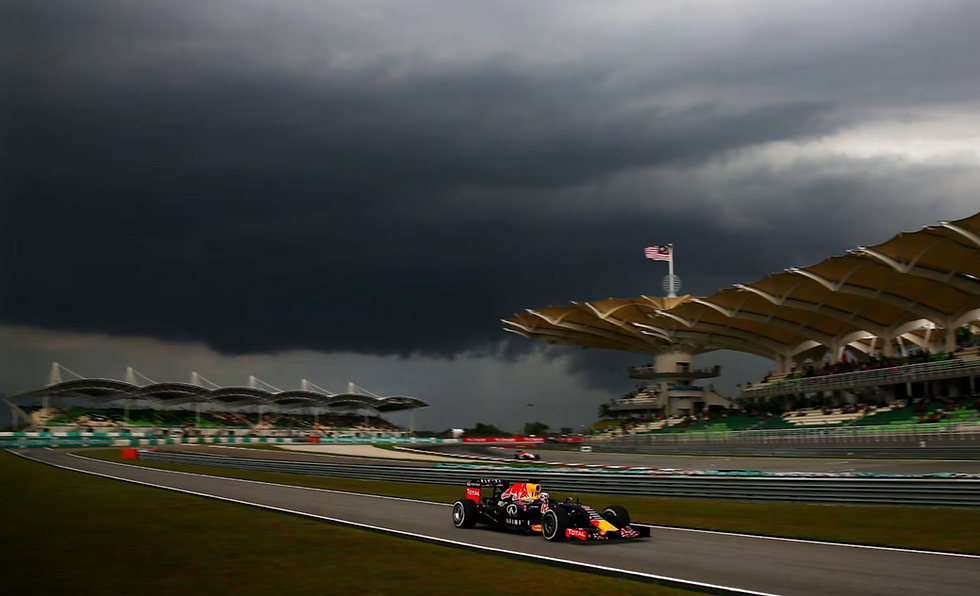
Sepang’s rain keeps a schedule of its own. Most afternoons the clouds stacked up over the grandstands just as the cars rolled onto the grid, and a race started there was always a bet against the sky.
Formula One raced at the venue from 1999 until 2017, and the weather was only one ingredient. Team orders, engine failures and a bargeboard row supplied the rest. Narrowing it to five meant leaving out plenty, including the storm-hit 2001 race—when both Ferraris went off before Michael Schumacher and Rubens Barrichello recovered to finish 1-2—but these are some of the greatest races that Sepang has played host to.
5. 2009: The race that finished on the grid
The race began dry beneath threatening skies on 5th April. Nico Rosberg launched from fourth on the grid into the lead, while pole-sitter Jenson Button ran wide at Turn 1 and dropped to fourth.
Strategy decided the rest. Timo Glock stayed on intermediate tyres when most of the field went to full wets, and he was soon lapping far quicker than anyone but Sebastian Vettel. He was up to second by Lap 28. Brawn saw the threat. Button pitted for intermediates on Lap 29 and passed Glock in less than a lap.
Then, the storm arrived. The intermediate runners all had to stop again, and the downpour was so heavy that even full wets struggled. A Safety Car came out on Lap 31 and the red flag followed almost immediately.
After nearly an hour on a sodden grid, officials declared the race over. The two-hour limit had run out. Nick Heidfeld took second because he had stayed on full wets, and Glock dropped to third on countback. Only half points were awarded, for the first time since the 1991 Australian Grand Prix.
It was Button’s second win in a row for Brawn, and he found out he had won while sitting in his car on the grid.
4. 1999: A debut, a favour and a disqualification
Sepang’s first Grand Prix came in October 1999 with a subplot no writer would dare invent. Schumacher had missed six races with a broken leg and came back to help Eddie Irvine’s title bid against McLaren’s Mika Häkkinen.
He qualified a second clear of the McLarens, then let Irvine past on Lap 4 and held up the chasing pack. David Coulthard forced his way through a lap later and was hunting the lead when his car broke down. Schumacher sped up when he had to protect the gap through the pit stops, then slowed again to hand Irvine the lead. Irvine later summed him up as “the best Number One and the best Number Two”.
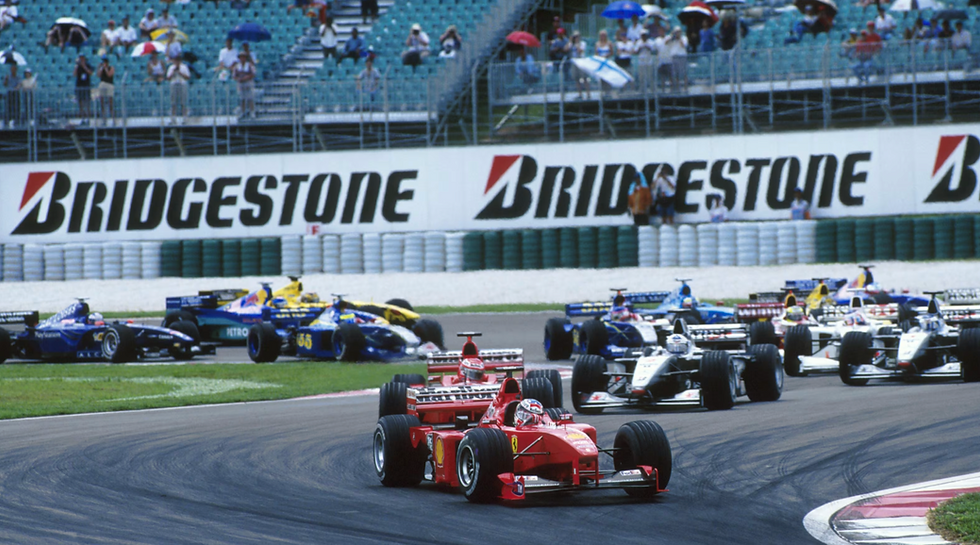
Hours after the race, stewards disqualified both Ferraris over bargeboard irregularities, handing Häkkinen the win. Ferrari appealed, and days later the court in Paris ruled the bargeboards legal and restored the 1-2. Irvine went to Suzuka four points clear, 70 to 66, but Häkkinen won there and took the championship.
3. 2012: Alonso and Pérez in the wet
Lewis Hamilton led from pole on 25th March 2012 and looked in control, until the rain forced the first red flag of the season, which cost about 50 minutes.
Then, the restart behind the Safety Car scrambled the order. Ferrari had no business thinking about a podium that weekend, never mind a win. Fernando Alonso picked his way to third after the restart, then used his next pit stop to take the lead. Sergio Pérez, in the Sauber, chased him down through the second half of the race. Some argued the young Mexican could have won it.
Alonso held on by 2.2 seconds, with Hamilton third, 14.5 seconds behind. A driver who had expected a damage-limitation start to the year left Malaysia five points clear at the top of the standings.
2. 2013: Multi-21
Vettel started from pole for the 2013 Grand Prix, but Mark Webber took the lead early. The race had already lost Alonso. His front wing clipped Vettel’s rear tyre on the opening lap, and Webber then caught the damaged wing, which took the Ferrari out. Meanwhile, Hamilton, in his first race for Mercedes, mistakenly drove into the McLaren pit garage, and was told repeatedly to save fuel, which eased the pressure on the Red Bulls.
With the race in hand, Red Bull tried to freeze the order. The team sent the coded “Multi-21” message, telling Vettel not to attack the leading Webber. Vettel ignored it and passed him around the outside of Turn 4 with 13 laps to go.
The podium was one of the coldest the sport has seen. Webber refused to acknowledge Vettel in the room beforehand, telling him “Multi-21, Seb”.
Vettel later conceded he should not have done it, though opinions remained split. Some saw a betrayal of the team, others the ruthlessness of a champion in Schumacher’s mould, and the fallout permanently damaged Webber’s relationship with both Vettel and Red Bull.
1. 2016: Hamilton’s engine, Ricciardo’s shoey
This edition saw Hamilton get away cleanly from pole, while behind him, Vettel dove to the inside of Max Verstappen and made contact that spun Rosberg round, also breaking the Ferrari’s front-left suspension. Rosberg dropped from second on the grid to the back.
Hamilton pulled away and built a lead of 22.7 seconds over Daniel Ricciardo. Then his engine blew on the approach to Turn 1 with 15 laps to go. He climbed out, crouched by the car and put his head in his hands. Afterwards, he questioned why his engines were the only ones to fail across the Mercedes-powered cars.
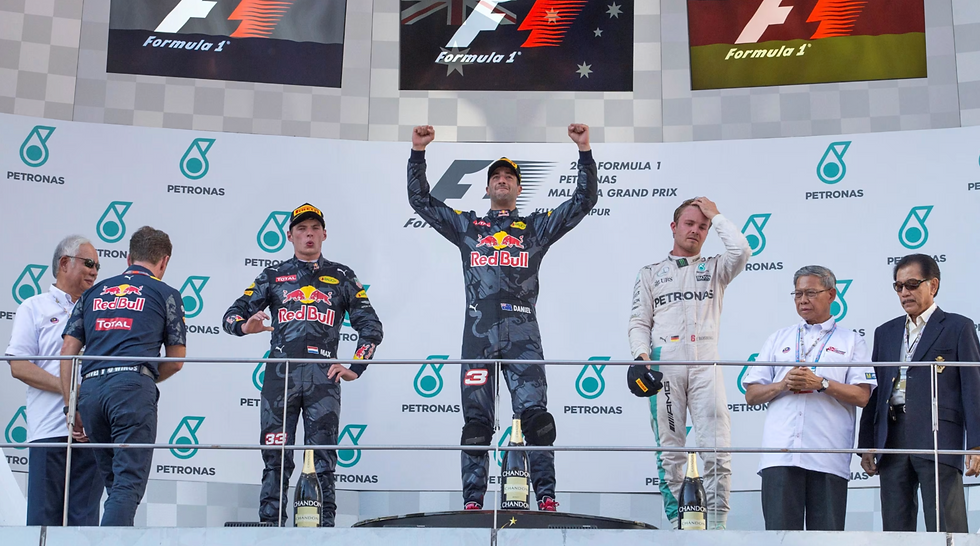
Red Bull took the opening. A Virtual Safety Car let both drivers pit for softs and rejoin well ahead of Rosberg. Ricciardo then absorbed the pressure from Verstappen. It was his first win since the 2014 Belgian Grand Prix and Red Bull’s first 1-2 since Brazil in 2013. He dedicated it to the late Jules Bianchi. Both drivers drank from their boots on the podium, Verstappen celebrating his 19th birthday.
Rosberg had fought back too. He picked up a 10-second penalty for a robust move on Kimi Räikkönen and still made the podium. He left with a 23-point lead over Hamilton. He went on to win the title by five.
Sepang left the calendar after 2017, and the sport lost a circuit that rarely raced the same way twice. Perhaps the Bahrain Grand Prix at Sepang will prove it again?
Edited by Meghana Sree






Comments