
Breaking down IndyCar’s unveiled “futuristic” Dallara IR-28 chassis

Updated: Jul 29

In a landmark day in the sport’s modern history, IndyCar has unveiled the first renderings of its new Dallara IR-28 chassis, which will debut in competition in 2028.
The new car will replace the outgoing Dallara DW12 chassis, which is now running in its 15th season having debuted in 2012. The modernised formula is lighter and faster, intended to break track records - including on the Indianapolis Motor Speedway (IMS) oval - while also encouraging improved racing and being the sport’s safest car to date.
“We are pleased to unveil renderings of the new IndyCar Series chassis that will take our sport into an exciting new era,” said IndyCar president Doug Boles. “A project of this magnitude takes an incredible amount of planning, collaboration and execution.
“I would like to thank all of our partners including Dallara, Chevrolet, Honda, Firestone and Shell, who have worked tirelessly to create a package that will enhance IndyCar’s already incredible competition and industry-leading growth
“There is still plenty of work to do before 2028, but we are well on our way to showcasing a new era of IndyCar, which will include enhanced wheel-to-wheel competition, track records, standards in raceability and new benchmarks in safety. We are confident the IR-28 is the ideal package to move IndyCar forward.”
Meanwhile, Stefano dePonti, Dallara USA’s chief executive officer, hailed IndyCar’s “continued trust” in the Italian race car manufacturer “to create a car that meets today’s needs while looking towards the future”.
While the specific dates within an “extensive” testing schedule are as yet unconfirmed, first on-track testing of the new car is set to begin this week. A variety of tracks and layouts are set to be used, including the IMS road course and oval, plus Sebring International Raceway.
DIVEBOMB breaks down the key things to know about the IR-28 and how new ground is going to be broken for IndyCar in 2028…
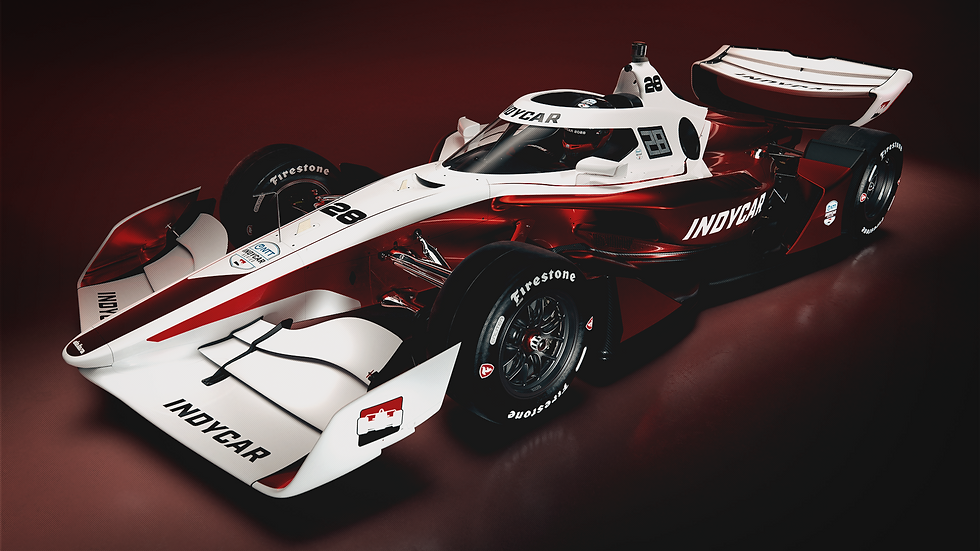
A lighter, modern car with IndyCar DNA
IndyCar has described its updated chassis as “sleek and modern” - but all while maintaining “the unmistakable DNA” of cars from throughout the series’ history. That said, the entire car features a new design built from scratch, meaning many changes from the DW12, which six-time champion Scott Dixon quipped to DIVEBOMB in May “could race in historic racing”.
At the forefront, the car will be approximately 100 pounds lighter, with more available power creating an improved power-to-weight ratio, which is intended to improve raceability. Particularly in recent years since the addition of the heavy hybrid unit, which will be made lighter in 2028, overtaking has proven tougher on road and street courses.
For the first time, aerodynamics will be “purpose-built to optimise the wake from the front to the back” of the 2028 car, as well as there being reduced outwash, which both aim to encourage more overtaking. The intention is for the cars to be able to follow more closely through corners, regardless of their position in the field.
Both the front and rear wings feature new designs with “style and efficiency” in mind. On road and street courses, these are intended to give “an aggressive stance”, while the superspeedway configuration aims to limit drag while offering maximum downforce.
At IMS specifically, there will be “a more aerodynamically stable speedway front wing” as the series bids to break the track records - 237.498 mph average across a single lap and 236.986 mph across four laps - set by Arie Luyenkdyk in 1996.
The aeroscreen is another thing to now be incorporated within the design, rather than retrofitted. It is to be made lighter and more aerodynamic without compromising safety, giving what IndyCar describes as a “fighter jet look and feel” to the car.

There will also be a new spec, Custom AXIS Inertance Control Suspension System, which IndyCar describes as being “built around a lightweight, shared damping architecture”. This is said to improve mechanical grip, reduce the reliance on aerodynamic load and offer teams more flexibility in car setups.
“IndyCar is the only major motorsports championship to permit both front and rear third-element inertance systems,” the series said, “making the IR-28 one of the most advanced suspension platforms in modern motorsport.”
In a final addition for the drivers, adjustable anti-roll bars will be controlled electronically rather than via knobs and handles, helping to streamline the interior of the cockpit.
For fans’ benefit, particularly those at the track, there will be a digital display on each car showing its position in a session, whether practice, qualifying or the race. A “unique transparent window in the engine cover” will also be featured to showcase manufacturer branding, alongside more visible areas for sponsorship.
The updated engine formula & hybrid
It has been known since the announcement of the new car being set for 2028 that a fresh engine formula - with 2.4-litre twin-turbocharged V6 internal combustion engines to be used - was inbound.
As part of an increased performance, it will produce up to 760 horsepower, alongside increased torque. Both Chevrolet and Honda are committed long-term to the project, with hopes that the direction of the sport may entice further manufacturer interest.
For 2028, there will also be an evolution to the divisive hybrid technology which was initially fitted to the DW12 for debut at Mid-Ohio in July 2024. The power storage will be increased and more deployment options offered to drivers, while the unit will significantly weigh approximately 20 pounds less than the current iteration of the hybrid.

IndyCar has partnered with UK-based company Helix, which specialises in electric drive systems and has experience in motorsport - having worked with Formula One and Formula E teams - to facilitate the improvement in hybrid performance. Their hybrid design will still be located inside the bellhousing, between the combustion engine and gearbox.
The refreshed system will also include IndyCar’s first battery-based Energy Storage System (ESS), which IndyCar selected to be supplied by BOLD Technology, who also have experience in motorsport as supplier of advanced battery systems for F1.
This ESS will deliver approximately 14 times the storage capacity of IndyCar’s current supercapacitor-based system, offering more flexibility in the deployment of hybrid power. The series also outlines that the system is “engineered and qualified to the most stringent motorsport safety standards” and is helping to contribute to a lighter power unit.
There will also be 25 pounds lost from the current gearbox. IndyCar’s long-time transmission supplier, Xtrac, will continue to supply transmission for the new chassis.
Growing impressive safety standards
IndyCar has prided itself on the vast safety innovations made to the existing DW12 chassis over the years. And while the IR-28 promises to be lighter and quicker, safety has remained top of mind and is set to take yet another step forward.
Recent safety developments, such as the aeroscreen, roll hoop and side-impact structures, remain integrated into the 2028 chassis. But there are more improvements to come as part of the new car, with the IndyCar goal “to exceed” the “more stringent” between their own or the FIA’s safety specification.
The cockpit of the new chassis will be wider, helping “to accommodate a greater range of driver heights and body types”, which Graham Rahal - as a tall driver - was used to validate. There will also be improved airflow into the cockpit to aid driver cooling - pertinent given the high temperatures for many of the summer races.

Side-impact protection will also be enhanced again following evaluation of decades of incidents, with a “stronger, more efficient side-structure design” featured, which will help to absorb more energy during impacts to the side of the car.
There will also be a more stable general crash structure, giving cars “a natural tendency to remain grounded during ‘nose-up’, sliding or spinning incidents”, preventing airborne moments from occurring following any accidents at the planned increased speeds.
With these crucial safety standards intact, initial signs certainly suggest the IR-28 aligns with the long wish-list for this long-awaited new chassis from those within the IndyCar world.
“The car is awesome,” said Alexander Rossi, nicely summing up the paddock’s glowing first consensus. “We all wanted a new, modern-day car that is lighter and looks futuristic and fast but still has all of the incredible safety advancements that IndyCar is known for. This does all of those things.
“There are still a lot of things to work through in terms of on-track testing and how it reacts to the different types of environments it will be exposed to. But from a visual standpoint, it’s incredible. This is something people will be excited about.”








Comments