
Felix Rosenqvist interview, part one: The story of Indianapolis 500 glory, six months on


Felix Rosenqvist was a shy child. “I wasn’t centre of attention or anything,” he says, recalling his days growing up in the small town of Värnamo in southern Sweden’s Jönköping County.
But at the beginning of December, as arranged by the municipality itself, he will return to his hometown as a hero. Expected to draw crowds from far and wide, domestic and beyond, Rosenqvist will be the nucleus of a public celebration, right where the dream was born.
“I can’t even imagine what it’s going to be like,” he utters, speaking as he nears the six-month anniversary of the day on which his name was inscribed into racing immortality.
It will be the latest memorable milestone for Rosenqvist, recently 35 years old, in a whirlwind year which, since the beginning of May, has been rife with life-affirming, life-altering events. That began with the birth of his first child, daughter Stella, on May 4th, to kickstart a month which, if forecasted as such beforehand, bordered on fantastical.
“It’s the one thing,” he explains of becoming a first-time father, “that changes truly how you look at everything and your goals and how you go about your day.”
Within days, Rosenqvist was to begin a fortnight-plus residency at the Indianapolis Motor Speedway (IMS), commencing with a calamitous race on the track’s road course, combining first-corner contact and a spectacular, if momentary, race-ending airborne moment. It was a comedown from a pole and runner-up finish in Long Beach the event prior.
With the two-week Indianapolis 500 campaign following immediately, it was the start of an unrelenting period, professionally, at the beginning of Rosenqvist’s foray into fatherhood, even without what was unknowingly set to amplify this seismically in short order.
Rosenqvist’s relationship with IMS and the Indianapolis 500 had been mixed, ever since crashing in a late multi-car incident on debut with Chip Ganassi Racing (CGR) in 2019. He qualified inside the top nine every year from 2022 onwards, headlined by a front-row start with Arrow McLaren in 2023. But while often racing at the front, his first seven Indy 500s resulted in four results of 27th or below, overshadowing a pair of fourth-place finishes.

He had not been short of front-running machinery, across CGR, Arrow McLaren and Meyer Shank Racing (MSR), with whom he finished fourth in 2025, but he was often denied by issue or incident. Returning in 2026 for an eighth bid for glory, though, from the outset, the sensations he felt from the cockpit were uncharted.
“I definitely felt like we had something special - and I’ve had some really good cars at Indy from the last five years,” Rosenqvist reflects. “But I felt like: ‘This is quite a lot better than that. It doesn’t matter what strategy we’ll end up on; we’ll probably have a shot to win this.’”
Following an encouraging practice week, Rosenqvist emerged as the clear favourite for pole position after comfortably topping the initial two segments of a weather-condensed single-day qualifying. As his car fell out of its best window in the Fast Six, he was confined to a fourth-place start. But significant hope remained, given the state of his race car.
“I was able to pick lines very easily; I did an occasional pass on the high line,” Rosenqvist recalls. “I just felt like I could always get around whoever was in front of me, which also increases your confidence - and you need a lot of confidence to be there at the end. It’s a very high-commitment race. You need to be able to just let it rip when the moment comes.”
This was a sense that proliferated very early in the 500 miles on race day. Rosenqvist knew he had to work hard to keep his car in “that little, thin window” he had discovered, for it eclipsed anything he had previously experienced at the Speedway.
His confidence was reflected by his consistent position among the lead pack in the race’s formative stages. But as the critical final quarter approached and the bulk of the front-runners pitted, confining themselves to having to stop yet again to make it to the end of the race, Rosenqvist and his No.60 squad opted to split off onto a different strategy.
Separating from the crowd appeared a gamble, as MSR attempted to eliminate one of those final two stops for Rosenqvist, requiring a fuel-save effort from the Swede.

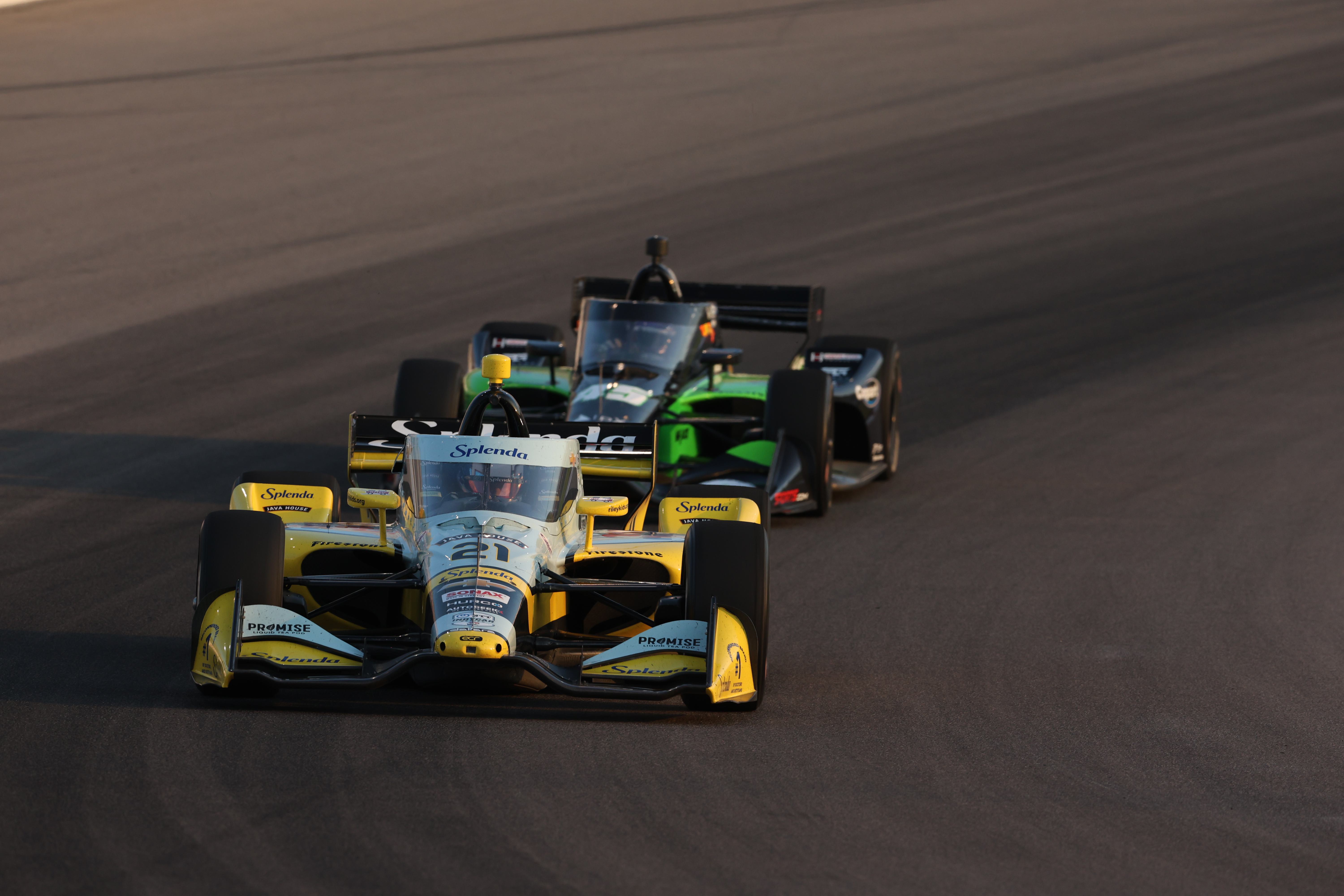
Remarkably, with his Honda fuel mileage, he was able to extend all the way to Lap 166, two laps further than Chevrolet-powered Pato O’Ward on the same alternate strategy, in a bid to enter the window within which he would not have to stop again.
Out of pit sequence, Rosenqvist first led on Lap 154. And on Lap 185, once the main-strategy pack had stopped again, he passed O’Ward to lead once more. Legitimately so.
There was a surreality as the situation unfolded, with Rosenqvist dropping his then-former, now-current-again Mexican teammate, with no signs of falling into fuel strife. A masterstroke versus most of the rest of the win-contending competition? There was no doubt in the minds of the No.60 team, who maintained stark assurance that there was no risk at play.
“I remember I had a lot of confidence during the whole race,” Rosenqvist suggests. “We were able to just kill it on fuel because [of] how good the car was. We were able to follow very closely, save a bunch of fuel. Everyone talks about ‘off-strategy’ but, for us, it wasn’t even off-strategy because we saw that we were going to make it so easily that it wasn’t even a question to do another stop - because we were so ahead on the fuel game.
“But then everything flipped around in the end and it was the worst case for us because the race [was] neutralised, everyone’s on the same fuel, we didn’t really have that advantage.”
Indeed, on Lap 192 arrived the scenario Rosenqvist - at the front of the field, surging towards a near-certain, almost easy-looking victory on his unfancied strategy - had been dreading. Rookie Caio Collet crashed heavily, bringing out a caution and, as has become standard to encourage green-flag conditions at the finish, subsequently a red flag.
Rosenqvist’s lead was eliminated and his strategic advantage negated. And on the Lap 196 restart, his MSR teammate Marcus Armstrong - on the same strategy - seized away the lead, with Rosenqvist falling to third in Turn 1 after a move from a resurgent David Malukas.

Near enough immediately, though, another caution fell as Mick Schumacher tapped the wall. This time, a lifeline, maybe, for Rosenqvist, after the harshness of the previous stoppage. As it proved, a one-lap shootout for Indy 500 victory beckoned.
“Luckily, I did feel like the car was so good anyway, so in those last moments, I never really stopped believing: ‘I’ll just figure it out. We’ll win it somehow,’” Rosenqvist insists.
“And that’s how it ended up.”
With 2.5 miles to decide one date with destiny and several with despair, Rosenqvist delivered what could go down as the greatest single-lap performance in history. It was a display that will be eternally etched in folklore far beyond the Indy 500 and into the depths of the motorsport archives, its significance magnified by the sheer magnitude of the stakes.
“It was a balls-to-the-wall move on the outside,” Rosenqvist describes. “I just felt like I would do whatever because you don’t get that shot very often, to have a car like that and to have that confidence.”
As Malukas snatched the lead off Armstrong in Turn 1, Rosenqvist pulled himself alongside his teammate, making slight contact - left-front corner to Armstrong’s rear-right tyre - but keeping his foot pinned. Wheel-to-wheel through the short chute. Side-by-side, still, into Turn 2. Likewise down the entire backstretch, towards Turn 3.
“Whatever-it-takes approach, at that point.”
Into the final two corners and Rosenqvist forced his way to the high side again. By Turn 4, inexplicably - after an entire lap side-by-side on the outside - he was through on Armstrong.
A move for the ages. But what would that matter if he stayed put? As the Yard of Bricks beckoned, Malukas remained clear ahead. But carrying such a mass of momentum, Rosenqvist had generated himself a dream run on the Team Penske hotshot.
Down the frontstretch. Closing. Closing. Closing. A jink to the right at the last moment to desperate screams of “Deploy! Deploy! Deploy!” over the radio. Alongside. Across the Bricks. A photo finish - 0.0233s the difference. The closest in Indianapolis 500 history.
Which way had it gone? Three seconds passed before Rosenqvist keyed up his radio.

“It’s such a big thing, you almost don’t want to believe it when it’s that close. It would have such a typical thing where like: ‘Oh, he got you by a thousandth.’ But I kind of knew it. I knew I was a little ahead. I just wanted to have confirmation and I heard my team celebrate on the radio so was like: ‘Okay, that’s it. We got it.’”
Between inaudible yelps came one discernible exclamation of realisation from Rosenqvist: “What a f**king finish! Hell yeah!”
Everything that followed was a blur, between rapturous celebrations inside and outside of the car, greeting his team, saluting the fans - including a loyal Swedish contingent - and FaceTiming his wife, Emille, and newborn Stella, who were not at the race.
“It’s wild, man. It’s almost like you don’t really remember it,” Rosenqvist says of the aftermath. But even if the entire sequence was guided by his subconscious, it was the highlight of the entire Indy-winning experience, as Rosenqvist declares, and a highlight of his life. As it unfolded, a tidal wave of visions from the past came flooding back.
“It’s a very emotional one. And I’m not very emotional; I don’t really look at racing from an emotional standpoint. It’s just what I’ve always done. I go out and race my hardest and that’s just always been the case. But with this one, you become more sentimental.
“I always look forward and this is the only time I’ve done a race and I started looking backwards after you cross the line. You look at the road that has led up to that moment and you just realise what a crazy journey and what a minimal chance [there is] for that to happen.
“You need to be with the right team; maybe you wouldn’t have been with that team if X didn’t happen. It’s like when you meet your wife… what are the odds of you meeting your wife? It’s the same calculation. You get very sentimental and emotional. You look back at everything.
“That was the only time I cried in the car ever, including a road car. It was a beautiful moment.”

Rosenqvist embraced the festivities. “Absolutely gross,” he laughs of his milk-covered suit and the added essence of the gifted floral wreath from the Victory Circle celebration. In an aftermath where he was almost in a flow state, he still remembers - and will likely never forget - the pungent mixture of warming milk and flowers, which almost confined the wreath to a rotten state before Rosenqvist realised it needed special treatment.
“It’s weird because I will always relate that smell to the best thing ever but it wasn’t a good smell,” he remarks with a smile. “That also started rotting because I just left it in my garage and then someone told me: ‘You need to preserve it.’ We found someone here in Indy who’s specialised in that so it’s taken care of now. But it was like a day from being forever lost.”
Rosenqvist celebrated the win hard with his team, who he would ultimately part company with the following month in favour of a return to Arrow McLaren for 2027, which he has labelled as the toughest decision of his career. They spent the post-race night together at Binkley’s in Indianapolis, with no care for an alarm call at the crack of dawn to commence a day - and entire week - of travelling for appearances and media commitments.
Early on Monday morning, he sat atop the aeroscreen of the winning ‘Morgan Wallen Radio’ Sirius XM-sponsored machine for several hours, cycling through countless hats resting within his cockpit and posing for pictures with everyone who contributed to the win. Mercifully, his milk-stained suit, which he sported again, was washed overnight.
“It was a little tough to get going that day,” Rosenqvist says without an ounce of regret. “You’re so sleep deprived. But you just have so much adrenaline - and that lasted for weeks. You actually enjoy it still. Your body doesn’t care you’re tired. Everything is just good. Adrenaline is a beautiful thing and it’s hard to get that kind of energy from anything else.

“I’m very happy I truly celebrated it. I really enjoyed that day. I took it in and we had a lot of fun with the team. [I was] probably out way too late and had too many gin and tonics. But that moment passes so quick and then you’re just back to the grind again - you’re back doing whatever you did before Indy.
“That would be my biggest advice to anyone who wins it: you’ve got to soak it in while it’s there.”
Some of the greatest fatigue came from several late nights attempting to catch up on congratulatory messages, given daytimes were otherwise occupied by the victory tour, before immediately returning to racing the following weekend in Detroit. Before Rosenqvist knew it, it would be 2am again and he would be rising within five hours.
“I truly think I got through all of them,” he acknowledges of the texts he received, whether from those as prolific as football players, basketball players or Formula One drivers.
“I think a lot of people saw the replay and they were like: ‘Oh my God, this is nuts.’ People from other sports, they just thought it was an awesome finish. I think that was the part I was mostly proud about, what a cool show it was for everyone who watched. You want to be part of something like that and I’m just so lucky to have been the guy who won it.”
On Monday morning at IMS, to Rosenqvist’s surprise, reigning F1 World Champion Lando Norris offered an in-person congratulations, right in front of the Yard of Bricks, as the Briton toured the facility with Arrow McLaren, the day after racing in the Canadian Grand Prix.
The crescendo of the congratulations soon followed, as Rosenqvist received royal recognition in the form of a telegram from the King and Queen of Sweden, delivered by mail.
His commitments as a winner have continued into the off-season, including a September visit to North Carolina and the house of sculptor Will Behrends to see his likeness, which will be displayed on the Borg-Warner Trophy. Rosenqvist was embedded in Behrends’ household - with his family and friends - as part of the trip.

“Dude, that was great,” he glowingly asserts. “That’s the most fun media trip I’ve done. It was amazing. Great people. Spent some time with him and he explained how he does it. He’s almost more like an engineer than an artist. It’s pretty cool how he goes about what he does.
“It’s a little bit weird seeing yourself. He was pretty nice in terms of how much hair I got, the thickness, so he definitely did me a favour. And apparently I’m the first… people give me a hard time when I say ‘bearded’ so I say [first] facial-haired winner. There’s some moustaches but not facial hair. Will had never done one of those so that was a bit of a challenge.
“But it turned out really good. My ears are a bit offset - things like that, he got right. It was a little creepy but super cool.”
As the half-a-year mark nears from Rosenqvist’s victorious day in May - only the second win of his eight-year IndyCar career and the first since 2020 - he feels not much has actually changed in his life. He remains a family man - more so than ever, now as a father - and a character defined by his humility, no matter how external perception may have altered.
“It’s funny,” Rosenqvist outlines of achieving his great goal. “It boosts your confidence. It’s a bit of a monkey off your back, where you just know how hard it is; let’s say you have the best car and you’re driving the best that day, there’s still a high likelihood that you’re not going to win that race. So just getting it done is a massive relief, in a way.
“But I feel like it hasn’t really changed anything, apart from it’s a good confidence boost for me going forward. I was surprised how much I wanted to win another one right after I won it. I thought I was going to be like: ‘Okay, you’re done.’ I think that’s how most drivers think of it because it’s just such a big thing. But then when you win it, you’re like: ‘Why not go win another one?’ If you would bet on anyone, it would probably be you because you just won it.

“So it hasn’t really changed much, man. I’m the same guy. I have the same goals. I probably just enjoy life a little more, which is a good thing.”
But in other ways, lots has changed. In a matter of weeks, the shy child with no regard for being the centre of attention, who left Sweden in pursuit of his racing fantasy, will return to his humble hometown of Värnamo to be the basis of a grand celebration.
“It’s weird to come back and be the guy that everyone’s celebrating. With your hometown, you press pause, you come back and you expect everything to be the same. It’s such a cool thing to have basically your own day in your hometown where the municipality is spending money to make this day all about you and celebrating your win with everyone.”
And he will be celebrated as a champion, immortalised in motorsporting history.
—
The second written part of DIVEBOMB’s interview with Rosenqvist will be released next week, where he discusses, in-depth, the decision to depart MSR after three years and return to Arrow McLaren, where he raced previously from 2021 through 2023.






Comments