
When the hunter becomes the hunted: How a dream Barcelona start turned into Genesis’ ultimate trial by fire


Genesis Magma Racing shocked the sports car racing world with a pole position at the 6 Hours of Barcelona. They did so in stunning fashion, with the silver-rated Mathys Jaubert piloting the No.17 to the top of the timing screens, and the No.19 sister car made it a 1–3 start for the South Korean team. However, their dream weekend immediately turned into a nightmare in just a single lap.
The Saturday peak: "A star has been born"
Having debuted this season, Genesis' rookie season in the FIA World Endurance Championship (WEC) has arguably been respectable. The Le Castellet-based team already scored points in only their second outing of the year at Spa-Francorchamps with an eighth-place finish. While a challenging race at Le Mans and São Paulo followed, the team bounced back in Austin.
But in Barcelona, Genesis felt they truly announced their arrival. After posting competitive lap times in FP2 and FP3, where the No.17 car went second-fastest on both occasions, the momentum was on their side as they approached qualifying.
No.19's Mathieu Jaminet topped the first qualifying session, with Jaubert in third. During the Hyperpole shootout, the roles were reversed, with Jaubert securing pole position while the No.19 car would be starting third, behind the No.8 Toyota.
"It’s an incredible feeling!", Jaubert said following the Hyperpole, having become WEC's youngest pole-sitter at the age of 21. "The team did a fantastic job to get both myself and Mathieu inside the top three, and the car was just amazing."
The conditions were less than favourable compared to the free practice due to the low level of grip. However, the team took note of the variables and was able to send both cars out with the appropriate tyres and strategy.

Surrounded by endurance racing greats, three-time Le Mans winner André Lotterer and two-time IMSA champion Luís Felipe Derani, Jaubert delivered a performance worthy of praise from his veteran co-drivers.
"We knew from the beginning he was quick", Lotterer said. "That’s why we put him in the car for qualifying, and I think a little star has been born here.
"We’ve had a few milestones in our short journey so far: finishing our first race, scoring our first points, but this is our first real impact, and it’s fantastic to achieve a result like this, which is down to a great team effort.
In particular, Lotterer and Jaubert were co-drivers for the No.18 IDEC Sport during the 2025 24 Hours of Le Mans, and already witnessed the Frenchman's pace at such a tender age, despite their eventual retirement on lap 206 with a lost wheel. The 44-year-old believed the pole position shows Genesis means "serious business."
Team Principal Cyril Abiteboul saw the milestone as a validation of his Genesis Trajectory Programme, an initiative he pitched to Hyundai executives to provide a clear path in WEC for promising or underutilised young drivers.
Where Genesis' Barcelona Sunday broke down
The race began under greasy conditions that saw Hypercar teams starting the race with wet tyres. Sprays of water made visibility difficult for the drivers, but that does not seem to deter home hero Daniel Juncadella. The Spanish driver made an excellent start, passing Toyota's Sébastien Buemi and overtaking teammate Lotterer at Turn 1.
Buemi overtook Lotterer easily with a cleaner exit, while Juncadella began to stretch his lead a bit, until that fateful corner. The 35-year-old went off at Turn 5 and immediately dropped to the back of the field as the Toyota easily breezed by. Taking advantage of the skirmish was Phil Hanson in the No.83 Ferrari, who moved to second as Lotterer dropped to third.
Race control declared a Virtual Safety Car (VSC) following a first-lap incident at Turn 1 and neutralised the field. After the green flag was waved around 20 minutes later, Lotterer immediately found himself targeted by the No.50 Ferrari's Miguel Molina, and he struggled to find any meaningful gains to chase Hanson ahead, who had been sitting by around four seconds.
Juncadella was trying to recover lost places but went off once more at the very same turn and was overtaken by the recovering No.35 Alpine, who initially started the race right behind in fourth. Another VSC was declared at 12:30 local time.
Before the VSC was downgraded to a Safety Car, the leading trio made their way to the pits to refuel their cars with less time lost than normal. But with everyone thinking of the same plan, it did not work out the way Genesis would have wanted, as Lotterer emerged from the pit lane in eighth.
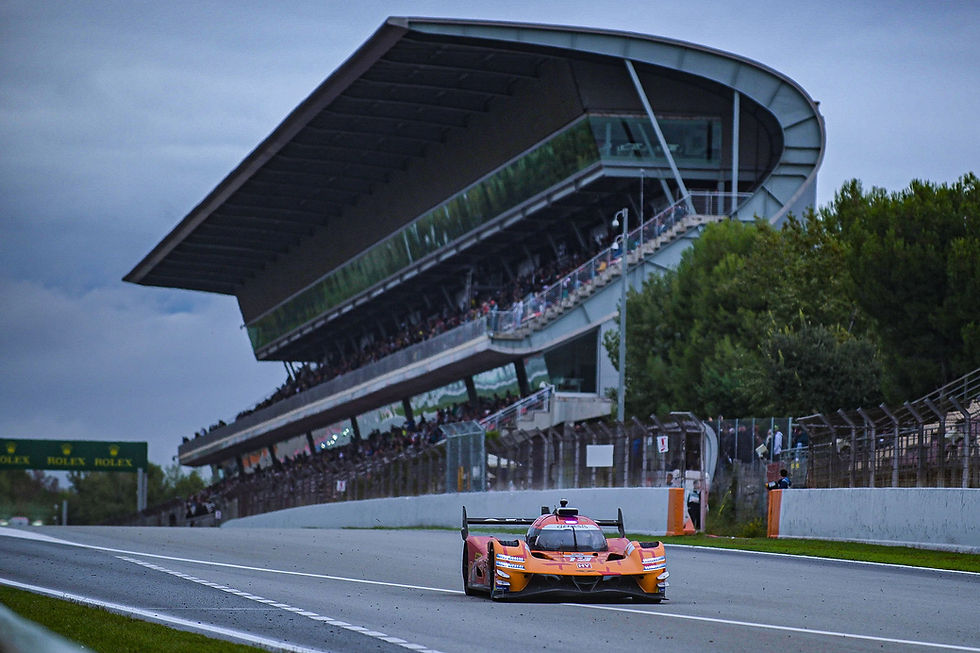
When the grid went racing again, the onboard camera showed Lotterer moving slowly at the finish-line straight and was a sitting duck, dropping four places back and sitting in 11th. He later explained that there was a technical issue with his car. Another visit to the gravel for Juncadella around Turns 4 and 5, not long after.
90 minutes into the race, Lotterer was already in 16th. Juncadella eventually found pace and held on to ninth but was overtaken by an Alpine and a BMW shortly after, dropping him out of the points. As conditions improved and became dry, the rest of the race was a back-and-forth for the No.19 side, going up as high as ninth at one point and holding on to 10th with less than two hours remaining.
The No.17 car was never in any condition to mount any challenge to fight back to the top 10 in the closing hours. With only the No.19 car left to salvage valuable points, the team elected to undercut their rivals for the final fuel stop.
In the end, the effort was not enough as Jaminet could only cross the line in a bitter 11th. Three laps behind the race-winning No.8 car, the No.17 car became the final classified finisher in 16th and was a minute behind the No.51 Ferrari. In a place where they were favourites to take their first podiums, Genesis instead came home with a measly point thanks to the pole position earlier.
Endurance racing is not won on the first lap
Not once has a Genesis car led a full lap, and as they have learned by now, the race showed how brutal the Hypercar class is. Experience and finesse were in full swing just in the opening lap alone. Buemi, who entered this round in his 100th WEC race, only needed to stay calm and position his TR010 Hybrid for the best possible exit at Turn 1.
Both Lotterer and Juncadella were incredibly aggresive into the corner, and the former lost a bit of time trying to find space, which allowed the Swiss driver to climb to second. As for Juncadella, the pressure of leading the race clearly got to him, which may have contributed to the costly error at Turn 5 that derailed the team's best chances for a win.
Turns 4 to 5 were considered a "nasty" downhill braking zone by former Formula One driver Jolyon Palmer. Local hero Juncadella learned in the most brutal way possible of being the first driver to find out what happened if you misjudged Turn 5.
"It’s a frustrating result for sure, [as] there are a lot of areas we need to analyse", admitted the frustrated Juncadella. "But personally, [it was] just a bad day. I made a good start and was looking good for four corners, and I just misjudged the grip and the braking point and went from first to last, which was very annoying."
Juncadella's subsequent skates to the gravel following his lap 1 error did little for the cause when the team relied on the No.19 car to deliver the points home. Despite momentarily being able to hold on to third at the beginning of the race, the No.17 car was plagued by intermittent systems-related issues that cost them time on a track where timing is everything, and they were unable to recover.
Chief Engineer Justin Taylor summarised the weekend as a "character-building day" for the entire team. "With the single lap pace that we showed yesterday, our expectations for the race were pretty high, but clearly, we still have a lot to learn", Taylor admitted. "We had a few small technical issues that just took us too long to sort out, and that cost us too much time in the end."

Lotterer also lamented the technical issue that prevented the No.17 car from staying in contention, and from that point onwards he believed that he could not extract more performance out of the car than it already had.
While achieving pole position during a team's rookie season is considered a massive feat, ultimately endurance racing does not reward teams who only think of one-lap pace. Winning a race requires operational perfection — the ability to race for hours, survive cautions and troubleshoot technical gremlins. This is where legacy teams like Toyota win races while new programmes get exposed, as shown at Fuji, where their strategy won them the race over Alpine.
"We had some issues during the race, which we were able to solve on the go", Derani recounted. "But this is the first year of this project, and there are a lot of lessons to take into the future. The car has shown a lot of performance, and [I'm] really happy about that."
Since the start of the Hypercar era in 2021, races have been more likely to go down to the wire, with more safety cars and cautions that changed everything. The high number of participating Hypercars also mean a driver would find themselves in a situation where they need to fight the other cars harder and find track position.
"We need to keep the positives", Jaminet urged. "Once again, we highlighted that the one-lap speed of the car is outstanding. For our first year, to start first and third was incredible, even if Saturday was not entirely smooth on our side.
"We clearly have the speed; there is no question about this, and we are able to fight with the others; we just need to execute at every level and make that step to score points with both cars."
What needs fixing before Monza
With the 6 Hours of Monza fast approaching on 7 November, time is running out for Genesis to sort out their problem. As things stand, the team is currently at the bottom of the Hypercar World Endurance Manufacturers' Championship with 14 points. With only 10 points separating them from the seventh-placed Peugeot, there is still an opportunity to finish the season on a positive note.
With the championship finale forced out of Bahrain due to Middle East conflicts, teams lost the chance to fight for the maximum 38 points typically awarded at the longer season closer. Instead, because its replacement at Monza was capped at just six hours, the maximum available points shrank to 25 — the same baseline used in Barcelona.
Genesis is set to face a massive disadvantage heading to Italy, shackled by early-season setbacks and a string of scoreless races. The internal contrast within the team is jarring as the No.19 car has yet to score a point, with Barcelona marking the agonisingly close moment they knocked loudest on the door. The team needs to be more aggressive to recover lost points and have both cars in the mix.
"There are still plenty of things to learn in terms of the race pace, car setup and the systems issues that we had during the race", Jaubert said. "There is a short gap between now and the last race of the year, so we hope to turn it around and score some points to finish the season on a high at Monza."

In July, ASP Lexus Team Principal Jérôme Policand exclusively revealed to DIVEBOMB that weather conditions and the cooler late autumn temperature would play a massive part in shaking up the late-season races. That premonition came true in the most brutal way possible during the chaotic Barcelona opening stages, proving that a changing climate leaves no room for rookie errors.
Monza presents a completely different challenge compared to the sweeping curves of Barcelona-Catalunya. Top speed and clinical exits are everything in the Temple of Speed, forcing teams to trim their wings and run ultra-low-downforce setups.
The circuit’s opening chicane, Variante del Rettifilo, forces drivers to slam on their brakes from their top speed into a brutal right-then-left complex. It is the infamous scene of countless first-lap incidents — a trap Genesis must avoid at all costs.
Treacherous gravel traps lie in wait throughout Sectors 2 and 3, while the circuit's notoriously narrow sections demand extreme patience and cunning as Hypercar drivers attempt to slice through slower LMGT3 traffic.

Though Monza is a high-speed sprint, losing focus for even a fraction of a second can leave a car beaching itself in the deep gravel, particularly at the daunting Curva Alboreto that hurls the grid back onto the main straight.
"In the end, we were only half a second away from scoring our first points for the No.19 car, so this proves that the pace was strong", according to No.19's Paul-Loup Chatin. "It is frustrating, but we have to learn together as a team, and I am sure our time will come."
"The positive point for us is knowing that we have a good car", according to Genesis Magma Racing Sporting Director Gabriel Tarquini. "But it’s clear that we also need to improve in certain areas, particularly in race trim. This will be our focus for the last race of the season at Monza, where we hope to have a trouble-free race there."
Earlier today, Genesis confirmed that they would retain the same drive lineup into the 2027 WEC season. Tarquini explained that the decision was based on the drivers' understanding of the car, the system and identifying what needs to be improved. Another reason was that the team believed their drivers have the experience and potential to go further and score points consistently next season.
The GMR-001 may possess the raw pace to take the fight to its rivals, but the gruelling season finale will mercilessly punish any remaining reliability gremlins or software bugs. Ultimately, whatever results they capture at the curtain-closer will dictate the team's trajectory and define the narrative that echoes through the paddock over the long winter break.






Comments