
How gratitude is fuelling Palou and Ganassi’s historic IndyCar run


“Every day,” Álex Palou insists. “Every day.”
The Spaniard is ever the humble champion. But that is not to say he doesn’t absorb every ounce of his near-unparalleled IndyCar success. He won’t go shouting about any rewriting of the history books, but you best believe every bit of his glory only fuels the beast.
“I just don’t [take] it for granted. Nobody in the team does,” adds the four-time champion, fresh off his sixth victory of the 2026 campaign, meaning he becomes only the third driver to win so many races in successive IndyCar seasons. “It’s not like once a year that you think about it; it’s every single day when we talk about it.”
Even in his quest to secure only the second ‘four-peat’ in series history this year - by winning four successive championships - the day-after phone call with strategist Barry Wanser following a victory will usually still follow the same tune. One still of great gratitude.
“Man, who expected that? Man, we’re so lucky to be in this position.”
And this is not Palou saying this for the sake of it - or to build a facade of endearing humility. He is as genuine an elite sportsperson as you will ever cross paths with. Each emphatic race-winning celebration atop his No.10 Chip Ganassi Racing (CGR) car comes from the same authentic belief that each victory should be celebrated as though it may be your last.
“You don’t know if it’s going to end next weekend, if it’s going to end next year, in ’28,” he continues. “At some point, it’s going to end. This cannot go forever. We’re doing a great job of understanding how lucky we are. When I say ‘we’, I mean the team as well - everybody in the No.10 car, CGR. That keeps us motivated.”

As much as he has come to win races in many different ways, Palou’s latest success, coming at Portland International Raceway, may have been the most archetypal. And nonsensical it may sound, but the early overtake by Marcus Ericsson - on the softer, alternate-compound tyre - to demote a second-place-starting Palou to third was defining.
The inside move into Turn 1 was textbook from the Andretti Global driver. But it was also one not fought greatly - if really at all - by Palou, whose every move on track is meticulously calculated. With Palou on the harder tyre, Ericsson would always have to pit earlier for his first stop. Palou saw little point in fretting over a pace advantage on the faster compound.
Indeed, in his typical manner, Palou hung back in third place with punishing patience, almost controlling the race from afar. When Ericsson pitted, then came the time to turn up the wick and, with clean air ahead, stalk and pounce upon his prey, race leader Felix Rosenqvist.
“We were, I would say, three, three-and-a-half seconds back from Felix,” Palou recalls. “Marcus was in between. The overcut doesn’t make anything there. You don’t lose three seconds on an out-lap; you lose one, one-and-a-half. You risk it to close the gap.
“As soon as Marcus pitted, just go on the back of [Rosenqvist’s] car and try and make him either pit or make a mistake. Or in case he was going to pit before us, just to make sure that we’re going to have one clean lap to go for it.
“It doesn’t always work. I was lucky that there was no traffic. I was lucky that my car was still handling super well. But as soon as I could see that my car was so good, I started pushing, the lap time started going down. I knew if the pit stop was good, we’re going to get him.”

Palou’s pace was scintillating and the gap closed seemingly seamlessly. It was Rosenqvist who first pulled the plug to pit, but Palou’s rampage resulted in him overcutting the polesitter after stopping the following lap. And the stint that followed was equally emphatic.
For that second stint, Palou had requested he remain on the primary tyres, though this was overruled by Wanser, who opted to switch his driver to run the mandatory soft-tyre stint.
“It sounds like being at home with [wife] Esther,” Palou quipped. “She’s the same: ‘What do you want for dinner, pasta or pizza?’ I say pasta. It’s like: ‘Okay, we’re going to have pizza.’”
But as it was - and as it so often is - the call from Palou’s stand was made with good reason. As Rosenqvist went the route Palou had wished, running a second successive hard-tyre stint, the Spaniard surged clear out front on the compound he tends to favour less, not uncommonly gaining towards half-a-second per lap early in the stint.
At one point, Wanser came over the radio to challenge his driver to run eight more laps on the tyres to put them in a better strategy window. Palou’s response? “Yeah, easy.” A message, for the sake of their own morale, one would hope was not transmitted field-wide.
“Pretty much nobody expected those soft tyres to be that fast and to be that good, especially so many laps,” Palou explains. “There’s times [Wanser] goes on the radio and says ‘eight more laps’ [and] I’m like: ‘No way.’ In my mind, I thought that I had to do another 15, so when he said another eight, I was like: ‘Oh, that’s good. We’re going to make it happen.’
“I started pushing a bit more and tried to get everything out of the tyre. I was glad that it was that way. It doesn’t usually happen where he goes on the radio and he gives me a better number than what I thought.”
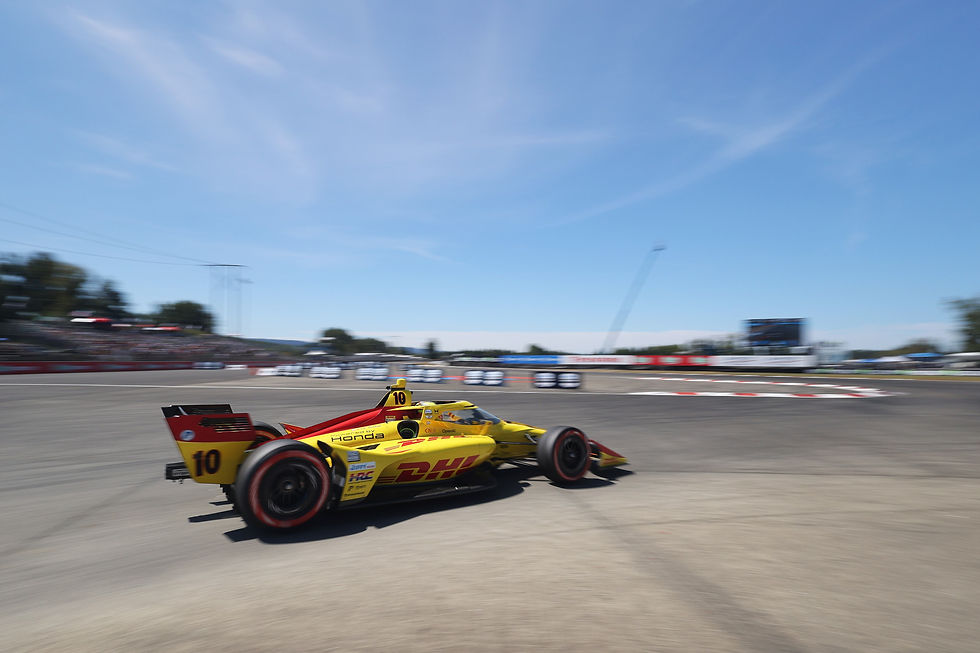
Rosenqvist came a little back into his own in the following stint, closing back to within two seconds of Palou - having had a five-plus-second deficit - during his soft-tyre stint, as backmarker traffic also started to become a factor. But that headway was all with the knowledge that he would have to beat Palou at his own game in the final stint.
As soon as Palou emerged from the final round of pit stops still ahead, with both on primary tyres - even if Palou’s were used - it was game over for Rosenqvist. Formidable on the harder compound, Palou was able to streak over four seconds clear by the chequered flag.
It may not have been his finest beatdown margin-wise, but it was a race commanded almost entirely from the outset - even before he first properly led the race on Lap 37.
“Having Álex and his talent, there’s nothing that replaces that,” Wanser asserts, crediting a driver who - with his typical modesty - often neglects to hand himself the warranted plaudits in favour of always ensuring praise is directed to his wider team. “No matter how good the car is, you need the driver to be able to extract that performance out of the car.”
A third Portland win marks the 25th victory of Palou’s seven-year IndyCar career, with all of his victories coming in the now-six seasons he has spent with the Ganassi team. Having reached a half-century of rostrums with his win at Nashville Superspeedway, his podium tally has been elevated to 51 inside only 111 career starts.
These sorts of statistics tend to be looked back upon more by drivers after their careers - which could yet be the best part of two decades away for 29-year-old Palou - but given his keenness to soak in the success, he nonetheless takes pride in the continued achievements.

“Very proud of both,” Palou admits of his win and podium tallies. “It’s incredible. I feel like you don’t really realise when you’re just going week in and week out, but when you look back and see those numbers, they’re incredible. But I could not do it without the team, with everybody that is around me, giving me the chance every single weekend.
“The preparation we have before every weekend, having always the best strategies, it’s incredible. But we need to keep it up. We need to keep on winning and keep on fighting for championships and [Indianapolis] 500s.”
At the head of the 2026 standings, Palou is now 110 points clear of Kyle Kirkwood in second place - an advantage 11 points larger than after 13 races in one of the all-time great IndyCar campaigns last year. But even considering he could sit out for two of the final five races and still lead, complacency never creeps in and he never settles with his successes.
Unknowns lie immediately ahead in the next two weekends in the form of new street races in Markham and Washington DC, which Palou is wary could yet provide late-season curveballs, as much as his team tends to rise exceptionally to fresh challenges.
“[We are] more comfortable than when we came [to Portland],” he debriefs of his points situation. “This was one of those weekends where we wanted to do good. I mean, we want to do good every single weekend but we don’t know what’s going to happen at Markham: new track for everyone, new track for me. We don’t know what’s going to happen at DC.
“There’s still a lot of points to play [for]. It was important to maximise. A win gives you a big, big amount of points. The same way that in the last two weekends we got a huge gap, someone else can do the exact same thing. So we need to keep on pushing.”

But as much as he may not acknowledge it, Palou is hurtling towards yet more history in the shape of becoming only the third-ever five-time champion and joining Sébastien Bourdais as one of only two drivers to win four consecutive titles. If that does come to fruition, he will unquestionably relish every second. And then use it to fuel the beast again.
Palou has landed a winning formula of equally being fixated on the next goal but being powered by the ambitions already fulfilled. And as another year ticks by in the career of a legend forged in record time, that superpower is multiplying in force.
“I really meant when I said that last year was very magical and it was very tough to repeat,” he says. “[But] maybe we can even improve it. We’ll try. We’ll give our best.”





Comments