
How Kimi Antonelli won his home race from the back of the grid


19th on the grid at his home race, with a fifth power unit of the year barely run in and a five-place penalty for every extra component Mercedes had bolted to it. Two laps later, Charles Leclerc was in the barriers at Parabolica and the whole field was called back for a second standing start.
By the chequered flag, Kimi Antonelli was on the top step at Monza, the first Italian driver to win there since 1966. It was one of the drives of the 2026 season. However, it was also not quite the story it looked like on the surface.
A penalty, a red flag and a recovery that started before the race properly did
The penalty had been coming for weeks. Antonelli suffered an electrical shutdown while running second at the Barcelona-Catalunya Grand Prix in June.
This damaged one engine. Mercedes then found a separate issue after the British Grand Prix that forced a fourth power unit in at Spa – meaning he was already out of room before Monza had even arrived.
Rather than risk another failure mid-season, Mercedes chose to take the hit at his home race, reasoning he’d be able to charge back through the field there more easily than elsewhere.
The final bill was steep: a new internal combustion engine, battery and control electronics, all three exceeding his allocation, triggering the maximum 30-place drop. He had qualified P7 on raw pace. He started P19.
From there, Pierre Gasly took a shock pole for Alpine, and George Russell lined up alongside him on the front row. Oscar Piastri was demoted three places for impeding Liam Lawson in Q2.
At the first chicane, Lewis Hamilton was squeezed onto the gravel and dropped to tenth, while Antonelli, further back, was already cutting through traffic.
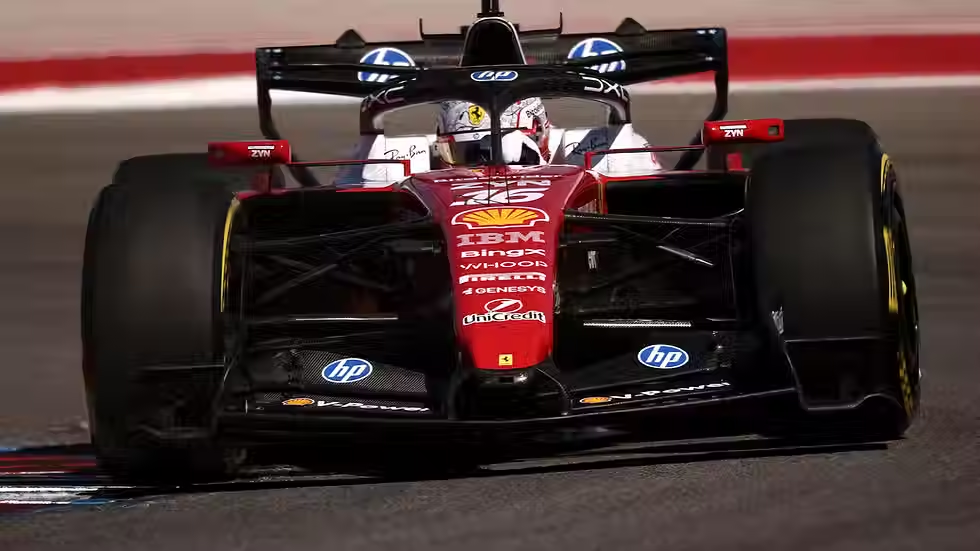
Barely two laps in, Leclerc lost the rear exiting the Parabolica and crashed alone, ending Ferrari’s home weekend and red-flagging the Grand Prix.
By that point, Antonelli had already climbed from 19th to 12th – the recovery was well underway before the race had even properly started.
The strategy split that decided it

The second standing start only sharpened things. Antonelli, who made moves at will, climbed up into third. The Italian, along with Russell and Verstappen, pulled clear of the pack, swapping the effective lead back and forth in a genuine three-way scrap rather than a formality for the polesitter.
The turning point came when Lance Stroll retired, and the Virtual Safety Car appeared around lap 29: Mercedes pitted Antonelli onto fresh mediums, while Russell – out front – was left on a set of hards that had already done half a race distance. It wasn’t pace that built Antonelli’s route back to the front from there. It was tyre age.
After the pit-stop cycle, Antonelli and Verstappen emerged around 15 seconds behind Russell on considerably fresher rubber.
Antonelli hunted his teammate down through the closing laps, running briefly wide through the gravel as the track began to break up, before finally getting the move done around lap 50 of 53.
To top it off, Antonelli sped away into the distance, crossing the line 3.857 seconds clear of Russell, with Verstappen completing the podium and the McLaren pair of Norris and Piastri rounding out the top five. Hamilton, the closest non-Mercedes title challenger, wound up a distant sixth.
What this actually says about Mercedes
Three weeks before Monza, after a difficult Zandvoort weekend, Antonelli himself had put it plainly: “We’re clearly not the fastest car anymore on the grid… we’re probably second or third.”
Wolff had been more blunt about why, admitting Mercedes “haven’t got the money to put developments on the car” to match the upgrade rate McLaren and Ferrari have sustained since the summer break.
The numbers made sense briefly: after winning the opening six rounds of the season, Mercedes had taken just two wins from the following six, level with Ferrari and McLaren over that stretch, with Norris arriving at Monza on the back of consecutive victories in Hungary and Zandvoort.
None of that showed up in the result. What Monza actually demonstrated is that Mercedes’ advantages this year have shifted shape – from a car that was simply faster than everything else, to a team that wins on strategy calls, reliability of execution and two drivers who keep converting whatever the car gives them into maximum points.

Antonelli’s title lead swelled to 66 points over Russell and 76 over third-placed Hamilton, while Mercedes’ constructors’ cushion over Ferrari grew to a commanding 122 points – with McLaren now sitting third, just 59 points behind Ferrari and closing.
Monza is a circuit built for recovery drivers: Four overtaking zones, low downforce, a car that’s quick in a straight line, able to make progress “relatively straightforwardly,” in the words of Mercedes’ own trackside engineering director. Most of what’s left on the 2026 calendar doesn’t offer that same margin.
Russell, for what it’s worth, is reportedly nearing his own component limit and could be facing a grid penalty of his own before the season is done – at a circuit that may not be as forgiving as this one was.
For one Sunday in front of his home crowd, Antonelli made a 30-place penalty look irrelevant. Mercedes will need him – or Russell – to keep doing it, because the cushion they’re building in both championships still depends on catching the right afternoon: a red flag at the right moment, a tyre-age gap to exploit or an opening for a fast car to actually show it.
Monza gave them that. Not every remaining race will.






Comments