
How McLaren lost Canada before Lap 1
- Alexa Bageas

- 2 hours ago
- 8 min read

Formula One is often described as a sport of seconds, and in Montreal, that was proved all too true.
A few seconds of incoming weather. A few seconds of uncertainty on the formation lap. A few seconds where McLaren believed they had identified an opportunity nobody else had seen. And ultimately, a few seconds that completely destroyed the team’s Canadian Grand Prix.
The Circuit Gilles Villeneuve has always rewarded bravery. Across its history, the venue has produced chaos, unpredictability, and races where strategic ambition can overturn the competitive order entirely. McLaren arrived in Canada believing they could exploit exactly that unpredictability. Instead, the team left Montreal with one of the most damaging Sundays of its modern F1 resurgence.
Lando Norris, reigning World Drivers’ Champion and the centrepiece of McLaren’s title ambitions, retired after a disastrous afternoon unravelled into a DNF. Oscar Piastri, after qualifying inside the top four with genuine podium potential, crossed the line in P11 following penalties, contact and a strategy collapse that compromised his race before it had properly begun.
What should have been a statement weekend became a public demonstration of F1’s most unforgiving truth: raw pace means absolutely nothing without operational execution.

A weekend that began with genuine promise
The scale of McLaren’s collapse becomes even more staggering when considering how competitive the team looked across the entire weekend.
The MCL40 appeared genuinely quick around the low downforce demands of Montreal from the very beginning of Free Practice 1. Through the final chicane and traction zones exiting Turns 2 and 10, the car demonstrated impressive rear stability and strong mechanical grip — two areas McLaren had spent much of early 2026 attempting to improve.
Friday long-run simulations suggested the MCL40 was significantly kinder on tyre degradation than earlier in the season. Telemetry comparisons also indicated the car had closed much of the medium-speed deficit to Mercedes, particularly through Sector 2.
By qualifying, optimism inside the McLaren garage was growing rapidly.
George Russell ultimately secured pole position for Mercedes with a 1:10.211, narrowly ahead of teammate and championship leader Kimi Antonelli. But Norris qualified third only fractions behind, while Piastri secured fourth to lock out the second row for McLaren.
The margins mattered because they changed the entire context of the race. McLaren were not relying on chaos to compete. They already possessed the pace to fight for victory.
Norris himself admitted after qualifying: “The car felt alive this weekend. Probably the strongest balance we’ve had across a full lap this season.”
Piastri echoed the optimism, praising the MCL40’s stability under braking and improved traction performance across Montreal’s notoriously difficult low-speed exits.
Internally, McLaren believed Canada represented one of their strongest opportunities yet to secure a Grand Prix victory in 2026. That context is what transformed Sunday from unfortunate into catastrophic.

The weather turns Montreal into a strategic minefield
Then came the weather.
Rain showers circled Circuit Gilles Villeneuve throughout Sunday afternoon, creating exactly the kind of unstable conditions F1 strategists both love and fear. Radar systems showed incoming rain bands. Several corners still contained visible moisture. Surface temperatures remained low enough to complicate tyre warm-up, while grip levels changed corner by corner.
Most teams chose caution. McLaren chose aggression.
As the grid prepared for the start, Mercedes, Ferrari, Aston Martin, and Red Bull all committed to slick tyres despite the uncertainty. McLaren went in the opposite direction. Both Norris and Piastri lined up on intermediate tyres — an extraordinarily bold strategic call based on forecasts suggesting further rain would intensify within the opening laps.
Andrea Stella later defended the decision publicly, insisting McLaren’s weather modelling showed a “strong probability” of worsening conditions shortly after the start.
And technically, the logic itself was not irrational.
In mixed conditions, intermediates can generate enormous advantages off the line and through the opening phase of a race. Had rainfall intensified quickly enough, McLaren’s gamble may genuinely have controlled the Grand Prix.
But F1 strategy exists within microscopic timing windows — and Montreal punished McLaren immediately.

Piastri knew the strategy was failing before the race began
The most damaging detail to emerge after the race was that Piastri himself appeared to recognise the problem before lights out.
During the formation laps, as the circuit rapidly dried, the Australian repeatedly questioned the decision over team radio: “It feels like the rain has stopped. I think it is time for slicks — shall we box?”
Moments later, after additional formation laps accelerated the drying process even further, Piastri became more direct: “These inters are a mistake now.”
Despite Piastri’s warnings, McLaren remained committed to the original strategy.
That detail fundamentally changed the optics surrounding the collapse.
This was not simply a gamble that failed because of unpredictable weather. The conditions were visibly evolving in real time, and at least one driver recognised immediately that the crossover window had already shifted toward slick tyres.
Yet McLaren doubled down.
Even more significantly, several analysts questioned why the team committed both cars to the same high-risk strategy rather than splitting approaches between the drivers. A split strategy would have reduced overall exposure and preserved at least one stable points opportunity.
Instead, McLaren risked both races simultaneously, losing control of both drivers’ fortunes almost immediately.

Norris takes the lead — then everything unravels
When the lights finally went out, Norris launched brilliantly. The intermediate tyres generated superior traction immediately, allowing the McLaren driver to attack aggressively into Turn 1. Spray lifted behind the papaya-orange car as Norris surged past the Mercedes pair to briefly take the lead of the Canadian Grand Prix.
For a moment, McLaren looked visionary. Even rival teams reportedly began questioning whether they had misread the conditions entirely.
But the illusion lasted barely two laps.
As the racing line dried further, the intermediates began overheating catastrophically. Norris immediately started losing lap time through the straights and high-speed sections as tyre temperatures spiralled beyond their operating window.
Telemetry later suggested Norris was losing nearly two seconds per lap once the crossover point fully arrived. The race had flipped violently against McLaren.
By Lap 2, Norris was forced into the pits for slick tyres. Piastri followed shortly afterwards. And with those pit stops, McLaren’s entire race structure collapsed.
The consequences were immediate, as both cars lost track position, rejoined in heavy midfield traffic, their tyre sequencing flexibility disappeared with strategic recovery options narrowing dramatically and the race instantly became reactive rather than proactive.
A weekend that should have been fought from the front became a damage-limitation exercise before Lap 5.

Piastri’s afternoon spirals into chaos
If Norris at least briefly experienced the illusion of success, Piastri never truly received even that.
Forced to abandon the intermediate strategy at the end of the opening lap, the Australian rejoined directly into midfield traffic — arguably the worst possible scenario at Circuit Gilles Villeneuve.
Piastri spent the opening phase trapped behind slower cars while the leaders stabilised their races at the front, as the frustration quickly became obvious over team radio.
At one stage, Piastri reportedly questioned why McLaren had committed both cars to the same high-risk strategy rather than splitting approaches between the drivers — a tactic frequently used by elite teams during unpredictable conditions.
Then came the defining moment of his afternoon.
On Lap 15, attempting to recover positions aggressively, Piastri collided with Alex Albon during an overtaking attempt into the final chicane. The incident damaged the McLaren’s floor and front wing while also earning the Australian a 10-second time penalty.
From there, the race became survival rather than competition.
The aerodynamic damage compromised the MCL40’s balance through high-speed sections, while the 10-second penalty compounded an already collapsing race.
By the time Piastri served the penalty, the damage had already been done. The Australian remained P11 even after the sanction, a reflection of just how heavily McLaren’s failed strategy had compromised the race long before the stewards became involved.
For a driver who had started fourth with genuine podium ambitions, it represented one of the most frustrating afternoons of his 2026 season.
“We could have been heroes, but we looked like idiots”
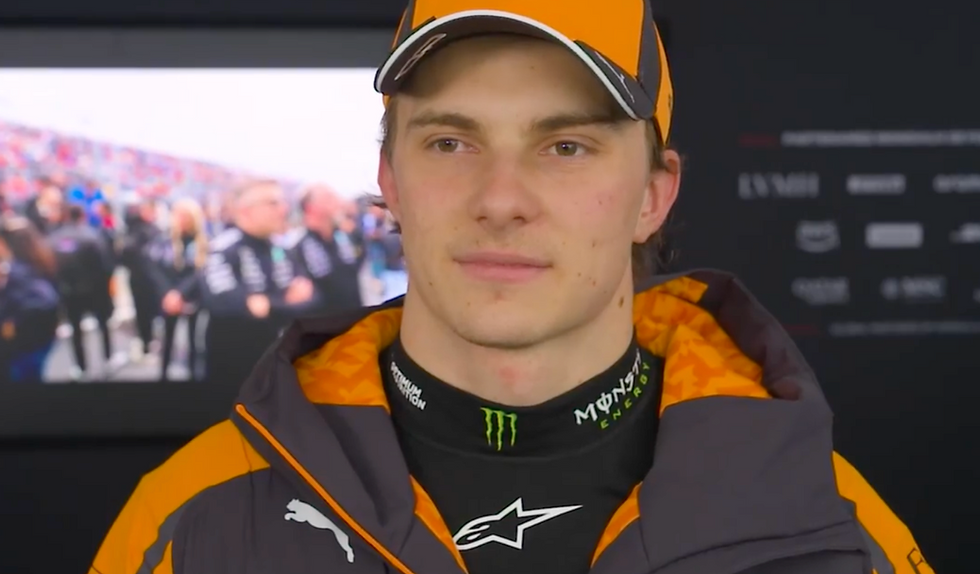
Piastri’s post-race comments immediately became one of the defining quotes of the weekend: “We could have been heroes, but we looked like idiots.”
It was brutally honest — and painfully accurate.
Because the most damaging aspect of McLaren’s strategy was not simply that it failed. F1 teams lose gambles constantly. Aggressive decision-making is embedded within the sport itself.
The problem was the context surrounding the gamble.
McLaren already possessed top-four starting positions, genuine race-winning pace, improved tyre degradation relative to their rivals and realistic podium potential.
The team voluntarily introduced unnecessary instability into a race where strong points were already highly probable. That distinction fundamentally changes how the paddock evaluates the decision.
Had a midfield team attempted the same strategy, the gamble would likely have been viewed as ambitious innovation. But victory-contending teams are judged differently.
Elite teams maximise probability. Mercedes did exactly that, while McLaren did not.
Norris’ recovery drive ends in disaster
Even after the failed tyre gamble, Norris still appeared capable of salvaging meaningful points.
Once the race settled into dry conditions, the reigning world champion began recovering aggressively through the field. At multiple stages, Norris produced lap times comparable to the leaders despite the compromised opening strategy.
But Montreal continued punishing McLaren.
Mid-race, Norris began reporting overheating concerns over team radio before engineers later identified a developing gearbox issue. The problem eventually became terminal on Lap 38, forcing the Briton into retirement.
Meanwhile, Mercedes continued operating with ruthless efficiency, barring Russell’s retirement.
Antonelli’s victory marked his fourth consecutive Grand Prix win — an extraordinary statistic for the Mercedes rookie and another painful reminder of the gap McLaren still needs to close operationally.
Stella’s defence — and why the questions remain
Following the race, Stella publicly defended McLaren’s decision-making.
The McLaren team principal insisted the gamble was based on legitimate meteorological modelling and argued the potential upside justified the risk.

And technically, Stella is correct.
Had the incoming rain intensified even slightly during the opening laps, McLaren’s intermediates may have generated a decisive strategic advantage. Formula One history is filled with examples where bold tyre decisions completely transform races.
But Canada exposed a potentially dangerous characteristic emerging within McLaren’s current philosophy: over-aggression.
The team increasingly appears willing to chase maximum upside even when stable points are already achievable.
Modern F1 strategy departments operate in windows measured by seconds rather than laps. In Montreal, McLaren’s pit wall appeared to commit emotionally to a forecast rather than adapt dynamically to the rapidly evolving circuit conditions.
That mentality may occasionally produce spectacular victories, but championship campaigns are rarely won through isolated moments of brilliance. They are won through relentless operational consistency.
And McLaren are still missing that.
The bigger problem emerging at McLaren
Montreal ultimately exposed a deeper issue than a failed tyre gamble. The MCL40 is unquestionably fast.
The car now performs competitively across multiple circuit profiles. Norris remains one of F1’s elite qualifiers. Piastri continues developing into one of the most technically complete drivers on the grid.
But F1 history repeatedly proves that pace alone means nothing.
Ferrari spent years learning that lesson during the late 2010s and early 2020s. Red Bull mastered the opposite during Verstappen’s championship dominance — combining raw speed with ruthless operational precision.
McLaren currently sit somewhere in between. Fast enough to compete. Not yet composed enough to dominate.
Canada became the clearest example yet of that imbalance.
A race capable of producing a double podium instead delivered a DNF, a P11 and zero points.
Few races illustrate F1’s interconnected fragility more brutally than that.

The psychological damage may matter most
Perhaps the most significant consequence of Montreal cannot even be measured statistically.
Momentum matters enormously in F1. McLaren entered Canada believing they were finally closing the gap to Mercedes. The upgrades were working. The drivers were optimistic. The MCL40 looked genuinely capable of fighting for victory.
Then one strategic decision destroyed the entire weekend. Because internally, McLaren know the truth: they did not lose Canada because they lacked speed. They lost it because they got the decision-making wrong.
And in F1, that is often the hardest kind of defeat to recover from.
Edited by Meghana Sree



Comments