
"Pretty much a disaster": Verstappen left powerless in Shanghai sprint

Written by Kavi Khandelwal, Edited by Benjamin Crundwell

Max Verstappen did not mince words after a frustrating Sprint at the Shanghai International Circuit, where a combination of power unit gremlins and a lack of balance left him outside the points.
Starting from eighth on the grid, the Dutchman’s afternoon was compromised before he even reached the first corner, dropping down to P13. A significant power delivery issue at the start saw his RB22 bog down, forcing him to defend aggressively just to stay within the top ten.
In the new era of energy management, falling into the pack early is a death sentence, and Verstappen found himself unable to claw back the lost ground.
Verstappen’s post-race assessment was a blunt reflection of a driver who felt he was fighting a losing battle from the moment the lights went out.
"I had no power, probably a similar issue to what Liam [Lawson] had in Melbourne. But even after that, because I could make my way forward a little bit, but [it was] terrible balance."
The reference to Liam Lawson’s Melbourne start points toward a potential recurring software glitch in the Red Bull Ford Powertrain. Under the 2026 rules, where the power split is nearly 50/50 between the internal combustion engine and the MGU-K, any hesitation in electrical deployment is catastrophic.
While his rivals were utilizing their Manual Override Mode to punch through the air on the back straight, Verstappen was effectively a sitting duck.
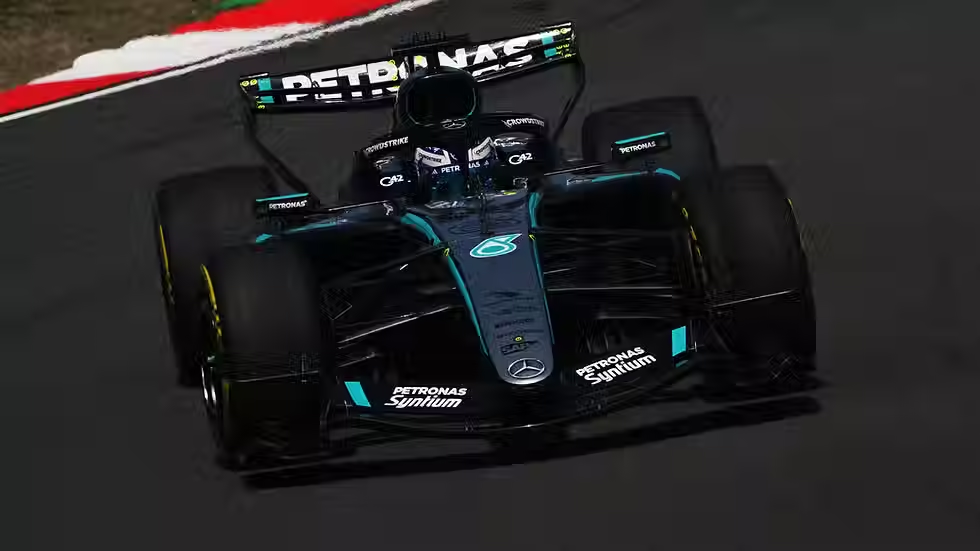
The struggle didn't end with the engine. The RB22, usually a benchmark for aerodynamic efficiency, looked unsettled in the high-speed sections of the Shanghai circuit. Verstappen struggled to keep the car in its "Z-Mode" (high downforce) during the corners, leading to excessive sliding.
"More degradation than the people around me in the midfield. So yeah, pretty much a disaster, I would say. So that's all that is."
In the 2026 "Active Aero" era, balance is everything. If the front and rear wing elements aren't perfectly synchronised when switching from low-drag to high-downforce, the car becomes unpredictable.
For Verstappen, this manifested as severe tire degradation, preventing him from utilising the Manual Override energy boost effectively because he simply couldn't get the exit speed required to stay within the one-second detection gap.
Finishing P9, just one spot shy of the Sprint points, Verstappen and the Milton Keynes squad now face a race against time. With the main Grand Prix looming, the focus shifts to whether this is a mapping error that can be fixed via software or a fundamental balance issue that will haunt them for the rest of the weekend.








Comments