
The end of an era: Ground effect and DRS

Written by Maham Mir, Edited by Meghana Sree
The thrilling 2025 season comes to an end in Abu Dhabi, as does another set of technical regulations with F1 bidding farewell to DRS and the ground effect era.

Sports like Formula One are reliant on the performance of drivers but also a team’s ability to master a set of regulations. Every few years, the regulations that teams are required to adhere to are changed, and 2026 is one such occasion that marks the start of a new era.
However, before the next era of technical regulations can begin, the current era dubbed the ground effect era still has one final round to shine under the lights in Abu Dhabi. During this era, it is Red Bull and Max Verstappen who have raced ahead with wins and championships even if McLaren steadily caught up in the final two years.
What is ground effect?
Originally finding its place in F1 during the late 1970s, it wasn’t a concept that had been perfected until the Lotus 79’s arrival, which was Mario Andretti’s championship-winning car. However, given the unpredictability of the development and the lack of technical awareness to make it safe, it was banned in 1982.
In 2022, ground effect cars returned to F1 for the first time in almost four decades with noticeable safety measures implemented to avoid the risk of the late 1970s and early 1980s. With considerably higher downforce than its predecessor car, these ground effect cars were designed to eliminate the issue of driving in ‘dirty air’ which renders overtaking incredibly difficult.

What is DRS?
The Drag Reduction System, or DRS, was initially introduced in 2011. Brought out as a method through which drivers could more easily overtake with increased speed, utilising DRS is accessible for the drivers through a button on their steering wheel. After being implemented in 2011, Jenson Button became the first driver to press this button and use DRS.
Available for use throughout the weekend, drivers are not limited to when they can use DRS during free practice or qualifying sessions. However, during the race, it is only available when a car is within one second of the car ahead.
During adverse weather conditions or immediately after a Safety Car, virtual or otherwise, race control has the final say about when DRS can be enabled.
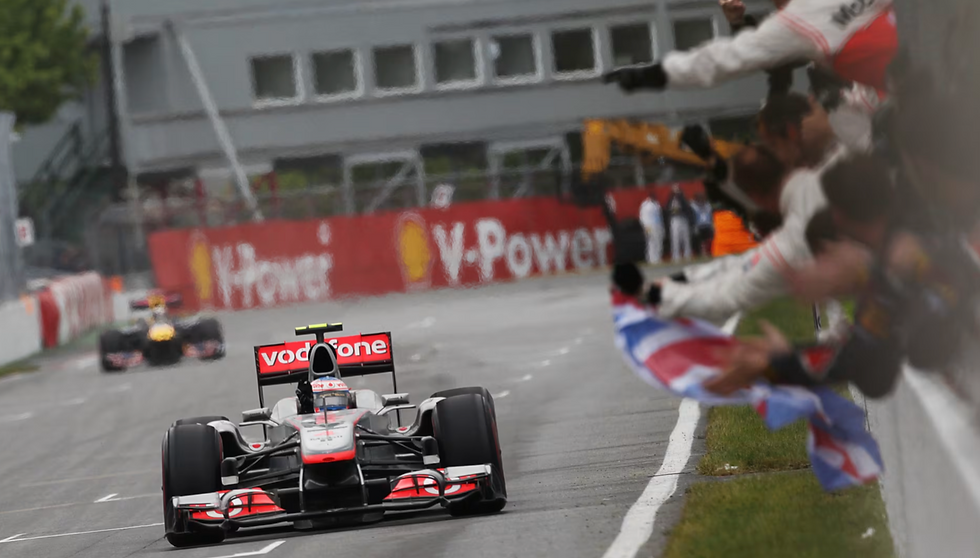
DRS and racing action
While originally conceptualised as a method to make overtaking easier, DRS has also given way to ‘DRS trains’ during races where many cars within a second of each other are able to follow closely.
With all the cars within a second of each other, however, the added advantage of DRS is voided therefore leaving the drivers without any way to overtake.
Many of the tracks on the current calendar have suffered from a lack of on-track action during the ground effect era. The size of the cars, specifically how big they are, has also limited overtaking, especially on the streets of Monaco which are notorious for their narrow and twisty ways.

What do the drivers think about ground effect and DRS?
Ground effect, while not a new aero concept, did not have the desired effect on track in aiding racing action or prompting closer racing. For many drivers, particularly those who had to deal with porpoising issues in the early stages of this era, the return to the old floor concept is a welcome one.
One such driver is Lewis Hamilton who enjoyed none of his previous championship success during this era. Hamilton, speaking to the media after the Qatar Grand Prix, stated: “I think we’re all excited to see the back end of these [regulations] for sure.”

Carlos Sainz followed up Hamilton’s comments and shared his sentiment. The Spaniard, who became a director of the Grand Prix Drivers’ Association earlier this year, outlined how the cars were entirely different to all the others from his F1 career so far. He said: “It's not in my nature to drive these cars the way I have to drive them. I had to relearn skills I never thought I'd need. I'm glad it's over.”
Fellow Spaniard Fernando Alonso also offered comments on DRS, particularly on DRS trains, having often been at the front of many, most recently in Qatar. The double world champion stated: “The only question I have in my mind is just the overtaking possibilities," when discussing his perspective on the removal of DRS.
The health risks associated with the early stages of ground effect cars were heavily intertwined with porpoising. As a concept, porpoising is the bouncing effect which occurs when high speed vehicles are repeatedly pulled to the ground and then pushed back up.
Hamilton’s former teammate, George Russell, has been vocal about the physical issues caused by trying to balance speed and ride height during the ground effect era. The five-time race winner stated: “We wanted to put one of our designers in the cockpit so they could understand what it was like in Baku.”

As a street track with long straights, the Baku circuit is perhaps one of the more prominent examples of where porpoising can be felt by drivers.
Like with the ground effect floors, DRS has become a dividing factor amongst the grid.
What are ground effect and DRS turning into?
The loss of DRS is one part of the new regulations set to be implemented in 2026. However, the concept of DRS and mechanical assistance for the drivers when overtaking is not being entirely abolished. Instead, like with many regulations in F1, it is evolving to suit the new style of the car build.
The introduction of ‘Manual Override Mode’, or ‘MOM’, from 2026 onwards is intended to serve the same purpose as DRS but through power changes rather than rear wing changes. When following within a second of the car ahead, drivers will be able to tap into extra electrical power from the battery designed to aid with overtaking. Meanwhile, their rival ahead will not be able to use the same power source.

Ground effect, for the second time, is being shelved to return to a tried and tested concept from eras gone by. From 2026 onwards, F1 cars will return to the previously used flat-floor design seen during the turbo-hybrid era.
For teams like Mercedes, who mastered these regulations during their era of dominance between 2014 to 2021, the return to the previous floor design is another opportunity for championship glory. Toto Wolff, Team Principal of Mercedes, conceded: “I think we never excelled at managing those regulations” when discussing the team’s lack of success between 2022 to 2025.
What technical changes are going to occur in 2026?
The new cars for 2026 are designed to be lighter and smaller to aid with on-track battles, powered by engines that have a greater reliance on battery power compared to the existing engines. 2026 will see a record-breaking six engine providers on the grid, all of whom are committed to F1’s current plans to go net zero by 2030.
The two main visual and technical changes between the current set of regulations and the upcoming set is the return to flat floors as opposed ground effect floors, and the removal of DRS in favour of the new style of front- and rear-wings’ capacity of flexing.

The end of an era
As the sport bids goodbye to ground effect cars and DRS, a chapter in F1’s illustrious history as a technical sport comes to a close. Only time will tell whether the new regulations, with their changed engines and lighter cars, will solve some of the main complaints from drivers and fans alike in recent years.


very informative