
The golden age of motorcycle racing: The two-stroke revolution

Wild, untameable beasts roamed the tracks. Aggressive, unstoppable drivers mastered the brutes. Staggered, stunned spectators filled the grandstands. This is only a brief glimpse into the golden age of racing: The two-stroke 500cc Grand Prix Motorcycle era.
Up until the 1970s, the 500cc competition had seen the use of two-strokes in minor classes, but not yet in the premier class, as opposed to the four-stroke, powerful and reliable main engine used. When, in 1974, Suzuki introduced the first two-stroke 500cc racing bike, Grand Prix motorcycle racing would be forever changed.

Mechanical aspects
Two-stroke engines were lighter and cheaper to build. Their main strength was their lack of complex parts, such as valves, which made the bike lighter and therefore faster. Let’s take a wider look at the picture.
Any internal combustion engine requires the burning of a fuel-air mixture, which gets pulled, compressed, burned and pushed out. A two-stroke performed this cycle within one complete crankshaft revolution, whereas a four-stroke required two revolutions. Which meant the engines produced twice as many power strokes per revolution as a four stroke, but in less time.
As a consequence, the engines would typically generate between 160 and 180 horsepower, hitting its peak of 200 with the Honda NSR500 in 1984.
As for the oil system, this type of engine required lubrication of the crankshaft, cylinder walls and connective rods. For this reason the automatic injection was acquired, which consisted in the oil being automatically mixed with fuel, stored in a reservoir and connected to a small pump directly in the engine.
What truly made these bikes distinctive was their lack of rider electronics. Which meant the riders had to manually control the throttle input to avoid spinning, the clutch for a smoother power application and their body positioning in order to manage stability. In other words, the racers were in total control of their unpredictable equipment. For this reason, only the most resourceful drivers could stand out.

Constructors’ timeline
The two-stroke engine era spanned from the mid 1970s up until 2002, in which many different constructors battled for success.
In the first years since the introduction, the dominance was spread out mostly between Yamaha and Suzuki. The two manufacturers built the most legendary bikes in history: the Yamaha YZR500 (0W23) and the Suzuki RG500. It’s safe to say that the first few seasons of two-stroke racing were filled with thrilling battles between the two.
The 1975 season saw the first two-stroke bike to win the premier class title, Giacomo Agostini in his brand new Yamaha. Suzuki quickly made its appearance, winning two consecutive titles in 1976 and 1977. But the decade ultimately ended with another two Yamaha wins.
By the end of the 1970s, most teams acknowledged the power of the new engines and had switched to two strokes, marking the start of two unforgettable decades.
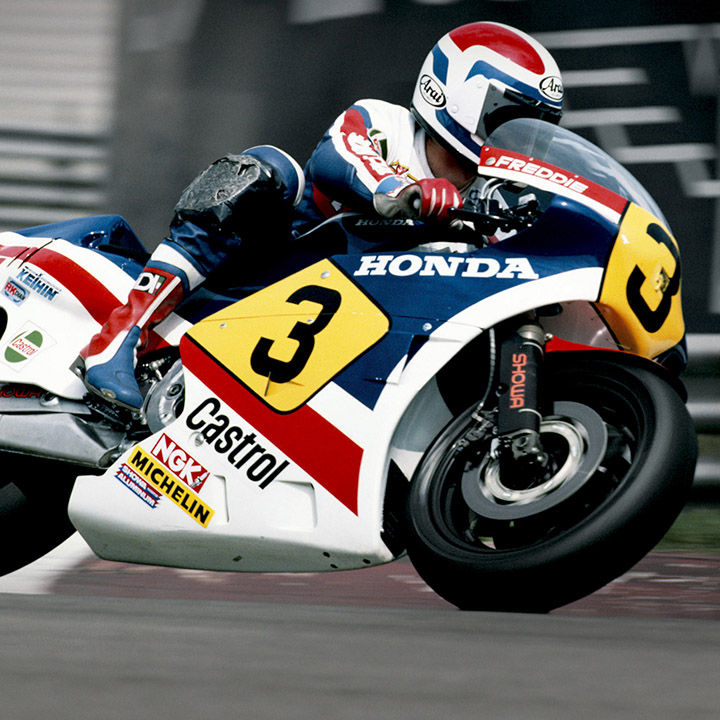
In the 1980s Suzuki and Yamaha were reconfirmed as the main forces, as they won respectively two and four championships. However, alongside them emerged a new force: Honda. With their NS500, the Japanese constructors triumphed in 1983,1985,1987,1989. Their solid results were mainly the consequence of impeccable mechanical superiority, as the bike was more reliable and balanced then Yamaha’s and Suzuki’s.
Honda introduced the rider-bike partnership and shifted the mechanics focus on building a bike around the driver and not the other way round. The groundbreaking modernizations brought by them forever shaped the premier class.
As for the 90s, Yamaha started off the decade in control, winning three consecutive titles from 1990 to 1992 with their YZR500. However, after only one title secured from Suzuki in 1993, Honda’s winning streak carried on for the better thanks to their NSR500.
The key to their success was an Australian phenomenon: Mick Doohan, who clinched five consecutive titles with the team from 1994 to 1998. The sixth for Honda arrived in 1999 with Àlex Crivillé, registering the longest pre-eminence in the modern two-stroke era.
The new decade called for new regulations, but the same winners. Suzuki won the first championship, but Honda promptly got on board with the winners by signing the Italian phenomenon Valentino Rossi who brought three consecutive titles to the team.
However, in 2002, the 500cc class officially became MotoGP, with that many new rules emerged. The engine regulations allowed engines up to 990cc four-stroke to compete alongside the two- strokes, although their power was definitely inferior. Many teams began switching to four-strokes as they became the main force, and by 2004 two-strokes had completely disappeared.
Major protagonists
To compete with such unpredictable bikes was a real struggle, only the most fearless and competent riders could wrestle the powerhouses and bring home some optimal results. Some of these have entered the motoracing hall of fame. These are only a few of the most significant names.
Giacomo Agostini was the first driver who won a title on a two-stroke bike. His career in the 500cc class began in 1965 with MV Augusta, with whom in nine years he won seven consecutive titles. He helped MV Augusta become a prominent force, becoming one of the greatest motorcycle racers of all time whilst doing that.
Agostini had a distinguished racing career, he was the real demonstration of what skill and devotion mean. He joined Yamaha in 1974, when he had a complicated season adjusting the new two-stroke. He overcame his struggles the next season and became the first ever driver to win a championship on a two-stroke bike. Beyond any doubt, his strategic intelligence and raw racing speed made him a true legend.
Kenny Roberts joined Yamaha in 1978 and immediately won his first title that same year, followed by two the next immediate seasons. His impact on racing mostly interests the racing style he introduced. His dirt-track-inspired technique consisted in taking the turn early to then lift the bike so he could gain maximum speed exiting the corner. He would also control the trajectory of the bike by sliding his rear. But the main revolution was the Hang-Off and Knee-Down style.
Although he wasn’t the one who invented such practice, as it's unclear who actually did, Roberts was the one who popularized it. He dramatically exaggerated the leaning off until his knee was fully touching the ground, to the point where he had to tape his knees so he wouldn’t feel pain while racing. His alternative approach shaped the riding techniques that are still used to this day.
Mick Doohan’s career began with Honda in 1989, a team which he never left. He quickly showed his talent and after a few years was already a title contender. But soon after, in 1992, Mick suffered a dreadful injury which almost cost him a leg. Despite his setback, he brought glory to the team by winning five consecutive titles from 1994 to 1998. His tenacious comeback truly highlighted his devotion to the sport, especially as he was directly involved with the engineering development of the bike. For this reason, he’s considered an extraordinary rider, not only for his ferocious skills but for his overall involvement in the team.
As the era ended new stars emerged, this was the case of Valentino Rossi. He joined Honda in 2000 and instantly demonstrated his impeccable technique, ending his rookie year as the championship runner-up. His first title in the 500cc class arrived the following year, as Valentino delivered a remarkable season. Even when in 2002 the four-stroke engines returned to the premier class, Rossi’s dominant run stayed unbroken.
Beyond all expectations he went on to win five consecutive titles, and two more at the end of the decade. Demonstrating how, although the new regulations had changed the riding style needed, the Italian proved to be an exceptional talent.

These remarkable legends wrote the pivotal stories of motor racing. The two-stroke era in which they rode, symbolizes one of the most complex and intense periods in motorsport history, where demanding machinery, pure speed and lionhearted racers were the only protagonists.





Comments