
Zandvoort proves Lawson and Tsunoda still have plenty to offer


Liam Lawson and Yuki Tsunoda entered the Dutch Grand Prix weekend under very different circumstances, but both emerged from Zandvoort having strengthened their cases for a future in Formula One.
While neither performance was enough to immediately put them back into Red Bull Racing contention, the weekend offered a timely reminder that both drivers remain valuable assets within the Red Bull system.
Zandvoort was never supposed to be a second chance for Liam Lawson and Yuki Tsunoda.
Lawson was only in the Oracle Red Bull Racing RB22 because Isack Hadjar was ruled out of the Dutch Grand Prix with a wrist injury, while Tsunoda was abruptly pulled from his reserve duties to take Lawson's seat at Racing Bulls.
By Sunday afternoon, however, both had made the most of an opportunity that neither had expected to receive.
Lawson finished seventh for Red Bull, securing six points despite a ten-second time penalty, while Tsunoda narrowly missed out on points in eleventh for Racing Bulls. On paper, those results may not appear transformative. In context, however, they were significant.
Neither driver had a conventional preparation for the weekend, and both were operating in machinery they had not driven for months or, in Lawson's case, since his brief Red Bull stint in 2025.
Lawson makes his case

For Lawson, Zandvoort represented something of a redemption opportunity.
The New Zealander was thrown into the RB22 with almost no preparation, having been recalled from Racing Bulls just days before the weekend. The challenge was compounded by the Sprint format, leaving him with only one hour of Free Practice before Sprint Qualifying.
Yet Lawson adapted quickly. He qualified eleventh for the Sprint, while his Racing Bulls replacement Tsunoda was only one position behind. Lawson then put together a considerably stronger performance when it mattered most, qualifying eighth for Sunday's Grand Prix — just 0.115 seconds behind Max Verstappen.
That result was particularly noteworthy given the Red Bull's relative lack of outright pace at Zandvoort. Verstappen qualified seventh, with Lawson immediately behind him.
The race provided an even stronger demonstration of Lawson's composure.
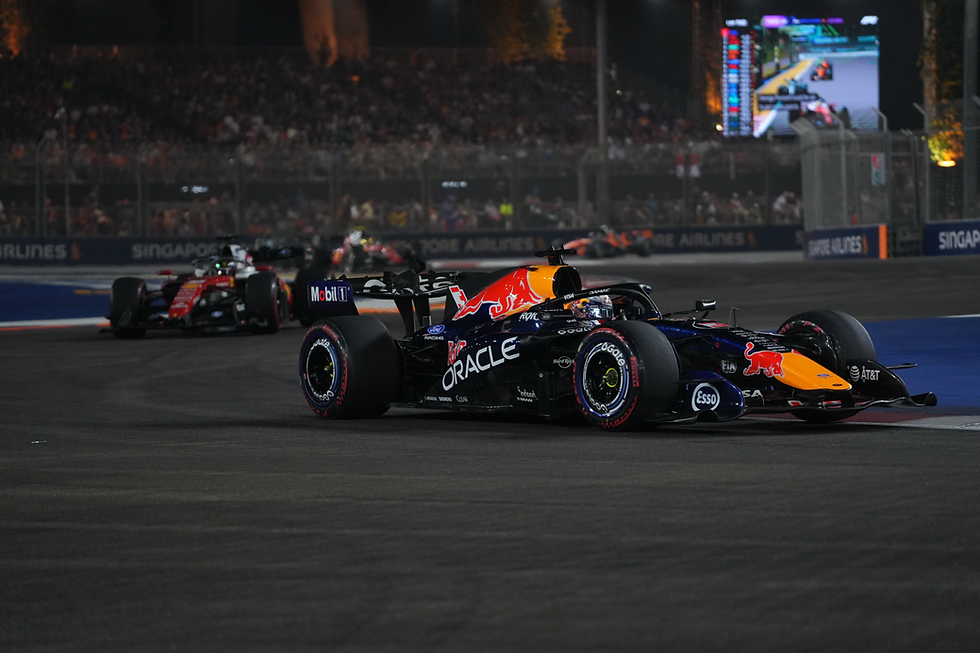
He made a clean start, avoided Verstappen's Lap 1 incident and settled into the points-paying positions early in the race. By Lap 10, Lawson was running seventh and would ultimately maintain that position to the chequered flag.
His ten-second penalty for a yellow-flag infringement was the obvious blemish on an otherwise controlled weekend, but it ultimately did not change his finishing position. Lawson crossed the line comfortably clear of the drivers behind him, meaning the penalty did not cost him seventh place.
More importantly, the performance demonstrated that Lawson could jump into a difficult car, work through its limitations and immediately deliver a points-scoring result. That matters in a world of F1 where performance and adaptability is crucial.
Lawson has already enjoyed a strong 2026 campaign with Racing Bulls, entering the Dutch Grand Prix ninth in the Drivers' Championship and having scored points in eight of the opening eleven rounds.
Zandvoort therefore did not create Lawson's case for a Red Bull future. It strengthened one that was already developing.
Don't mistake this for an immediate Red Bull return

The biggest caveat is that Lawson's performance does not suddenly mean Red Bull should replace Hadjar.
Hadjar's absence was injury-related, and the Frenchman remains the driver who has earned the opportunity alongside Verstappen. Lawson's return was explicitly a stand-in situation rather than a permanent reshuffle.
However, that does not make the weekend irrelevant to Lawson's future. Red Bull now has another piece of evidence when evaluating its driver pool.
The question is no longer simply whether Lawson can perform in a Red Bull. He has now demonstrated that he can return to the team under exceptionally difficult circumstances and immediately produce a respectable result.
Lawson's biggest asset may ultimately be his consistency and adaptability. His 2026 season at Racing Bulls has already shown a driver who is more settled than the version seen during his brief Red Bull stint in 2025. Zandvoort added another layer to that development.
If Red Bull ever needs another replacement, Lawson has now given the team a very compelling reason to look his way.
Tsunoda's forgotten opportunity

Tsunoda's weekend was arguably even more intriguing.
Unlike Lawson, Tsunoda was not returning to the team that he wanted to prove himself to. He was returning to a Racing Bulls car after eight months away from Formula One machinery. The circumstances were almost comically sudden.
Tsunoda was on holiday when he received the call that would send him back to the F1 grid, with Lawson's promotion to Red Bull creating a vacancy at Racing Bulls.
He consequently entered the Sprint weekend with minimal preparation and had to adapt to the latest-generation car almost immediately.
He did so impressively.
Tsunoda qualified twelfth for the Sprint, finished thirteenth, and then qualified twelfth for Sunday's Grand Prix. Crucially, he was consistently close to Racing Bulls rookie Arvid Lindblad despite having significantly less recent running in the car.
Tsunoda himself admitted that the 2026 machinery felt very different from the cars he had previously driven, particularly through the high-speed sections of Zandvoort.
Yet he continued to improve throughout the weekend.
By Sunday's race, Tsunoda was firmly in the fight for the points. He made a strong start, gained a position and spent much of the Grand Prix battling with the likes of Pierre Gasly and Nico Hülkenberg.
His move on Gasly was particularly encouraging, demonstrating that the racecraft that had made Tsunoda such an effective midfield racer had not disappeared during his time away from the grid.
Ultimately, a three-stop strategy compromised his chances of finishing inside the top ten, with Fernando Alonso's two-stop strategy allowing the Aston Martin driver to jump ahead. Tsunoda finished eleventh, just a place away from a point-scoring position that would have made for a remarkable return.
What does it mean for Tsunoda's future?

Tsunoda's situation is more complicated than Lawson's.
The Japanese driver is currently operating as Red Bull's reserve after losing his Racing Bulls seat, meaning Zandvoort was not the beginning of a permanent comeback.
But it did provide something that Tsunoda desperately needed: evidence. Evidence that he can still jump into a Formula One car and perform. Evidence that eight months away from the grid has not dulled his ability to race wheel-to-wheel. And, perhaps most importantly, evidence that he can adapt quickly to a completely different generation of machinery.
Racing Bulls team principal Alan Permane was openly positive about Tsunoda's performance, describing his work across the weekend as "superb" given the circumstances.
That does not guarantee Tsunoda a seat for 2027. But it could help him significantly if opportunities elsewhere begin to emerge.
His future may no longer be tied exclusively to Red Bull.
A strong reserve campaign combined with a convincing one-off return gives Tsunoda something he did not have before Zandvoort: a fresh reference point for teams evaluating experienced drivers for future seats.
Two drivers, two very different futures

The irony of the Dutch Grand Prix is that Lawson and Tsunoda effectively swapped places, and both benefited from it.
Lawson demonstrated that he can operate at the front of the Red Bull midfield and score points in a car he had barely driven. Tsunoda demonstrated that he can return from the sidelines, adapt to unfamiliar machinery and immediately fight for points.
Neither performance changes the Red Bull hierarchy overnight.
Hadjar remains the driver with the seat. Verstappen remains the centrepiece of the team. And neither Lawson nor Tsunoda can reasonably expect a permanent promotion simply because they performed well at Zandvoort.
But that was never really the point.
Formula One is a sport where opportunities can arrive with almost no warning. Lawson's call-up was proof of that. Tsunoda's return was proof of it too. When those opportunities came, neither driver looked out of place.
That may ultimately be the most important takeaway from Zandvoort.
Lawson has strengthened his position as one of Red Bull's most credible contingency options, while Tsunoda has reminded the paddock that his career should not necessarily be considered finished simply because his Red Bull chapter appeared to be.
Neither is immediately returning to Red Bull Racing. But after Zandvoort, it would be a mistake to write either of them off.
Edited by Marit Everett




Comments