
A comeback from crisis: How Ericsson ended 1,260-day wait for an IndyCar win


Sixty-three races. The best part of four seasons. Almost three-and-a-half years. A painstaking 1,260 days total. Frankly, whichever way you look at it, it had been an agonising wait for a race victory for an Indianapolis 500 winner and one of IndyCar’s big-name drivers.
“You have to believe in yourself,” he rallies. “I went eight years without a win when I went from F2, went [to] F1, then came to IndyCar. It’s easy to give up and do something else. I always feel like mental strength and that ability to push myself, even when things don’t go your way, it’s been one of my biggest strengths as a driver.”
That fortitude has been firmly tested in the past two years, for after leaving Chip Ganassi Racing for Andretti Global ahead of the 2024 season, Marcus Ericsson has been through the wringer. One of IndyCar’s most consistent drivers spiralled into the antithesis, stumbling to 15th in the standings in his first season in Andretti colours and slumping to 20th last year.
It was the starkest contrast to his final three seasons with the Ganassi team, in which the Swede had recorded three successive sixth-place championship finishes. His own self-belief threatened to erode and his reliability of performance suffered greatly.
“I didn’t recognise myself as a driver,” Ericsson said in March, offering a brutal self-assessment after a torrid two years. “I wasn’t aggressive. I lost confidence.”
It took only five races with Andretti to match his mere four results outside the top 15 in the half-century of races prior. Over the course of the ensuing two seasons, he would log 18 finishes lower than 15th as he grappled with an extreme lack of trust in his No.28 machine.
In 2025, he only twice finished inside the top 10 all season, albeit having been disqualified from runner-up in the Indy 500, which only sent him further off-kilter as the year progressed post-May.

“I don’t think there was any scenario last year where I would have won a race because I just wasn’t fast and I wasn’t happy with the way the car felt,” Ericsson reflects. “It was no one’s fault. Things didn’t work out; we were in a bad spiral.
“[An upturn] comes from working hard, putting the work in. There’s nothing coming for free. You can’t, after a season like last year, sit around and think: ‘Hopefully next year will be better.’ You have to put in hours with the team, with the personnel, with yourself.
“That’s where I really did that over the winter - and that’s been paying off.”
That is not to say Ericsson left stones unturned following the 2024 campaign. But ahead of 2026 came a notched-up refresh after a surprising further regression in 2025. This included further work with a mental coach - Ericsson being a huge advocate of the practice - as well as physical work and driving GT3 cars to rediscover a pure enjoyment for racing.
There was much time spent with his Andretti team, too, with a number of changes made to his car-specific squad ahead of his third campaign with the organisation. Crucially, from the get-go this year, there seemed a marked amount more stability. And its impact showed.
In Round 3 on the streets of Arlington, Ericsson secured his first-ever IndyCar pole. By the end of the following round, he had already usurped his tally of top-10 finishes from the year prior. Errant weekends still remained but there was more poise about Ericsson, whether in regular traces of front-running raw speed or returning hints of more aggression in races.
His display at World Wide Technology Raceway in June was particularly eye-opening, losing out only to the oval omnipotence of Josef Newgarden en-route to an impressive runner-up finish: his second podium with Andretti and first in over two years.
From trailing his teammates in the two seasons prior, Ericsson had grown a frequent match for Kyle Kirkwood and, new to the team for 2026, Will Power, whose arrival Ericsson credits as a sizeable cog behind his return to form. The bond established between the trio has created an environment in which Ericsson has come to thrive.
“I had a terrible season last year. I lost a lot of confidence in myself and struggled with the car,” he reaffirms. “It was a big reset over the winter. I worked very hard on myself but also within the team, with my guys, to try and get the car more to my liking, more in a window where I feel like I can perform and get the most out of myself.
“Will has been a big part of that as well, really driving the development on the setups in a certain direction. Also the fact we are three really fast drivers that work really well together, pushing the team forward, that’s been paying off a lot.”
This past weekend in Markham, from the very outset, Ericsson’s renewed comfort shone through more brightly than at any point in this season of revitalisation.
That started in qualifying, where he has become a reliable force again, with eight Fast 12 appearances across 10 road-and-street rounds this season, including in each of the last five. By qualifying fourth on Saturday, he marked his fifth Fast Six appearance of the campaign.
It was his re-found steadiness that then prevailed in race trim on Sunday. After holding position at the start, the first major twist came under the second caution of the race on Lap 31 - for a spin by Marcus Armstrong - which proved timely for Ericsson, who had pitted for the first time the lap prior, as race leader Louis Foster was caught without having stopped.

With that, as Foster pitted under yellow conditions, Ericsson was promoted to the lead among the drivers on the preferred two-stop strategy - and third in the overall order. Foster was forced to recover from outside the top 10, which he did decisively until crashing in his attempt to pass Ericsson in Turn 4, slamming the outside concrete barrier having clipped the inside wall.
This placed Ericsson firmly in the box seat to put pay to the anguish of his win drought.
The next critical moment came under the Lap 54 caution caused by his Andretti teammate Kirkwood, who similarly crashed after touching the inside wall in Turn 4, only moments after being elevated to third in an Andretti 1-2-3 after Romain Grosjean pitted from the lead.
While most of the lead pack pitted under the caution, in a risky strategy call, Andretti opted to keep Ericsson and Power out at the head of the field, hoping for green-flag runs to build an advantage in clean air. An immediate sixth caution saw Power’s No.26 team pull the plug and admit their slight misstep, but Ericsson and his No.28 squad stood defiant.
Mercifully for Ericsson, unlikely as it had seemed, a green-flag run presented itself on the restart. From Lap 61 to Lap 70, he pulled as much as three seconds per lap out on the cars behind - that pack led by Grosjean, whose planned three-stop strategy had converged with the two-stopper and put him in firm contention for a first IndyCar win.
By the time he stopped, Ericsson had built enough of an advantage that he cycled out in seventh place - directly behind Power - to limit the damage of the strategy gamble.
“It was an eventful race. There were a lot of curve balls thrown at us,” Ericsson assesses. “I felt all the way through, especially in the race, that I had a really fast car. There were key decisions there where we decided to stay out. I was pushing really hard to stay out.

“I know it was not ideal because I needed a tonne of pace to be able to pull out the gap needed to come out in a decent place, but I really felt like the car was just so fast that I wanted to try and stay out and use that to my advantage. It was fun, that middle stint, when I was doing quali laps. That was a good time. [But] it was still tough to make our way back.”
An electric charge forward ensued. Ericsson initially picked off the struggling Chevrolets of Rinus VeeKay, David Malukas and Scott McLaughlin. As the 90-lap race ticked into its final 10 tours, he was up to fourth and the fastest car on track, pursuing teammate Power.
To that point, Ericsson’s overtaking had been ruthlessly clinical yet measured. But it so happened that the attempt to pass his teammate was the most brash of all, diving to the inside of the Turn 5 hairpin and catching Power unawares, leading to not-insignificant contact and an expletive-laden radio call from the typically fiery Australian.
The plan had been to orchestrate the pass on the subsequent straight so Ericsson, with a tyre and fuel advantage on Power, could dispatch of Álex Palou in second, with the team still conscious of taking points off the championship leader in Kirkwood’s long-shot title bid.
“It was miscommunication because the team came on and said: ‘Marcus is really quick. He’s coming,’” recalled Power, who quickly calmed down and shared laughs with Ericsson. “I said: ‘Okay, tell him I’ll let him go on the back straight so I can stay close to Palou.’
“He didn’t get the message or it wasn’t quick enough for him. I didn’t even look in my mirror; I just turned. Obviously at that point, I was upset because we lost such a gap. Just miscommunication. We ended where we were going to end anyway, so it was fine.”

The pair both emerged unscathed and, within two laps, Ericsson had worked another inside move in the hairpin to seize second place from Palou. His pace was scintillating and, unfortunately for Grosjean out front, the writing was on the wall up ahead.
After another two laps, this time with a lunge into the the heavy-braking Turn 6, Ericsson had clinically manoeuvred his way to a hard-earned race lead, demoting his former Formula One rival Grosjean to a sixth IndyCar runner-up finish.
“I was really eager to get by and hunt down the leaders because I really felt like I had the pace to win at that point,” Ericsson himself utters of the Power contact. “It’s all good. We talked about it. We touched but we were all square, side-by-side. There’s no hard feelings.
“When I got by Will, there was Álex and Romain in front of me. I knew they were on a bit of a fuel save; they were doing some lifting [and] coasting down the straights. When I hunted them down, I could see their weaknesses quite quickly. With Romain, I know he was lifting quite a bit at the end of the straight. I knew where I wanted to make my move on him.
“It’s still difficult - very tight with the walls. You don’t know how he’s going to defend. With my advantage, I wanted to get by him straight away because you never know if there’s a yellow, the fuel advantage goes away, it’s a restart… anything can happen.”
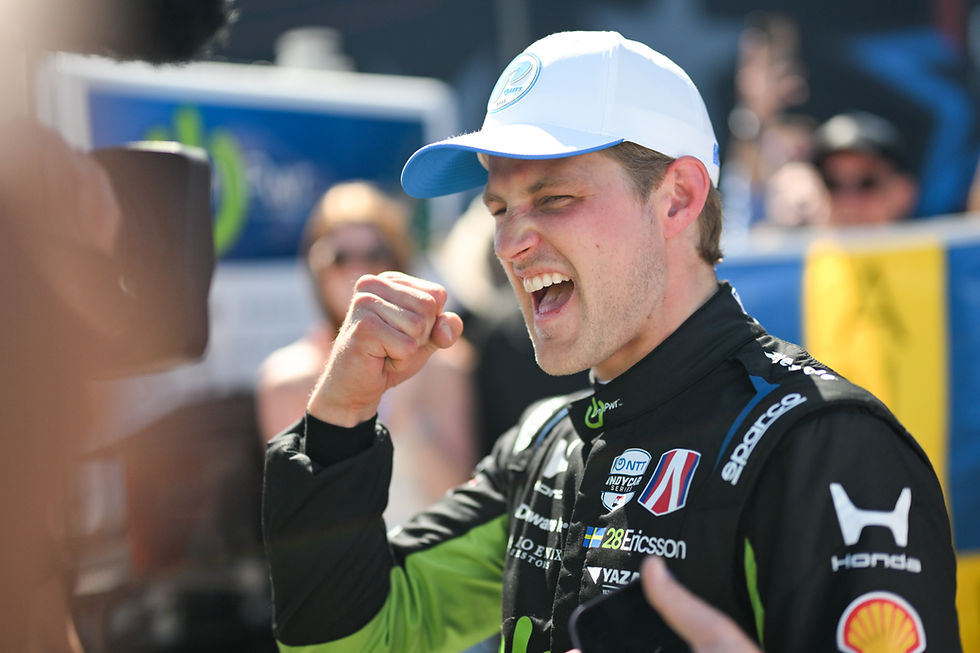
There was no looking back once Ericsson had executed what proved to be the race-winning pass. By 7.5305 seconds, he delivered an ultimately emphatic fifth career win - and, an interesting quirk, a first that didn’t involve a red flag at some point in the race - to consolidate his position back as a top-10 driver in the standings in ninth.
This one was won entirely on merit, unlike those 1,260 days earlier in St. Petersburg in 2023, when a brief plenum fire caused leader Pato O’Ward to slow and handed him victory late on.

“It was probably close to a red flag here today with all the cautions. It’s a messy street race,” Ericsson smiled. “My other street course wins, I’ve been fast as well - but it’s been some circumstances. Today, we won it on pure pace.
“We were the best car out there and we won it because we played the game and we pushed when we needed to and we delivered when we needed to. So that felt really good.
“Apart from [the Indy 500 in 2022], this was my strongest win, where I really showed pure pace all the way through and had to fight my way back. I really had to work for this one. I really felt like I put in the work to deserve to win today. I felt really good.”
It was a statement display from Ericsson which validates Andretti’s decision - made before the previous round in Portland - to hand him a new deal through 2027. It was a sensible choice, given the dynamic built between the three drivers and the progress made as a team to be competitive across three cars on every track type - not purely street courses.
In Markham, Ericsson appeared to be a driver liberated with the weight of uncertainty lifted from his shoulders, though he equally relishes high-pressure situations and delivered under the duress of a contract year to achieve his renewal in the first place.
“It feels great to have the confidence from the team to continue,” he admits. “But it’s been a trend all season that we’ve been strong. I think I’m the fourth-best qualifier in the field on average. I feel like we’ve had quite a few big results and podiums taken away from us from… I hate saying bad luck but things not really going our way.

“The No.28 crew has been working really well together. I have a couple of new people on my car this year. We’ve been gelling really well. I don’t see this as a surprise that we’re sitting here winning. That’s been trending that way.”
Markham was the display of an assertive, self-assured Ericsson with his identity as a driver restored, performing with a fluidity emblematic of enjoying driving a race car with which he is at one again. He may have been tested by the tumult of the last two years, but he looks back to his best - and maybe even a level beyond that.
“I knew I could do it. I just needed the right scenario around me really to get back into that space. Now, I’m driving better than I’ve ever been in IndyCar. I had three years with Ganassi where I finished at the top of the championship and won races. The pace we’ve had this year, every weekend with every track, I think it’s better than that.
“This race was fun, especially the second half of the race, to get everything out of the car and just push maximum. When you are in that zone where you feel at one with the car, it does not happen that often. Today, it really happened.
“I really felt super confident to just push. It’s a good feeling.”






Comments