
Fast & Curious: Formula One’s Boldest Car Designs

Written by Bo Helmus, Edited by Morgan Holiday

Formula One has seen some weird cars going around the track. In honour of World Creativity and Innovation Day, let’s have a look at some of the most out-of-the-box car designs.
In Formula One, car designers are constantly battling to build the quickest car on track. To be fast, you have to think outside of the box. There have been many creative design ideas in the sport’s history to try to make the car go as fast as possible. Some designs were even so good that they were banned. Here are five of the most creative, in no particular order.
Rolling six with the Tyrrell P34
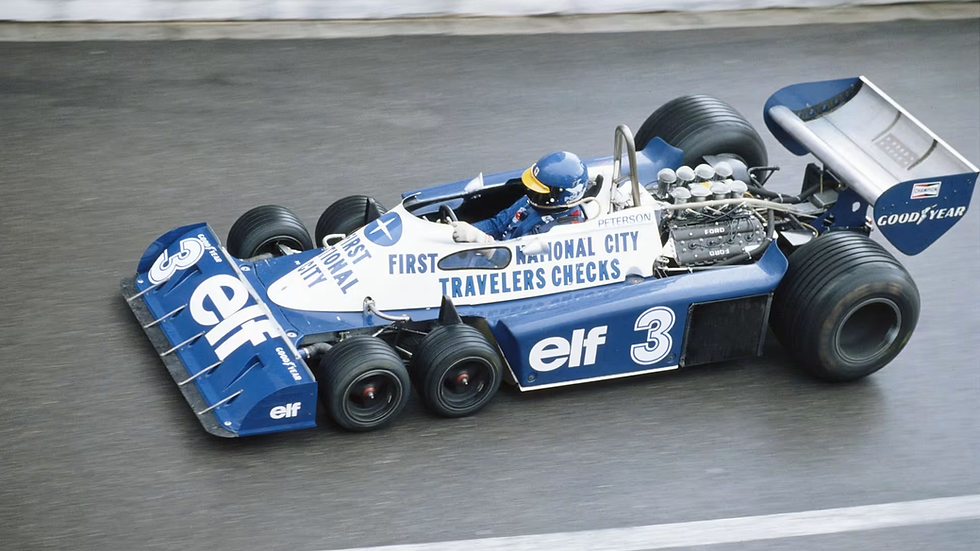
The more surface area of a tyre that is touching the track, the more grip it gives the car. So what if you run six tyres rather than four? Designer Derek Gardner posed exactly this question, and built the Tyrrell P34 to get it answered.
Debuting in 1976, the car immediately impressed. Tyrrell got third place in the constructors’ championship and scored multiple podiums. The next year, however, wasn’t so successful for the Ockham team.
Their tyre supplier, Goodyear, was focused on making regular size tyres rather than the small ones that Tyrrell needed. They retired more often than not in races, so the experiment was doomed to fail.
The next year, the car had four tyres again.
The fan-tastic Brabham BT46B


In the late seventies, F1 saw a big rivalry between Lotus and Brabham. Both constructors were keen to keep adding wins to their names. The Australian team was having some issues with their Alfa Romeo engine, not in the least that it was impractical to package into the design of the car.
The engine was so big and flat that there was no space left underneath for aerodynamic parts, which caused a massive lack of downforce. Gordon Murray, designer for the Brabham team, came up with a trick.
He placed a giant fan at the rear of the car, which sucked all the air from underneath and created a vacuum. The car was now glued to the track, solving the downforce problem.
In the first race they entered in 1978, Niki Lauda drove the BT46B to its first and only victory. Cars were not allowed to have moving aerodynamic parts per the regulations. Brabham assured that the fan was used to cool the air from the engine, but other teams protested. Bernie Ecclestone decided to withdraw the car after just one race to keep the peace.
Spill the tea: the Ligier JS5

In 1976, Guy Ligier entered his first grand prix as a constructor. He hired Gérard Ducarouge to design his car. What made this car so special was the giant airbox behind the cockpit. This airbox’s task was to cool the engine. It looked so out of place that it was often referred to as ‘the teapot’.
The team only had one driver on the grid, which finished sixth in the constructors’ championship. In the fifth race in Belgium, Ligier scored its first podium. About halfway through the season, the FIA deemed this chassis illegal.
Ligier changed the design, removing the airbox and placing the rear wing further towards the front of the car. Even with the new car, the team still secured several podiums.
Serve it hot: the March 711

In 1971, STP March Racing Team entered the grid with the March 711, designed by Frank Costin. He had previously built aircrafts and used that experience to create a high-downforce, low-drag car.
Costin placed the radiators on the side of the car, which allowed for a more experimental use of the nose. This original design was the result of that choice, and it was soon nicknamed ‘the tea tray’.
In terms of performance, the car scored pretty well. Ronnie Peterson, one of the March drivers, had numerous second place-finishes which led him to the runner-up spot in the drivers’ championship. He was the only driver to score points for the team that year, resulting in a fourth place in the constructors’ championship.
In 1972, Team Williams Motul used the 711 throughout the season, but was notably less successful. Carlos Pace, the driver behind the wheel of the 711, only got 18th place in the championship.
Double trouble: the Ferrari 126C2

Most inventions spring from creativity, but this one sprung out of spite. In 1982, teams were testing the limits in the regulations. Williams had tried something new in Brazil: water-cooled brakes. Ferrari was not amused with the fact that they got away with this innovation, so the Italians decided to find another loophole.
The prancing horses entered the next race, the Long Beach Grand Prix, with a peculiar car. This design had two rear wings. Each one was as wide as they were allowed to be, and it wasn’t specified in the rulebook that it could only be one wing per car. Gilles Villeneuve, one of Ferrari’s drivers, finished the race in third place, but was later disqualified.
The next race, Ferrari used their ‘normal’ car again, and kept doing so for the rest of the season. They did become constructors’ champions, but lost both of their drivers along the way. Villeneuve died in a crash at the Belgium Grand Prix and Didier Pironi suffered a similar incident in Germany, which he survived at the cost of his racing career.
Honorable mention: Lotus 88 - the one that never was

The most controversial car that F1 ever knew is the Lotus 88. It is still a very well-known car, which is extra special considering that it never raced. The twin-chassis design, the outer one for aerodynamics and the inner one for the driver and suspension, was deemed illegal before it had the chance to prove itself.
Colin Chapman, the designer of this masterpiece, found a loophole in the regulations. Chassis, singular, and chassis, plural, are written in the same way, so there was nothing in the regulations saying that a car couldn’t have two of them.
The Lotus 88 should have made its racing debut in 1981, but the other teams protested and the FIA complied. As a result, no one got to see the true potential of this magnificent design.
The future is bright
F1 is the pinnacle of motorsports for a reason. Not only the drivers, but everyone building the car is giving their all to go as fast as possible. We have already seen so many cool designs, and we will definitely see some more in the future.
Which epic cars have we missed in this overview? Let us know in the comments!




Comments