
From Bengaluru’s karts to the temple of speed: Ary Bansal eyes the ultimate dream in maiden Italian F4 campaign

Written by Vyas Ponnuri and Trisha Lynnette

Once a youngster in Bengaluru rooting for his favourite stars on the television, 16-year-old Ary Bansal has taken a major leap towards becoming one of them. The Indian driver became the first from his country to win the GB4 championship, doing so after a topsy-turvy finale at Donington Park in 2025. DIVEBOMB caught up with the youngster ahead of his upcoming Italian F4 campaign.
While Bengaluru has been known for its pleasant weather and fervent love for sport, it has emerged as a motorsport hub, sending young talent onto the global stage. DTM and sportscar racer Arjun Maini, ART’s Formula 2 racer Kush Maini and FREC racer Dion Gowda have all grown their early motorsport careers in the city.
Similarly, Bansal’s fascination with motorsport emerged from collecting toy cars as a kid and racing rental karts around the city. Staying close to the sport at a young age helped him discover the pathway to fulfilling his dream.
I've always loved cars,” Bansal said, mentioning the early beginnings of following the sport. “I've always had old car toys, I've always done some rental karting here and there, watched Formula One, all that sort of stuff.
“I also learned about professional karting and then also learned about how you get up into junior formulae, then finding out that's a ladder all the way up to Formula One. So, yeah, I started doing a bit more rental karting, more professional karting, and went up to some local Bengaluru tracks such as Meco (Kartopia),” Bansal mentioned, explaining his growing interest in the sport at a young age.
To pursue that dream, Bansal would have to leave a city he called home. Moving to the UK to pursue his motorsport dreams, he would face the challenge of adapting to a new land, but more importantly, gain plenty of exposure to the global motorsport scene.
“Everything was different,” Bansal expressed, speaking on the sea change he immediately faced. “There's much more motorsport in the UK than in India, so I think there was always a race going on. You can always drive somewhere, there’s much more competition, a lot of stuff (to focus on),” he continued.
Having raced in karting championships for three years, Bansal’s big break would come towards the end of 2024. He would step up to Spanish F4 on the eve of his 15th birthday, meeting the eligibility criteria to drive a single-seater car.
Bansal would also compete in the inaugural Formula Trophy UAE over the winter, finishing 14th in the seven-race series as he settled into single-seaters steadily. The phase of switching from karting to single-seaters is always a tough one to make, with more power underneath the right foot and a much bigger beast to tame. Bansal expresses this, speaking of just how much he had to adapt to on making this switch.
“It's a completely different thing,” Bansal summed up, reflecting on his transition to single-seaters. “Obviously, a much bigger car, bigger tracks, more power and also now downforce, then you have four brakes, two of them at the rear of the car.
“It took some time to get used to, but I think in the end, I managed to understand how the cars work, the technical aspects of the cars, and how to utilise those to go faster,” Bansal concluded, speaking on how he got up to speed.
It was this phase of learning in 2024 which set Bansal up for a barnstorming year of racing ahead. The Indian would take part in the GB4 championship in 2025, driving for runners-up Elite Motorsport alongside fellow rookies Isaac Phelps and Alexandros Kattoulas, amid several F4 championship appearances along the way.

Alongside his GB4 campaign, Bansal also drove six race weekends in the British F4 Championship. Driving for Fortec Motorsport, he would be eligible for the Challenge Cup, an accolade handed out to drivers competing across a select series of seven races or less during the season.
The Indian driver triumphed in Zandvoort, while further podiums in Knockhill and Silverstone meant he finished 11th in the standings, taking home the Challenge Cup, ahead of established competitors such as F1 Academy’s Ella Lloyd and Alba Larsen along the way. He would take home the £25,000 prize money to put towards further seasons in the championships.
Conquering GB4: The Ary way

Bansal enjoyed success on his debut GB4 weekend, taking victory at Donington to kick off his season on a high. A brace of podiums in Silverstone and back-to-back victories in Snetterton put him in contention for the title, alongside teammates Phelps and Kattoulas, as well as Hillspeed’s Daniel Guinchard.
Leaving the penultimate weekend at Brands Hatch, Guinchard led the standings, with 341 points, followed by Phelps, while Bansal sat a distant third, with 316 points to his name.
The trio would have four races in the season finale at Donington to decide the title, with the third of the races at Brands Hatch cancelled due to prior incidents in a support race that weekend.
A weekend of twists and turns would follow, in typical theme of a series finale, and Bansal focused on keeping his foot in the door, and maximise his scoring in every race.
“I was just trying to see what I could do, still like a bit of an underdog, because I think it was much closer between the top two (Phelps and Guinchard) in terms of the championship. But, yeah, I just wanted to keep going and keep maximising (every race),” Bansal mentioned, backing his approach.
The first of those races at Donington would play out in Bansal’s favour, with title rivals Phelps and Guinchard coming together on the opening lap, promoting the 16-year-old up into fourth. On a day when both only ended up ninth and 12th, Bansal’s second-place put him just five points off championship leader Guinchard, as the GB4 season headed into its final day of racing.
For Bansal, he was delighted to have left the first race with points, having taken the best result possible on the day.
“It was a reverse grid race for the first one of the weekend, so I was just trying to stay safe, trying to maximise, stay with the other championship contenders, and try to figure out how to be quick with minimal risk management,” Bansal reflected on his result.
Donington dash: Not over until the chequered flag falls

The final day of Bansal’s GB4 campaign featured three races, each with its own twists and turns. While he would ascend three positions on the opening lap and finish third on the road, a 10-second penalty would drop him well down the order.
However, in a massive turn of events, both his championship rivals received heavy penalties for track limit violations, eventually promoting Bansal back up to ninth and into the lead of the championship for the first time all year.
While races often tend to be chaotic and often decided well beyond the finishing line, Bansal believes the best way forward is to go with the flow, or get swallowed up by the pack behind.
“With that scenario, it can be quite different, because you need to kind of, like, go with the chaos,” he mentioned, speaking on how hectic and fast-paced the races can be.
“If you're caught up in the chaos, or you have a crash, you need to keep going with the flow. Because if you start holding back, then people start overtaking you, they will dive past you, and then it can leave you with some issues,” Bansal continued.
A feature of the Indian driver’s Donington weekend was to make a net gain on his starting position. This was evidenced by going from fourth to the lead in the penultimate race and gaining one place in the finale later on. While it can be a challenging phase of the race, Bansal believes it’s all about moving forward and being intuitive and alert on the opening sequences.

“If you have a better race start than the others, you have to go forward no matter what. In a race start, you never lift, unless obviously there's a huge crash in front,” Bansal mentions, backing his belief to go for it off the start line.
“Being able to analyse what the others are doing, and see their movements and what they might do, and predicting what they might do from experience, is also helpful,” he concluded.
Despite the chaos and action, Bansal clinched the title after the final race, winning the penultimate race and finishing third in the finale. He fended off Guinchard and Phelps by 11 points, becoming the first Indian to win the GB4 title and bringing a sense of pride to his nation. Victory also came with a significant reward, a £50,000 boost towards a potential GB3 drive in the following year.
For the 16-year-old, it was a moment to finally take a breather as he crossed the line, to soak it in after all the emotions and the ups and downs of the two days, and an entire year of close, hard-fought racing.
“It was very relieving, because finally the season was over, and I was able to take a breather on the end lap,” Bansal recollected, thinking back to the winning moment.
“I was like, ‘it's finally happened, it's done,’ and I was able to win the championship. It was also very relieving, because for sure that weekend was challenging. A lot of ups and downs, and lots of aspects fell into place. We had a lot of celebration, and then drove home, enjoyed it,” Bansal said, speaking of his greatest achievement so far.
Bansal’s title win capped off a stellar year for Elite Motorsport, who took the overall teams’ title, as teammates Phelps and Kattoulas finished second and fourth, respectively.
Italian F4, the off-season, and staying in shape

Alongside his title-winning GB4 season, Bansal undertook a variety of racing expeditions across the year. Only a week after his success on Donington Park’s speedy straights and fast corners, the Indian would strap in for his Italian F4 debut at the popular Misano circuit.
Bansal’s appearances in the Euro 4 Championship and his Italian F4 appearance helped him get used to the new F4-spec car, a different beast from his GB4 ride all season. The Indian, who had tested the F4 car prior, was able to get up to speed quickly.
The outcome of these appearances, though, was to get accustomed to new shores and his new team, US Racing, runners-up in 2025.
“I was probably told during the middle of the GB4 season (that I would be driving in Italian F4),” Bansal mentions, speaking on how his plans lined up for 2026. “I was also told about the greater preparation and the testing days to come, and then we were also introduced to the E4 Championship,” he concluded, speaking on how the move came about.

Bansal also undertook two rounds in the five-round F4 Saudi Arabian Championship, with a race victory and two further podiums seeing him finish seventh in the standings. The Indian racer also competed in the Formula Winter Series, winning two races and securing third in the standings. For the Indian, these campaigns were all about gaining experience and building a rapport with his new team US Racing during the off-season to stay championship-ready.
“The Formula Winter Series was also done with US (Racing) basically, still staying in touch with the team, and getting more used to it again. This year’s racing was mostly wet, although some of the dry running we had was very beneficial for the actual (Italian F4) championship. It’s also a good idea of how our car performs in different conditions,” Bansal concluded, summing up his racing season.
The series of weekends ensures Bansal enters the current Italian F4 and Euro 4 seasons with momentum and confidence, primed to bring about a repeat of his GB4 campaign.
Macau, and the art of maximising track time
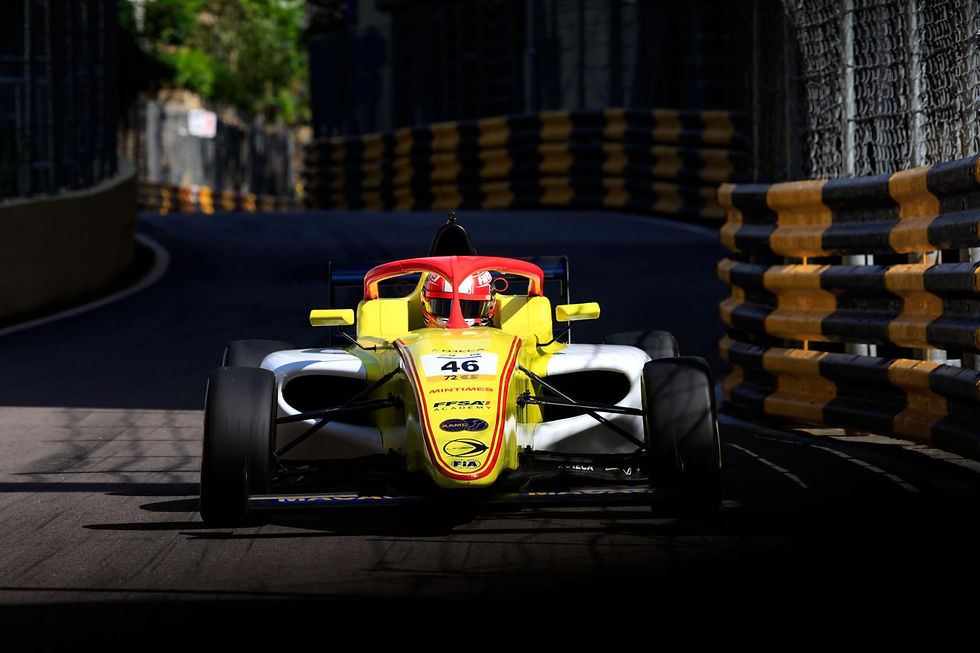
Bansal added another notable entry to his résumé in 2025: the Macau Grand Prix, representing India in the Formula 4 World Cup. It is one of motorsport's most iconic events and one of its most demanding.
"It is a proper street circuit," Bansal reflects. "You're driving on the road, and it's completely bumpy, and everything is different to what is normally seen on a normal track."
What makes Macau particularly unique is how it compresses the learning process. Two practice sessions, then straight into qualifying. For a driver attending for the first time, the margins for error are vanishingly small.
"Risk management is quite big there, because you want to maximise track time," he says. "If you lose track time and you only have, like, two practice sessions and then straight into qualifying, you want to make sure you can learn as much as possible."
Beyond the logistical challenge, Macau simply offers something few circuits in the world can match: the sheer sensory experience of threading an open-wheel car through a street circuit flanked by skyscrapers.
"You're driving through skyscrapers and stuff," Bansal notes, with a trace of amusement. "It's completely, completely different."
The narrowness of the layout demands absolute commitment from its very first corners — but Bansal is quick to clarify where the real challenge lies.
"It's not really narrowness. It's just more how tight some of the corners are, and how technical some of the corners are. Then it narrows up completely after it goes up. More bumpy, more undulating, and yeah, many more things to go wrong, but also many things to manage."
The variances in F4-spec machinery
Bansal arrives in the upcoming Italian F4 season on the back of Saudi F4 and Formula Winter Series campaigns in the off-season. But adapting between machinery remains one of the more nuanced aspects of his development as a driver.
The GB4 car, he is clear, is the more enjoyable of the two to pilot.
"One of the big things is the rear, like how the power is delivered to the wheels - it's completely different," he explains. "You can easily slide both rear wheels; you have much more control over the car. You can be much more precise, and in the wet, it's more fun."
That is perhaps unsurprising given the GB4 car's origins: it was effectively the previous generation GB3 machine, designed around considerably more power and downforce than a conventional F4 car.
"Mechanically speaking, it was much better than the F4 car," Bansal says. "Much more grip. So the agility of it was nicer."
Adapting to the Italian F4 car, then, required a recalibration. Fortunately, Bansal had logged some time in it even before committing to the GB4 season, which helped smooth the transition.
"Lots of things were different," he admits. "The (steering) rig was similar, with the wings and the tyres, but everything else was completely different."
What remains constant, regardless of which car he is in, is the importance of driver input to the team's direction. Bansal is candid about just how central that feedback loop is.
"The input is crucial," he says. "That's the only way teams know what direction they have to go in and what they are lacking. The team can learn a lot. Even small things here and there — they can understand the entire philosophy of the car and how it's handling."
Between rounds: school, simulators, and staying sharp
One of the more striking aspects of Bansal's situation is what his off-track schedule actually looks like. Bansal’s GB4 - and upcoming Italian F4 campaign - feature long gaps between rounds, and the question of how to stay sharp - while not burning out - is one every young driver navigates differently.
For Bansal, the answer is fairly straightforward.
"Most of it is taken up by training, some simulator work, and primarily school," he says matter-of-factly. "I still go to school."
It is easy to forget, given the level of racing and the international travel involved, that Bansal is still a teenager balancing competitive motorsport with a standard education. He appears entirely unfazed by the juggling act.
Getting back to Bangalore, where his journey started, with local karting at tracks like Meco, is a rarity that he cherishes.
"I take whatever time I can get," he says. "It's usually at the end of the year or the beginning. Maybe maximum twice a year."
And when he does make it back? The answer is wonderfully normal.
"Just relax, game - play some games, go on the PS5. I have a simulator here in India so I can have some fun on that. And mainly with friends, honestly, spend all my time with friends, having maybe some lunch. And we also go to a cricket match on a Sunday night."
Carrying the flag

There is a weight that comes with being the most prominent active Indian racing driver in Europe's junior single-seater scene, a responsibility Bansal clearly does not take lightly, even if he carries it without any apparent burden.
He is forthright about what it means to stand on a podium with the tricolour.
"Very, very good," he says. "Especially if you go on a podium, you see the flag. And if I win, the anthem is very nice to hear. I'm quite proud of it."
On the broader question of how to grow motorsport back home, Bansal is thoughtful. He views the grassroots accessibility problem, or lack thereof, as the central issue. Cricket, he points out, is the obvious comparison point.
"Cricket is super popular, and it's very, very accessible. You have to buy a bat and a ball, and you can set up cricket anywhere, and you can play. But motorsport is completely different. So maybe more little karting areas could help, it would have more people having fun around racing."
He also sees a role for India's growing community of motorsport content creators, particularly those who cover Formula 1.
"For sure it would help a lot," he says. "More publicity. Many Indians are watching. Maybe they also know about my career, but also Formula 1 as a whole - it could introduce more fan base, an Indian fan base, and promote F1 more in India."
The road ahead
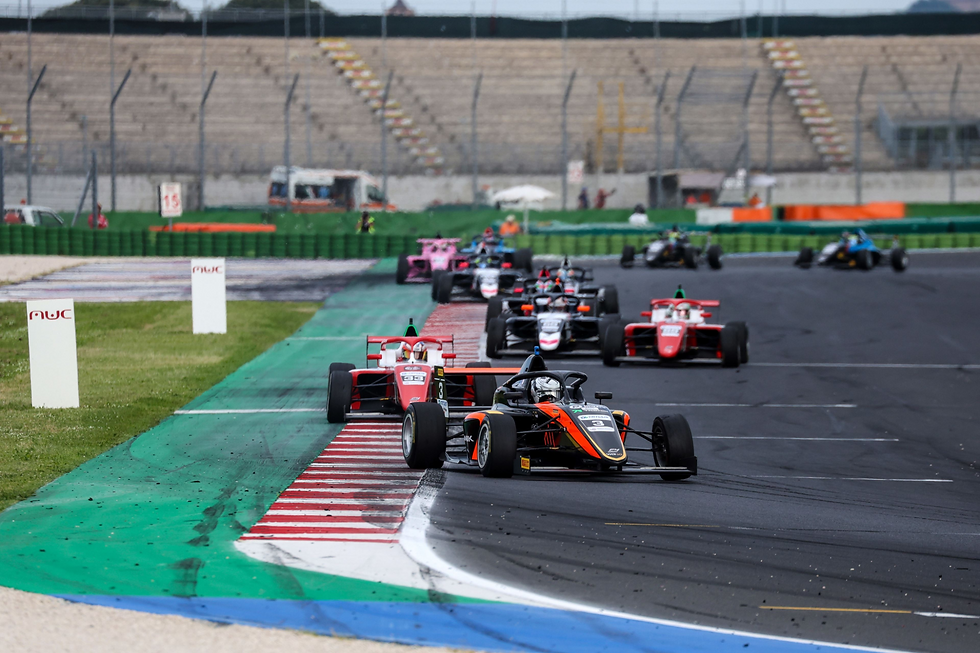
There is, of course, the small matter of what happens next. The Italian F4 season is where Bansal's attention is firmly fixed for 2026, and the ambition is uncomplicated.
"Try to do as well as possible," he says. "Try to win it, obviously."
Beyond that, the trajectory is clear. Italian F4 has served as a proving ground for some of the sport's brightest young talents in recent years, Kimi Antonelli and Oliver Bearman among them, and Bansal is well aware of the opportunity that performing there represents.
"For sure, it will get drivers into the correct trajectory in their career," he reflects. "As each year goes on, it gets more and more important. Even the competition in an F4 championship is very, very tight.
It will help drivers more than maybe future teams, because of the experience the driver can gain."
The ultimate destination is no secret. Formula 1 is the goal, as it is for virtually every driver at this level. But Bansal has a pragmatic, grounded understanding of the path required to get there. He will not be rushed.
"F1 is the current goal," he says simply. "But if there's a chance to do IndyCar or something obviously not going from F1, I'll take it. I think that'd be quite a fun experience. Especially the ovals."
For now, though, circuits like Imola, Monza and Mugello await. And for a teenager who, not long ago, was doing rental karting laps around Bangalore and watching Formula 1 races from the sofa, none of it is lost on him.


Comments