
Is a playoff system viable for IndyCar?


IndyCar finds itself at a crossroads.
It has a racing product that is second-to-none against any other motorsport, drivers who are world class in their own right, a calendar that is the most diverse of any series and an authenticity of racing that many others are crying out for. Despite all this, it still struggles to hold its own against the NASCAR Cup Series in the United States and with Formula One continuing to surge in US viewership, the series risks not being the most popular single-seater motorsport on its own turf.
That said, there is no hiding that the first year of FOX Sports' coverage of the series has been encouraging. The series averaged 1.36 million viewers, a 27% increase on NBC's numbers the year prior, with a significant increase in viewers aged 18-34, as well as in female viewers. It's certainly the boost that the series needed with a new broadcaster, but how does IndyCar make the next step from here?
There's certainly a sequence of announcements that are only helping the cause. A new marquee race in Arlington, a new exclusive game created by iRacing, a new chassis to be introduced in 2028 and most significantly, a 33% investment in Penske Entertainment from the FOX Corporation.
It re-affirmed FOX's long-term commitment to the series, with an extension of media rights and now a formal business interest in both IndyCar and the Indianapolis Motor Speedway. It came with a focus on three key branches, in innovative and industry-leading racing and entertainment events, a hyper-engaged digital strategy and immersive content focus and enhanced promotion and star-building opportunities for IndyCar drivers.
To achieve these objectives, IndyCar will need to make some bold decisions, maybe the biggest of which being its calendar. To avoid competing for viewership with the NFL, the series runs a calendar that is only six months long, meaning that it is always going to be difficult to harness any momentum, especially when NASCAR runs from February to November whilst F1 races from March to December.
It was the same crossroads that NASCAR came to prior to both 2004 and 2014, how do you increase viewership once the NFL season starts by keeping interest late in the season and avoid drivers winning the title well before seasons end? The other key question they faced was: how do you also prevent drivers dominating the series year-after-year, like Jimmie Johnson's five-in-a-row between 2006 and 2010? A story that is beginning to feel remarkably similar with Álex Palou's current dominance of the series.
NASCAR's solution? A playoff system to decide a champion, similar to that of all other major American sports. No champions crowned until the final race, more unpredictability across the course of the season, no such thing as a mid-season lull and a format that promotes harder, more aggressive racing.
Something that sounded fantastic in principle, but a system that many criticise as taking away the legitimacy of its champions and a format loathed by hardcore fans for over a decade, so much so that NASCAR is now considering moving away from the highly controversial format, with their plans on how they crown a champion for 2026 yet to be confirmed.
It may be a telling story that NASCAR are dropping the playoff format, but does this present an opportunity for IndyCar which is too good not to take for aggressive growth? It becomes the ultimate question into entertainment versus sporting integrity.
How does the NASCAR playoff system work?

Until 2025, the three national NASCAR series (Cup, Xfinity and Truck) were the only major motorsport series to utilise a playoff-style format. For 2025, the Australian Supercars championship introduced a similar system, but with the format in its infancy, it would be unfair to make any assessment or comparison to the series. We're going to focus on the format used by the Cup Series.
NASCAR's calendar is broken down into two different sections. The first 26 races make up the regular season, which also features several of the crown jewel races including the Daytona 500, Coca-Cola 600 and Brickyard 400. The sole objective of the opening 26 races is to be one of the 16 drivers who will make up the playoffs, the 10 races that make up the second portion of the season and
There are two ways this can be done, the easiest of which is by winning a race. Any driver who wins any of the opening 26 races will lock themselves into the playoffs. The remaining spaces are made up of the winless drivers who are highest in the points at the cut-off race (Race 26). You can't rely on that though as was the case for Martin Truex Jr., who missed the playoffs in 2022 despite being fourth in regular season points. The 20 full-time drivers who missed the playoffs can no longer win the championship after the cut-off race. They will continue to race during the playoffs, but can only achieve a maximum of 17th in the standings and will be racing in pursuit of victories.
The 16 who do make the playoffs will be re-ordered based on the 'playoff points' they achieve during the regular season. These playoff points are awarded in three separate ways during the regular season. Five points are earned for winning a race whilst a further point is awarded for any stage wins, meaning a maximum of seven playoff points can be earned in a regular season weekend (eight for the Coca-Cola 600).
The top 10 drivers in the regular season points standings will earn additional playoffs points based on where they finished (assuming they make the playoffs) with the regular season champion earning the most. The handout is currently 15-10-8-7-6-5-4-3-2-1 .
The playoff points from race wins, stages and regular season points are added to create a new playoff standings, with drivers continuing to use the same points scoring system as they have done for the regular season.

The Round of 16 comprises of three races. Similarly to the regular season, any driver who wins a race during the Round of 16 is automatically locked into the Round of 12 through Win and You're In. The four drivers with the lowest points at the conclusion of the three races are eliminated from championship contention but continue to race like the non-playoff drivers. If there is a tie for elimination, the driver with a higher finish in that round proceeds to the following round.
The points then reset at the start of the Round of 12 to those prior to the Round of 16. However, playoff points are still earned during the Round of 16 through race wins and stage wins so any drivers who have earned playoff points in the Round of 16 gets them added to their regular season playoff points.
The Round of 12 follows the same format as the Round of 16, with four drivers eliminated after three races and Win and You're In still in play. Once again, the playoff points reset at the start of the Round of 8 with any further playoff points earned during the Round of 12 added to the pre-Round of 12 playoff points. The Round of 8 follows the same format, where four drivers are eliminated after three races and drivers can win their way into the next round.
Once 16 has been whittled to four, the four remaining drivers will head into the season finale all level in points. Playoff points do not carry over and each driver heads into the finale with an equal shot at the championship. It's a case of winner takes all. The 35 races prior now have no impact and there's no stage points up for grabs. The lead driver of the Championship Four in the season finale will take home the NASCAR championship.
How would an IndyCar playoff system work?

This is the hardest question to answer of them all. The structure of the IndyCar season makes it inherently more difficult to find a system that balances both a regular season and playoffs due to the infrequency of races in comparison to NASCAR.
A disproportionately large playoffs means that there would be over-reliance on the opening rounds of the season, which could bear a challenge for those in new teams, as well as series rookies. With the focus of the Indianapolis 500 as part of that stretch too, you don't want drivers sacrificing Indianapolis 500 results in order to gain a more favourable playoff position, a similar reasoning into with double points were removed from the race at the conclusion of 2022.
NASCAR's Cup Series playoffs currently make up 10 of the 36 races in a season (roughly 28% of the calendar), whilst the Xfinity Series playoffs are seven of 33 races (21%), with the Truck Series having seven of its 25 races as part of their playoffs (28%).
I had originally tried a format where IndyCar used 10 races for its regular season in a standard 17-race calendar, before commencing the playoffs with the Round of 12 which compromised of three races. Once four drivers had been eliminated, that would turn into a Round of 8, where a further three races would decide a Championship Four.

However, seven of 17 races gave a much larger 41% of the calendar being playoff races. It also saw the COVID-shortened 2020 have 50% of races as the playoffs which caused problems relating to Win and You're In. Felix Rosenqvist won his maiden race at Road America in the fourth race of the season, but had not finished inside the top 11 positions in any of the other six races that made up that years' regular season. Despite this, the points earned through that win still would have sent Rosenqvist to the playoffs on points, even if Win and You're In didn't exist.
In response to this, I tested the playoffs in a Round of 10 format, like the one utilised in the Truck Series, but it made little impact to the results and Win and You're In was still pointless as a format, as every driver who won a race made it through on points anyway. The only exemption to this was when running a full 12-driver playoff system in 2022, when Alexander Rossi proceeded into the Round of 8 by winning at the Indianapolis Road Course. The caveat to this was that Rossi was docked 20 points for illegal ballast and would have made it through anyway should that car have been legal. For clarity, Hélio Castroneves does not benefit from Win and You're In by winning the 2021 Indianapolis 500 as he was not contesting a full season.
The next trial was IndyCar utilising a 13 race regular season and a four-race playoffs. The format would still utilise Win and You're In and go straight to a Round of 8. The Round of 8 would once again be compromised of three races to not place over-dependence on individual results, which would ultimately decide a Championship Four. A 13/4 split of races meant that approximately 24% of the season made up the playoffs which was far more comparable to NASCAR's format.
Eight of 27 full-time drivers would see 30% of the drivers competing in the playoffs, lower than the Cup Series holds at 16/36 drivers (44%), the Xfinity Series (12/27 - 44%), and the Truck Series (10/23 - 43%).

The lower percentage of drivers in the playoffs can be justified through the general dominance of the top competitors in IndyCar. You don't get the Harrison Burton story of 2024, where a driver struggling in points can claim a win due to the unpredictable nature of a Superspeedway. You also don't get the likes of Shane van Gisbergen who can dominate all the opposition at a particular discipline but struggle comparatively at the others. Generally, the top IndyCar drivers excel at both road courses and ovals.
You also want a playoffs filled with the very best drivers. Although great stories, the likes of Josh Berry or Austin Dillon didn't add much value to the playoff story - the real significance of them in the playoff picture was taking a spot away from a contender who hasn't won a race, like was the case for Alex Bowman as he nervously watched on from the sidelines at Daytona in August.
Win and You're In also played a far larger impact in a system where IndyCar went directly to a Round of 8. Pato O'Ward's victory at Milwaukee in 2024 to lock him into the Championship Four saw Colton Herta miss out on competing for a title (which he would have won). It also saw Kyle Kirkwood knock Will Power out the playoffs in 2023, Herta and Alexander Rossi knock out Palou and Rosenqvist in 2022 and Rinus VeeKay knock out Simon Pagenaud in 2021. Power's win in the autumn Indianapolis race that same year saw Graham Rahal knocked out at the last regular season race - the type of anticipation a playoff system needs.
This format also resolved the Rosenqvist saga in 2020. Although the regular season only consisted of 10 races, Rosenqvist had to rely on Win and You're In to make the playoffs with Rahal once again being the one to miss out.
One of the other key challenges is how playoff points for stage victories are transferred across to an IndyCar system. With NASCAR being the only motorsport who utilise stages, there is no direct IndyCar alternative. However, in the interest of rewarding something similar, I've provided an extra playoff point for the driver with the most laps led in each race. IndyCar do already provide two bonus points for the statistic but a playoff point could give it that extra incentive for drivers chasing a playoff advantage.

Another adjustment that had to be made was how playoff points were awarded for regular season standings, with it being illogical to provide the top 10 in points with playoff points when only eight make it through the round. In this format, the regular season champion will continue to have a 50% increase on that of second in points, with third on downward decreasing by a single point in the standings, with a 12-8-6-5-4-3-2-1 format being chosen.
It also had to be considered if the value of playoff points would have to be adjusted against the standard points system. NASCAR drivers can earn a maximum of 61 points per race (including stage points), whilst IndyCar drivers earn a maximum of 54. With the consideration that 61 points in a weekend is near impossible, the points reward for winning a race in both series was relatively comparable, meaning no changes have to be made to the existing points format.
In short, the regular season would last of 13 races (10 in 2020, 12 in 2021) with three races making up the Round of 8 and the season finale being a winner takes-all format. Drivers can make the Round of 8 through Win and You're In, with any remaining spaces being taken by the drivers highest in regular season points. Five playoff points will be awarded for any regular season victory, one for leading the most laps and the top eight in points in a 12-8-6-5-4-3-2-1 format.
The Round of 8 will take the usual points system in account and continue to utilise Win and You're In. The results of the Round of 8 added with the pre-existing playoff points will decide the Championship Four, with the lowest four in points eliminated. Drivers who don't make the playoffs will continue to participate in every race but can only compete for a maximum of ninth in the championship.
The combination of all of these adjustments created a playoff system that was most comparable to NASCAR's, meant Win and You're In was still a significant factor into the playoff picture and still rewarded those who exceeded in the regular season.
How would the 2025 season have looked with a playoff system?

It's probably best at this point we have a look at how the 2025 season would have panned out with the above playoff system, to see if it would have had any real impact on what the season would have looked like. We obviously have to consider the fact that drivers may have been more conservative or aggressive with this system in place, but it's fun to look at hypotheticals.
Palou's dominant start to 2025 meant he locked himself into the playoffs at the opening round in St. Petersburg, with his other regular season wins at Thermal, Barber, Indianapolis, the Indy 500, Road America and Iowa creating a very large pool of playoff points, which would become a huge factor once the Round of 8 started.
It was a similar story for Kirkwood, who locked himself into the playoffs early in the season at Long Beach and continued to bolster his playoff points through victories at Detroit and Gateway, in addition to leading the most laps on two occasions.
With Palou and Kirkwood winning the first nine races and therefore taking up the majority of available playoff points it created a rather awkward playoff picture. The likes of O'Ward, Rosenqvist, Scott Dixon and Christian Lundgaard could have sat comfortably based on their points positions and the reduced threat of disruption via Win and You're In, but needed to gain playoff points to help their cause in the Round of 8. The likes of Josef Newgarden and Marcus Ericsson, who suffered disastrous starts to the season, needed to focus solely on achieving wins if they wanted to lock themselves into the playoffs.

Dixon, who was already almost certain to make the playoffs on points, confirmed his place with victory at Mid-Ohio, whilst Newgarden almost looked certain to save his season with victory in the opening Iowa race, until he was jumped in the final set of stops by O'Ward, who in turn confirmed his place in the playoffs. Newgarden almost made amends by winning the second race but fell short as he was caught out by multiple yellows, with David Malukas suffering the same outcome.
Toronto would have been 2025's cut-off race, and with a playoff format implemented, it would have been quite the spectacle. Power, Herta, Malukas, Santino Ferrucci and Scott McLaughlin were all within 10 points of the final transfer spot but all risked missing out completely if somebody below them in the standings won the race - which included a previous Toronto winner in Newgarden.
Although the chaotic opening sequences completely reverberated the playoff picture, O'Ward's victory meant that nobody could win their way into the playoffs. Herta's fourth place finish was enough for him to jump Power in points and seal himself in the 2025 playoffs alongside Palou, Kirkwood, O'Ward, Dixon, Lundgaard, Rosenqvist and Marcus Armstrong.
Heading into the Round of 8, Palou's dominant regular season saw him almost an entire race victory clear of the drop zone, with both Kirkwood and O'Ward having comfortable margins too. Lundgaard, Rosenqvist, Armstrong and Herta entered the round in the elimination zone being seven, eight, nine and 10 points off Dixon respectively.
Palou's dominant victory in Laguna Seca saw him lock himself into the Championship Four at the earliest available opportunity, with Lundgaard's run to second pulling him clear of the drop zone. A difficult race for Kirkwood suddenly elevated him into the bottom four, whilst Rosenqvist's opening lap crash put him 32 points behind the safe zone, with the Swede having significant work to do in Portland and Milwaukee.

With a non-playoff driver in Power winning in Portland, nobody could lock themselves into the Championship Four. Another second-place finish for Lundgaard saw him move a comfortable 29 points clear of the drop with a singular race left in the round. On the other side of the McLaren garage, O'Ward had his round turned on its head after a mechanical failure meant he left Portland with minimum points and just one point safe over Herta. With Dixon, O'Ward, Herta, Armstrong and Kirkwood all within 13 points of each other, it created a tantalising cut-off race in Milwaukee. Rosenqvist, 26 points back, would realistically have to win in Milwaukee to advance to the final four.
With another non-playoff driver winning in Milwaukee, this time in Rasmussen, three Championship Four spots were up for grabs. Lundgaard's sixth-place finish comfortably confirmed his place in the finale, whilst O'Ward's steady run to fifth saw him avoid the potential disaster his Portland retirement could have caused him. Armstrong's wild strategy proved no good even in this format, with Dixon fending off his countryman's challenge, and with Andretti struggling throughout the weekend, Dixon sealed his place in the Championship Four by seven points.
It would be Palou, O'Ward, Lundgaard and Dixon who would challenge for the championship in Nashville. With all playoff points now removed, it would be a case of 'winner takes all' at Nashville, with the highest-placed of the Championship Four winning the IndyCar title.
It was looking rosy for O'Ward, who took a dominant pole position in the all-important finale. He would fend off the challenge of championship rival Palou after an enthralling battle in the opening laps and it had seemed smooth sailing for the Mexican for 126 laps until a tyre failure took him out the race and ended his championship hopes. At the same time, Lundgaard's championship hopes also came to an end as he retired in the pits with a mechanical failure. With Dixon not having the pace of teammate Palou, the Spaniard simply had to not make an error in the second half of the race, with his second-place finish sealing him the IndyCar title, as he did with a non-playoff format.

The end result may have been the same with Palou winning the title but plenty can still be taken away from the season with a playoff format involved. A chaotic Toronto race only has its stakes increased with five drivers battling for an all-important playoff place, the fantastic racing at the season finale means only more with a championship on the line, Newgarden's frustrating 2025 season is almost saved with victory at Iowa and Palou's dominance only takes him so far in his championship challenge.
It may have been easy for a casual to switch off in the usual 2025 format with Palou's week-on-week dominance, but would this format increase the engagement with the title coming down to the wire? It's once again the question if Palou's dominance should be sacrificed for the sake of sporting entertainment and any viewership associated with it.
What else can we take from previous seasons?

2025 certainly gives us an interesting read, but it doesn't necessarily give us the full picture, hence I've ran simulations since 2020 to see how different the series would have looked with a playoff format.
The result of most interest is of course how the championship picture played out in a playoff format in comparison to the full-season format that the series currently utilises.
Year | Finale Location | Actual Champion | Playoff Champion |
2025 | Nashville | Palou | Palou |
2024 | Nashville | Palou | O'Ward |
2023 | Laguna Seca | Palou | Dixon |
2022 | Laguna Seca | Power | Newgarden |
2021 | Long Beach | Palou | Herta |
2020 | St. Petersburg | Dixon | Newgarden |
A playoff format clearly creates a rather difficult outcome to the previous six IndyCar seasons, with Palou's 2025 success the only one that matches the actual outcome. It gives an unprecedented level of parity, with five champions in five years, something that hasn't happened in the series since between 2003 and 2007. Of course, champions-in-waiting usually take little risks in the season finale with the title on the line, but that's not an option in this format, with the actual champions finishing second, 11th, third, third, fourth and third respectively in the proposed championship race.
Over the course of the six seasons, eight different drivers made the Championship Four. The positions represented in the table below represent where each driver finished if they made the Championship Four, RO8 signifying they made the Round of 8, but did not advance, with an X signifying they missed the playoffs. A black square means the driver was not playoff-eligible that season (they did not complete the full season).
Driver/Year | 2025 | 2024 | 2023 | 2022 | 2021 | 2020 |
Palou | 1st | 3rd | 3rd | X | 3rd | X |
Dixon | 2nd | RO8 | 1st | 4th | RO8 | 2nd |
O'Ward | 3rd | 1st | 4th | RO8 | 4th | RO8 |
Lundgaard | 4th | X | RO8 | X | ||
McLaughlin | X | 2nd | 2nd | 3rd | X | |
Power | X | 4th | X | 2nd | RO8 | 4th |
Newgarden | X | RO8 | RO8 | 1st | 2nd | 1st |
Herta | RO8 | RO8 | X | RO8 | 1st | 3rd |
Across the time period, 81.25% of drivers locked themselves into the playoffs through victories, with drivers getting into the playoffs based on regular season points on nine occasions. NASCAR had a very comparable 83.35% of drivers lock themselves in through victories in the same time period. In both 2021 and 2022, no drivers reached the playoffs on points, with all eight winning in the regular season.
Although it hasn't happened since 2023, the format also saw six drivers benefit from Win and You're In to reach the playoffs, equating to 12.5%. NASCAR saw 14 in the same timeframe, once again giving a comparable 14.5% of drivers reaching the playoffs through Win and You're In, with half of those coming in the last two seasons.
Notable events from each season include (drivers in bold make the Championship 4 with drivers ordered on playoff standings to begin the Round of 8):
2024: Palou, McLaughlin, Dixon, Power, Herta, O'Ward, Newgarden, Kirkwood
The top eight drivers in points at the end of the regular season all progress into the playoffs.
Palou's strong regular season earns him 26 playoff points, eight more than anybody else, with seven drivers entering with over 10 playoff points.
O'Ward's Win and You're In at Milwaukee knocks Herta out of the Championship Four, with Power and McLaughlin also winning their way into the finale at Portland and Milwaukee respectively.
O'Ward wins the title with a brave tyre strategy as he comes home in second after a late overtake from Herta.
2023: Palou, Newgarden, Kirkwood, McLaughlin, Ericsson, Lundgaard, Dixon, O'Ward
Kirkwood's victories in Long Beach and Nashville knock Power out of the playoffs through Win and You're In.
Palou and Newgarden dominate the regular season with four wins apiece, having 35 and 31 playoff points respectively.
However, consecutive 25th place finishes in Indianapolis and Gateway sees Newgarden miss the Championship Four by 16 points.
Dixon and Palou win their way into the finale in Gateway and Portland, with O'Ward and McLaughlin making it on points.
Dixon, McLaughlin and Palou finish 1-2-3 at the finale, providing Dixon the title.
2022: Newgarden, Power, McLaughlin, O'Ward, Ericsson, Dixon, Rossi, Herta
Herta's win in Indianapolis in May and Rossi's Indianapolis win in August knocks both Palou and Rosenqvist out of the playoff picture.
All eight drivers who make the playoffs won a race during the regular season to secure their playoff place.
Newgarden's four regular season victories see a comfortable 12 point lead starting the Round of 8.
Dixon, Newgarden and McLaughlin win their way into the finale in Nashville, Gateway and Portland respectively with Power becoming the final driver confirmed in the finale with a comfortable 25 point gap to O'Ward.
Palou dominates the proceedings, but Newgarden's drive from the back secures him the title over Power, with McLaughlin sealing a Penske 1-2-3 at seasons end.
2021: Palou, O'Ward, Ericsson, Newgarden, Dixon, Herta, Power, VeeKay
VeeKay's win in Indianapolis in May knocks Pagenaud out the playoffs, with Power's win at the same track in the autumn knocking out Rahal in the cut-off race.
All eight drivers who make the playoffs won a race during the regular season to secure their playoff place.
Six drivers enter the playoffs with over 10 playoff points, with Palou earning the most with 23.
Newgarden, Palou and Herta win their way into the finale at Gateway, Portland and Laguna Seca respectively with O'Ward reaching the finale with a 15 point gap over Ericsson.
Herta dominates his home race, with Newgarden and Palou close behind in second and fourth. O'Ward's hopes end early after being hit by Ed Jones.
2020: Dixon, Newgarden, Sato, Power, O'Ward, Pagenaud, Rosenqvist, Herta
Rosenqvist's victory at Road America seal his place in the playoffs despite a terrible regular season, with Win and You're In stopping Rahal from making the playoffs.
Dixon opens up an early lead after winning four of the 10 regular season races, having a 14 point gap to Newgarden in playoff points, who himself is nine clear of Sato and Power.
Herta, Newgarden and Power win their way into the finale in Mid-Ohio and Indianapolis respectively, with Dixon's playoff buffer proving key as he comfortably makes it into the finale on points.
Newgarden wins the finale in St. Petersburg with Dixon only third.
Whatever your thoughts on a playoff format are, there is little to dispute that the system created a series even more unpredictable and entertaining right until the final moments of the season. Is that a way to keep your fans engaged or is it detracting from the brilliance of those who dominate seasons?
What do the drivers think about a playoff format?

“I don’t have a say, but that would suck.”
The words of Palou, the driver who would be the most affected by a playoff system, the driver who would have lost three of his four championships with a NASCAR-style playoff format, the driver who's year-on-year dominance could lead to very little with a playoffs in place.
The luck problem
“I don’t really like the playoff style," Palou added. "In motorsport, you can just get very lucky one day, and I don’t think you can get lucky in a whole NFL game. You can get lucky in one play or two plays, but not over a game."
Palou raises an important point here to the playoff argument. There isn't a single dispute in the NFL or NBA playoff formats that the system is 'unfair'. As Palou says, can get unfortunate in one or two plays in the Super Bowl, but the best teams will still generally come out on top throughout the course of the playoffs.
The same applies to the NBA, where each playoff match-up is contested over a best-of-seven format. Yes, you could get unfortunate in one game - like when the New York Knicks lost to the Indiana Pacers in Game 1 of the Eastern Conference Finals last year when the Pacers' shots had a magnet attached to the Knicks' basket, but the reason why the Pacers won the series is because they were the better team throughout all six games - not because the Knicks got unlucky in Game 1.
There was no doubting last season that the Oklahoma City Thunder were the best team across the 82-game regular season last year, and because they were the best team, they won the title. It isn't a system that is dependent on luck or misfortune, it's a playoff system that rewards the best.
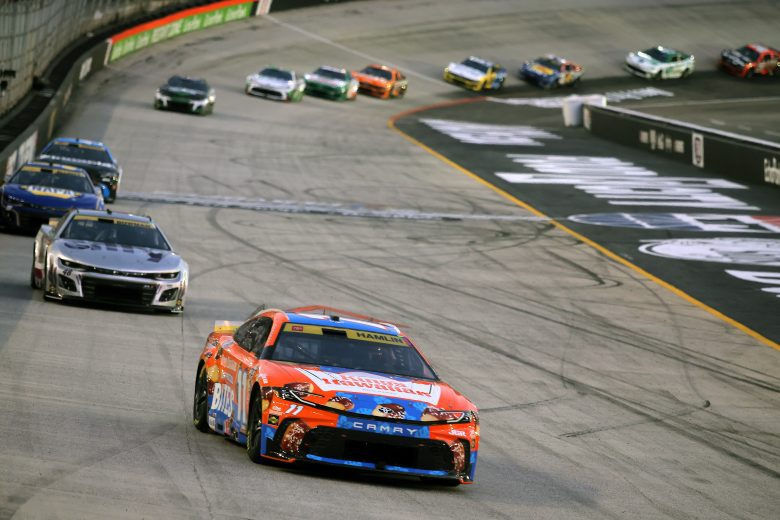
The luck element is the reason why the NASCAR playoff format is so unpopular, you only have to look at this season's finale. After dominating all race, Denny Hamlin's frustrating wait for a championship finally looked to be coming to an end until William Byron's tyre flattened, sending the race to overtime. It was a scenario completely out of Hamlin's control, which ultimately lost him a championship - that's not the fair systems which rewards winners like in the NBA or NFL, and it is a problem IndyCar would inevitably have with a playoff format.
Even in this years' theoretical playoffs, any scenario where Palou doesn't win the title is completely unjust in the context of the season he had. If O'Ward's tyre does not go down mid-way through and he goes onto win at Nashville, that's not the sporting system which rewards the very best. Even in O'Ward's case, how fair would it be for him to lose a theoretical title because of a factor completely outside of his control - and in the hands of one of the series' official suppliers?
Implications of a one-race decider

A one-race finale promotes a similar discussion. Although Palou made leaps and bounds in his oval performance in 2025, how fair would it be for one of the six ovals to host the season finale when the likes of Newgarden or O'Ward are considered stronger oval drivers? Either could snatch it from Palou's dominant 2025 hand on the basis they're stronger at ovals. For comparison, imagine if NASCAR hosted their season finale on a road course, how fair would it be if van Gisbergen snuck his way into the Championship Four and snatched a title, just because it was an environment that favoured him?
It's exactly that scenario which concerns Palou most about a playoff system: “The season finale’s now at Nashville, and maybe ‘I’ve never raced at Nashville’ or ‘I have bad confidence there,’ and suddenly, you’ve won eight races that year, and someone who’s just won once is the champion.”
In recent seasons, there's been a trend of Chip Ganassi Racing leading the way on road courses, Team Penske on ovals and Andretti Global on street courses, the type of advantage that is not seen in NASCAR. That immediate advantage in setup to some drivers will play an ultimately unfair role in deciding a champion, as noted by Lundgaard: "There is such a big difference in teams on street courses specifically, for example. Somebody is going to get completely hosed on one of those weekends and I don't think we need to do that."
There's no coincidence that Team Penske won three consecutive NASCAR titles at Phoenix Raceway. It was a track that suited their setups year-in, year-out and rewarded Ryan Blaney and Joey Logano with championships, even if they were far from the best in the field that season.
The NFL doesn't choose to host the Super Bowl on a grass field or a gravel field or a dirt field. Yes it rotates the stadium, but it doesn't create a situation that can be vastly unfair to an individual or team competing for a championship. The NBA rewards the team with the better regular season record with home court advantage, which although provides a small advantage, is something ultimately earned as isn't going to change the complexion of a playoff series.
The flip side is that a one-race decider will gather more attention than it would have done otherwise, with a driver needing to finish in 'x position' to seal the title in the finale. I recall the build-up to the 2021 Abu Dhabi Grand Prix where for the first time, it felt like F1 was the talk of the town. Why? Because two of the sports heavyweights approached the final race with a straight shootout for championship glory. Is that not the same as what a playoff system does year-on-year?
Like Townsend Bell and many others, that situation will make them tune into the final race: "The diehard fans don't like that [a one-race finale], they criticise that, they think it is fabricated for TV, but I am not a diehard NASCAR fan in that I don't watch all the races, but there I was watching the NASCAR Cup Series Championship Race because we wanted to see who was going to be the champion."
In response to this, I tried a format where drivers carried over all their playoff points into Nashville, to give an advantage to those who had had a better season to that point, but also provide the intrigue of the championship always going to the final race. Although it didn't make a significant difference, it saw Palou re-claim his 2023 title, the only other season in this format where the real championship was won before the final race. Is that a fair method of rewarding success but keeping the battle going right down to the wire? Maybe not completely, but more so than a 'winner takes all' decider.
The fluke factor

Logano's 2024 championship puts into question the legitimacy of any champion crowned under a playoff format. Throughout the season, seven top five finishes with four conveniently-timed victories saw Logano crowned NASCAR champion despite finishing 11th in points across the course of all 36 races.
A regular season victory at Nashville, which in itself was controversial after five overtimes saw the race effectively become a competition of who had the most fuel, Logano secured his place in the playoffs. Logano then quickly locked himself into the Round of 12 by winning the opening playoff race at Atlanta. However, Logano's third championship dream looked to be over after the Round of 12 cut-off race at the Charlotte Roval eliminated him on points, until Bowman failed post-race inspection, providing Logano a second chance. Logano would lock himself into the Championship Four by winning the opening Round of 8 race at Las Vegas before coming out on top at Phoenix to claim a controversial third Cup Series Championship.
The NBA hasn't had a champion that finished lower than third in their conference since 1995, mainly because the way the playoffs are designed means that you can't 'fluke' your way through, unlike the NASCAR system. You of course have the underdogs like the 1999 Knicks or the 2023 Heat or even the 2025 Pacers who have stunning playoff runs, but the underdog story is a part of sport until the underdog story becomes so common that it doesn't hold value and it becomes a lottery.
Newgarden's 2025 is an excellent comparison to Logano's 2024. Let's say Newgarden theoretically wins at Gateway if he doesn't hit the spinning Louis Foster and locks himself into the Round of 8. He then has things to go his way on strategy at Milwaukee (Rasmussen-style) to take another victory before taking the win he did claim at Nashville. Suddenly, in a season as catastrophic as the one Newgarden has endured this year, he leaves with the Astor Challenge Cup, with Palou's eight victories meaning little come seasons end.
That's not a fair way to crown a sporting champion. Performing at three of 17 events is not symbolic of the great sporting outfits, instead it highlights the flaws in a system which reward peak performance over regular consistency, especially a system that doesn't reward those with the best peaks, but instead the peaks that happen at convenient times.
How does it affect the fans?

Any reasoning behind the playoff system will always circle back to fan interest and having a product that appeals to a casual audience. IndyCar may currently have the best racing product out there, but it is also no use if it isn't reaching the audience that it is intended for. It was clear that IndyCar have a core fanbase of 700,000 viewers based on 2025's figures, but how does it reach the 2.5 million that watch NASCAR weekly?
As somebody who does watch NASCAR as a non-hardcore fan, the playoffs are an exciting and unpredictable way to decide a champion, and something that is ultimately more appealing to casual viewers of the series. Ross Chastain's wall ride at Martinsville in 2022 was one of the most viral sporting moments of the year and a moment that never would have occurred if not for the playoffs.
With the FOX investment playing a focus on digital content, moments like that are certainly going to help visibility and appeal to a social-based audience who otherwise may have little knowledge of the series. In a playoff system where every race has the stakes so much higher, it is also those moments that make any casual viewer increasingly engaged to the action. It means there is naturally going to be a boosted interest to the racing as opposed to a season finale where the championship has already been sealed and that is what will build a connection and a following from fans to drivers and series.
That was exactly the case for the self-described casual NASCAR fan in Townsend Bell: "We were heartbroken for Denny Hamlin because he didn't win. But, we had an emotional reaction to a NASCAR race as non-hardcore fans. So that's the problem, is that better for growing the sport because you had two non-hardcore fans with an emotional reaction to a broadcast? Is that a way to draw in more fans? The answer is I don't know. I don't know if that's better or not."
Even if it does reach that target audience, the playoffs remain a format that is very complex to understand, particularly for people trying to access the series for the first time. My multiple-paragraph explanation earlier only emphasises that point and if you are trying to reach a new audience, how do you expect to keep them engaged with a format they could struggle to follow? This isn't the NFL where it is as simple as 'whoever wins this game goes through,' there's multiple permutations and complications all the way through the explanation.
This was a point highly emphasised by Lundgaard: "The only reason why I would say no is because I find it always very confusing if you just talk about the NASCAR playoff system, they have a regular season championship then they have a playoff system at the end of it where it's always very confusing to understand why specifically those four cars or eight cars that are in the playoffs are always the cars that are in the top eight anyway."
There's a lot of discussion on how a playoff would attract new fans to the sport, but NASCAR's implementation of a playoff system alienated a lot of its hardcore fanbase and that is a huge consideration into any discussions IndyCar would ever have. Is a short-sighted move to try and boost viewership figures worth the sacrifice of the hardcore fans falling out of touch?
It's a difficult thought for even the likes of long-time IndyCar fan and FOX Sports commentator Will Buxton: "I'm a purist and I believe that racing championships should be the result of an entire season and not just a snapshot of that season."
How will it fit in the IndyCar schedule?

One of IndyCar's key selling points is the variety of its schedule, with the series racing on road courses, street courses, short ovals and superspeedways. Although NASCAR places more of an emphasis on ovals, the 2025 calendar saw races on road courses, street courses, short ovals, intermediates and superspeedways.
The 10-race playoff that NASCAR utilises allows the series to create a playoff schedule which creates a variation of different track types to not give an emphasis to a particular skillset. 2025 saw six intermediates (although a very loose term), two short ovals, a superspeedway and a road course.
Although the final four races of 2026 will take place on three different track types, a shorter playoff calendar makes it difficult for IndyCar to have the same spread of track types in a playoff system, which risks giving a disproportionate advantage to drivers more suited at one track type. With no superspeedway races currently outside of the Indianapolis 500 (Nashville isn't a superspeedway despite its name), IndyCar can't currently showcase its full range of racing types in a playoff system.
When we posed this question to Buxton, this was his key problem with the playoff format: "IndyCar has always been about showing the strength of a driver over the course of a season in multiple different disciplines in terms of racetrack that is road courses, street courses, superspeedways, short ovals. To introduce a playoff system that didn't include all types of circuit, to introduce a playoff system that didn't include the result of the Indianapolis 500, I think would be quite strange."
Lundgaard echoed a similar point: "I'm not sure how that would work for us with ovals, with street races, with road courses," before finalising: "In my opinion, I don't think you necessarily need it [the playoffs]."
Although we've explored options of playoff formats for IndyCar, there still does seem a consensus that the formatting of the current calendar means that the playoffs may not have their desired intention. IndyCar would almost certainly have to extend it's season into the NFL schedule if it really did have the desire of increasing its global audience. That could be done through international races, especially in places such as Mexico City, but you also risk the series doing too much at once.
Ferrucci, who has raced in the NASCAR Xfinity Series before, echoes that sentiment: "The correct answer for the playoffs is it worked for NASCAR to create a different set of championships. They race 30-plus times a year. We run 17 times a year. That's essentially what their playoff is. It doesn't make any logical sense for us to do that."
Does the racing product actually need it?

The potential TV viewership is always going to be the primary reason for a playoffs if IndyCar do ever decide to implement it, but with the increasing dominance of Palou year-on-year, the inconsistency and disruption that can be caused by the playoffs could be an incentive to change things up to the championship format.
Periods dominated by one driver in motorsport are never popular, whether that's Jimmie Johnson, Sébastien Loeb, Michael Schumacher, Sebastian Vettel, Lewis Hamilton or Max Verstappen and it raises an interesting question if IndyCar risks it being the same story with Palou. Palou's yearly dominance isn't reflective of a series so often marketed as unpredictable, especially when there is no fight for the ultimate annual glory.
Is sacrificing Palou's dominance worth it to keep fans engaged all season long?
"I do know that it would be very disruptive to switch IndyCar to the playoffs," continued Bell from his earlier comments. "But what it would address is Palou winning the championship two races early this year, maybe five races early, who knows? I don't think that's good either for finishing things off."
It felt pretty obvious since the third race of the season on the Streets of Long Beach that Palou had a fourth championship in his pocket throughout 2025. There of course will undoubtedly be other storylines to follow throughout the season, but when the primary one of 'who will win the championship?' is gone from the picture so early, it doesn't hold a huge appeal to any fan trying to grow their interest in the series.
We're going through a phase of the sport where Palou is dominating, winning four of the last five championships. Palou is only just entering his prime and you would certainly expect more titles to come his way. As we've seen with a playoffs though, suddenly 2025 would have marked Palou's first championship and there is no guarantee year-on-year that he will be the champion.
With the perceived competitiveness of the series taken into account, what standard does it set that a driver wins the title two races early in a 17 race season?
But, is this all a knee-jerk reaction? 2025 was the first time in 23 years that an IndyCar championship had been wrapped up with multiple races left in the season. Palou's title-crowning moment in Portland in 2023 was the first time in 16 years that a driver had not won the title at the season finale, the exact same standards you're looking for in a playoff.
Yes, domination is boring, and that applies to every sport. It is a ridiculous concept to penalise somebody because they excel against the greatest in their field. Yes, Schumacher's five titles in a row were boring, but many still look back in awe at how great the German was compared to the opposition during that time. The same applies to Palou now, we should be asking: 'how great is he?' instead of 'how great was he?'.
We saw that five of the last six champions would not have won their titles with a playoff in place and that's not a system which is fair to the very best that season. As we discussed earlier, that doesn't apply to the NFL and NBA because the best teams do come out on top. Yes, they may not win the regular season but you have to take into account injuries to star players during the regular season, with ultimately, the cream always rising to the top in their systems, it doesn't in NASCAR, it won't in IndyCar.
The domination argument aside, IndyCar's racing is already at a standard that is regarded as one of the best in motorsport and it doesn't need to be manufactured further to create a better product. IndyCar does not need to force stages, it does not need to force overtime and it does not need to force a playoff in the pursuit of a better racing product.
Palou's domination may not be entertaining for many, but that does not equate to the on-track action being boring too, a perspective that Palou himself takes too: "If you look at the season we've had, I don't think it's been boring. It's been very exciting for everybody to watch."
One of the most controversial topics of the playoff format is also what drivers will do in order to win. Whether that was the Hail Melon or Chastain's move on Hamlin at the Roval this year or most notably, Dillon's controversial victory at Richmond in 2024. The format creates a fine line between epic driving displays but also creates a desperation which promotes dangerous and reckless behaviour on-track with sometimes, farcical outcomes. That may be fine in a heavy stock car but in an Indy car, that danger cannot be toyed with.
It was one of Lundgaard's main concerns with the system: "I feel a lot of drivers would be doing something they shouldn't do on ovals, to get a result. I think the consequence is a lot higher for us than it is for NASCAR on ovals if something goes wrong."
It is no longer a secret on how superb IndyCar's on-track product is week-in, week-out. It doesn't feel particularly necessary for the series to create a situation where drivers need to become desperate or over-the-line to create a better product, because that product is the standard for others to follow. Yes, it might stop domination, but does it play itself a bigger risk at moments that make the series and the format look like a laughing stock?
The verdict

There's a lot to unpick and a lot of differing viewpoints on what a playoff format would and would not add to IndyCar. Bell is certainly correct in stating that: "It's a complicated scenario that nobody has the answer to yet."
We still await confirmation on what NASCAR is going to do with the playoffs heading into 2026, but that still gives us two different perspectives. Is it a case of an opportunity that IndyCar can now take with its main competitor not taking advantage? Or is it a format that proved so unpopular that it was adjusted or even removed for a reason?
"I don't know what IndyCar is going to do, but I'm open to the playoffs," added Bell. His FOX Sports co-commentator Buxton made clear his differing viewpoint: "I don't know what the future holds, but I'm also a realist in that things change, but I hope they don't."
Although there seems to be little certainty from any of the FOX organisation, who's stake in Penske Entertainment has re-promoted these discussions, maybe to the relief of many, IndyCar President Doug Boles has re-affirmed it's something not currently in IndyCar's short-term plans.
“We pay attention to what others are doing,” Boles said. “The one thing I know is that we don't have any interest in doing a playoffs-type situation like NASCAR has. That's not something that's on our bingo card.”
It'll be a relief to many drivers in the paddock, many of whom have clearly stated their distaste at any suggestions of the playoffs. I posed the question to Louis Foster and just 10 words have me the full picture on a driver's perspective.
"Hard no to them doing that, system is a joke."
There seems like a general resounding no from anybody involved in the series, but one of the key stakeholders in one of IndyCar's major races thinks otherwise. One of the biggest backers of the proposed system is Scott Borchetta, the CEO of the Music City Grand Prix, who's event would have hosted the Championship Race for the last two seasons had a playoffs been in place.
“I think an IndyCar playoff would be great, and arguably needed,” Borchetta said. "I can also understand why it’s hard for drivers who have had a dominating season like Alex for the championship to come down to a single race.”
But from all of the words spoken, it was Kirkwood's that still ring truest in my mind when he was posed the question, which is ultimately the attitude that IndyCar needs to have if it wants to keep any credibility as a series.
"No way, don't even ask. Yes, 100 percent don't. Please don't ask that."
IndyCar's product is superb, the racing is just as good as it has ever been and it creates a set of storylines unrivalled by any other motorsport. We are firmly in the Palou era, but why should we penalise his greatness? Why should the product be sacrificed for the desire of the potential for short-term aggressive growth? That product should be shouted from the hills and promoted like no tomorrow, exactly the framework that FOX has put into the series in its first 12 months.
IndyCar certainly has a long way to go in trying to restore the series to its former glory, especially against the popularity of NASCAR and F1, but it shouldn't be giving themselves an opportunity to be ridiculed at with a playoffs in place. That question of entertainment versus sporting integrity is not one that needs to be posed, at least for now.



Comments