
MotoGP marshals: The overlooked force behind every race weekend


While riders and team principals are constantly at the forefront of every race weekend, marshals are the unsung heroes that make your favourite races possible. Today we shine a spotlight on these volunteers, their history and duties.
The history of safety volunteering
The history of MotoGP marshals goes as far as the history of the sport itself, with their duties evolving alongside the racing.
At the start of the 20th century when motorcycle racing first began to take shape, safety protocols were not as thorough as they are today and marshals played a less important role in this regard. The volunteers were mainly people alongside the track that would help with the organizational aspects, but were not properly trained in any regard.

When races became professionally organised, the need for a large number of people to help along the track and respond quickly to crashes led to the reliance on volunteers for modern-day races as well, but this time with some key changes in their duties.
Firstly their duties are now more tied to rider safety, as the sheer number of marshals all along the track ensure fast first-aid after crashes and quick debris clearance. These volunteers are usually the first people that riders depend on after a crash, and the first to signal to others that there is danger on track.
Secondly all volunteers must now undergo professional training before being allowed to partake in race weekends. While they might not be professional motorsport workers, many of them have years of experience, driven by their pure passion for the sport.
The Fédération Internationale de Motocyclisme (FIM), celebrated 120 years of racing in 2024 and the president Jorge Viegas recognised the importance of the volunteers by stating: “Volunteers are truly the lifeline of the motorcycling world. Without their hard work and passion, we would not be able to enjoy sport at the level we do today.
As we celebrate this incredible milestone of 120 years, it is our priority to ensure that volunteers receive the recognition they deserve. They have been instrumental in shaping the sport’s history, and they are equally crucial to its future.”
Marshal duties and training
MotoGP races require major human resources in order to take place. Alongside the riders, engineers and other team members, hundreds of volunteers that ensure everyone’s safety are vital for every race weekend.

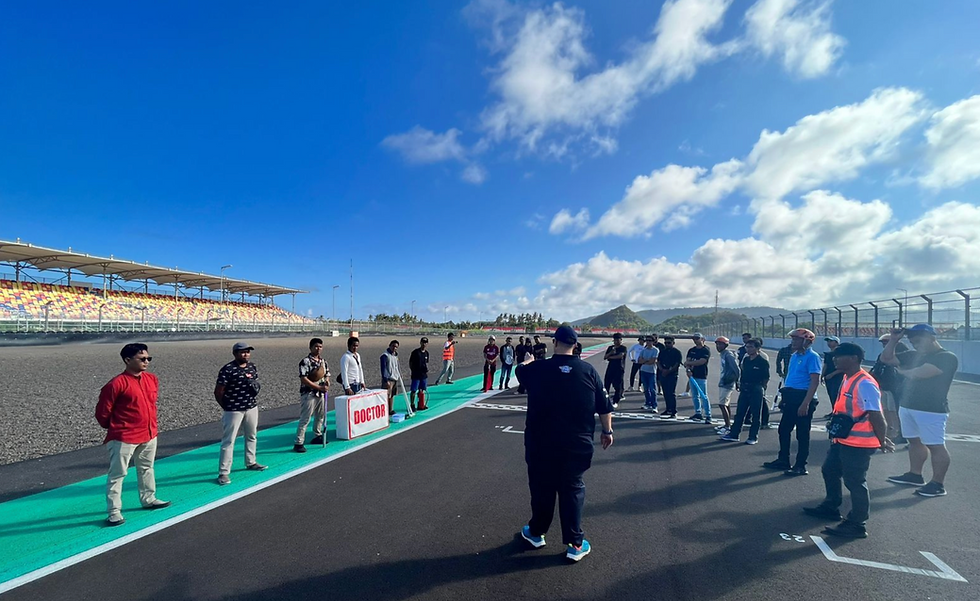
Their duties range from relaying information to race control (communication marshals), communicating information to riders about on-track dangers using flags (flag marshals) and clearing the debris and removing bikes after crashes (track marshals).
In order to ensure that these procedures happen safely, for both the marshals and the riders on track, the volunteers undergo specific training based on the track they choose to help at and the role that they’ll have during the weekend.
Penny Swinbourne, a teenage girl who is passionate about motorsport and marshalling, shared a bit about her experience attending races as a volunteer. Although she is not yet accredited for bike races, her time at events such as British Touring Cars and Gold Cup at Oulton Park help give an idea about starting one’s journey as a marshal.
She described her training as learning “a bit of everything”, stating: “Part of this is basic first aid and a test about what to do if things go wrong. Once a year there is also a training day for marshals which helps refresh memories.”
This sort of diverse training is to be expected with all marshals regardless of their role, as their help could be needed at all points across the track. Additionally all marshals are taught the corresponding flag signals, how to communicate incidents clearly and how to respond to crashes.
Potential for mistreatment
Just recently, rider Marco Bezzecchi was banned from the 2026 Czech Grand Prix for striking one of the marshals on track and unfortunately, this isn’t the first time that these volunteers have been mistreated.
Mostly riders are fined for disobeying track marshal orders, as was the case for Fabio Quartararo at the 2025 French Grand Prix or Franco Morbidelli at the 2025 Catalan Grand Prix. While riders might feel they know best when it comes to their own safety, volunteers have to make quick decisions that have to keep all riders’ and attendees’ safety in mind.

The volunteers can make mistakes and frustration naturally arise among the most experienced on track, but it’s important to note that the marshals are already put in enough danger as is and riders disobeying or slowing their procedures can make things more difficult for them.
Swinbourne herself had difficult encounters with team members and attendees during race weekends, but highlights that being a marshal also gave her a sense of power.
She recalled: “There have been a few occasions on which members of teams or the public have been slightly rude towards me. For example, an older man who was with a team kept trying to tell me that I was wrong – I felt he partially did this because I am a teenage girl – but when I have my orange overalls on I have the authority as I’m just trying to keep everybody safe.”
Becoming a marshal yourself
With hundreds of marshals being needed for every race weekend in all corners of the world, volunteers being interested in giving a helping hand are more important than ever before.
Although the work can be extremely challenging, being on track also poses a unique way of interacting with your favourite sport and being a part of the spectacle.

Swinbourne recommends this experience to others as it fosters many skills and helps connect you to the community. She explained: “I’d highly recommend it to anybody who has an interest in motorsport as it gets you close to the action and introduces you to so many different disciplines.
“It also helped massively with my confidence especially during the bigger meets where crowd control is necessary. The community side is also very important as you all have to work together to keep everything running smoothly.
“Motorsport couldn’t happen without marshals, and that’s what I love about it.”
Edited by Rohan Brown






Comments