
Passport control: How a driver’s flag shapes their F1 career
- Kavi Khandelwal

- 2 hours ago
- 7 min read

Formula One has always presented itself as the pinnacle of motorsport. What it has been less willing to advertise is how much the passport in a driver’s pocket shapes the seat they sit in, the sponsors on their car and the headlines above their names.
There is a version of F1 that exists purely on stopwatch data. Clean, objective and indifferent to borders. In that version, the fastest driver gets the fastest car, the best coverage and the biggest cheques.
That version has never existed.
The real one runs on something messier — television markets, commercial relationships and the gravitational pull of a fanbase millions of miles from the nearest circuit. A driver’s nationality sits at the centre of all of it.
This observation is one that the sport rarely examines with honesty, perhaps because the answer is uncomfortable. Pull at this thread and you pull at the entire economic fabric of F1. Once you start pulling, it is very difficult to stop.
The seat as a commercial product
When Bernie Ecclestone restructured F1 as a global television product through the 1970s and 80s, he did not invent the sport’s relationship with nationality — he industrialised it.
The question teams had always quietly asked about the sponsorships that a driver could bring in, became a formal line in the budget discussion and a spreadsheet entry.
The Japanese wave of the late 1980s is the cleanest case study. Honda’s engine programme brought with it an entire industrial ecosystem willing to spend on F1 visibility.

With it came a generation of Japanese drivers whose presence on the grid was, by varying degrees, commercially motivated. Satoru Nakajima’s seat at Lotus and Aguri Suzuki at Larrousse.
Neither man was among the fastest drivers of his generation, and both were broadly candid about the commercial dimension of their careers. It was the sport functioning exactly as designed.
The pattern repeated itself with near-mathematical regularity across the following decades. Pastor Maldonado and Venezuelan state oil money at Williams and Tiago Monteiro and the Portuguese market in the mid-2000s.
Zhou Guanyu’s 2022 arrival at Alfa Romeo came packaged with Chinese commercial partnerships that the Hinwil team needed badly. In each case, the media narrative around the driver was shaped — fairly or not — by the shadow of that commercial logic, regardless of what the lap times were saying.
“The system is what it is,” Flavio Briatore said in 2009, making no particular attempt to dress it up. “A driver who brings money is a driver who makes the team possible.”

And yet Guanyu’s example illustrates something the cynical reading misses. He won the Formula 2 sprint race at Monza and finished third in the championship. He had earned his place within the system’s own criteria.
However, the asterisk followed him wherever he went. The commercial logic and the sporting logic had converged, but only the commercial logic made the headlines.
The sponsorship pipeline
The relationship between a driver’s flag and their sponsorship portfolio is, in many ways, the most honest indicator of how commercially valuable their nationality is considered to be.
Teams do not invest in this casually. When Red Bull formalised its Honda engine partnership ahead of 2019, Racing Bulls, formerly known as Toro Rosso, suddenly became a far more hospitable environment for Japanese driver development. It was simply the F1 economy working transparently with nobody pretending otherwise.
The more troubling version of the same logic is what happens to drivers whose nations do not have an equivalent infrastructure behind them. How many careers were truncated not for lack of talent but for lack of a commercially interesting power?
It is, by definition, a question with no clear answer. One cannot count the drivers who never got their runway. The sport’s junior ladder offers clues, though.
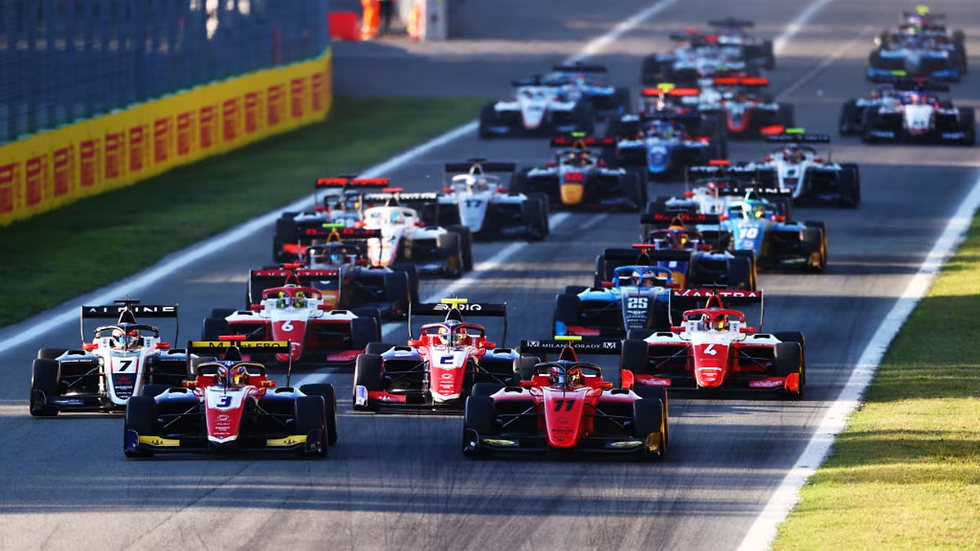
Access to elite karting, Euroformula, Formula 3 and F2, correlates uncomfortably well with national wealth and the presence of a domestic motorsport culture. Talent from outside that geography faces not just a funding gap but a visibility gap.
They are not in the rooms where decisions are made, and they are not racing in the series where the right eyes are watching.
Sergio Pérez is the counter-argument the sport often reaches for: a driver from Mexico whose early career was partly sustained by Carlos Slim’s Telmex, the largest and most dominant telecommunications company in Mexico, backing who turned out to be genuinely excellent.
“Without Telmex, I don’t have a career at this level,” he said in 2013. “That is the reality.” That he then became one of the better drivers on the grid does not vindicate the system.
It means the system, in this instance, got lucky. For every Pérez who is given the runway and proves the investment right, there is an unknown quantity who was never given it.
The narrative problem
Beyond coverage volume lies the subtler question of how a driver’s story is told. What themes are applied to them, what interpretive lens their performances are filtered through.
This is where nationality does some of its most insidious work, because it operates below the level of conscious editorial decision.
A European driver in a difficult season tends to receive coverage in the language of redemption — talent finding its form, a champion waiting to emerge.
A driver from a nation without an established F1 heritage in the same position is more often framed in the language of interrogation. Is he really good enough? Did his national backing buy him a seat he doesn’t merit? When will the team cut their losses?

Yuki Tsunoda’s case is instructive here. He arrived in F1 as a demonstrably quick driver — his F2 qualifying pace was not the work of a passenger and his raw speed at Racing Bulls, formerly AlphaTauri, was consistently evident.
The dominant media narrative across his first two seasons focused heavily on radio outbursts and consistency issues in a way that occasionally felt disproportionate to their actual frequency.
Those criticisms were not unfair. The question is whether a European driver with an identical error profile would have received the same sustained scrutiny, or whether he would instead have been offered a more generous character study — the hot-headed talent learning his craft.
The framing matters. It shapes public perception which shapes the commercial value. That shapes whether a driver can keep their seat.
The British bias question
The debate around British media bias in F1 is rarely a debate about evidence. It is a debate about perception. Perception, in this sport, has a habit of hardening into received wisdom before anyone has checked whether it is actually true.
The accusations tend to work like this: a British commentator says something complimentary about a British driver, and a portion of the audience immediately labels it bias.
It does not matter whether the comment was accurate or whether the same commentator has said equally complimentary things about drivers from other nations.

The nationality of the speaker and the subject align and that is enough for the charge to stick. Martin Brundle praises Lewis Hamilton’s racecraft in a difficult stint — bias. David Croft celebrates a pole lap by Lando Norris — bias. The assumption precedes the analysis, but the analysis never quite catches up.
What this creates over time is a peculiar kind of overcorrection. British journalists and commentators, acutely aware of how any positive remark about a British driver will be received, begin to commensate.
They become, if anything, harder on British drivers than the evidence warrants — not because they dislike them, but because they are trying to demonstrate that they don’t like them too much.
The results of this overcorrection are visible and have been for years. Jenson Button spent the early part of his career being written off with a consistency that bordered on a campaign.
The British press that should, by the bias theory, have been carrying him on a velvet cushion instead produced a steady stream of pieces questioning his mental strength, his hunger and his right to the Williams seat.
When he finally won the 2009 championship with Brawn GP, the coverage was celebratory, but the years of scepticism that preceded it had been real and sustained.

George Russell is the most recent case. During his first full season at Mercedes in 2022, he was subjected to sharper criticism from British outlets than from the majority of international ones. His qualifying performance was praised but his race craft and wheel-to-wheel instincts were questioned with a frequency that surprised fans.
Norris, for all his enormous popularity, faced pointed questions from the British media about his mentality and race craft whenever a run of results had disappointed. These were questions that tend to arrive faster than any praise ever did for the good ones.
So does British bias exist? The more accurate diagnosis is that the fear of being accused of British bias has produced its own distortion. They overcorrect and drag their own drivers through the mud to prove they are not carrying them.
The bias charge, whether fair or not, has had consequences for how British drivers are actually covered. That is its own kind of irony, and the sport’s discourse has not caught up with it.
Where this leaves us
F1 is expanding into markets that do not arrive with inherited hierarchies. Newer audiences came through Drive to Survive without pre-loaded narratives and have built their own. The sport is broader now commercially, geographically and editorially than it has ever been.
But broader is not the same as fixed. The access gap in junior categories remains. The sponsorship logic remains and the narrative defaults remain.
The hundreds of millions of people living in countries with no connection to this motorsport whatsoever remain as invisible to the sport as they have always been, not because the sport looked at them and turned away but because the sport has never built anything that would allow them to be seen in the first place.
In the end, every driver who reaches F1 has cleared a series of barriers that would have stopped most people long before the pitlane. The question the sport should sit with is how many never got close enough to the barriers to attempt them. Not because they lacked the speed but because their flag was the wrong one to carry into a room full of sponsors.
The stopwatch does not care where you are from. F1, as a business, always has.



Comments