
Rahal fights “bulls**t” for first IndyCar podium since 2023


Graham Rahal is aware of the talk. Of those who think his best days are gone. Of those who insist he cannot cut it at the top anymore and that retirement nears. Of those who dismiss his Rahal Letterman Lanigan Racing (RLL) team too.
But over the weekend at Barber Motorsports Park, he quietened some of those critics.
“I think you guys know what I mean about that,” he insisted. “I don’t have to say a whole lot. There’s enough bulls**t out there that I’ve got to deal with. It’s nice. It’s nice.
“I’ll still hear it. It’s funny, you read Twitter every day: ‘He can’t qualify.’ I qualified in the second row last week. Just shut up. There’s a whole lot of dumbasses out in this world right now. Get to live with it. Pardon my French.”
It has not been the easiest few years for Rahal. After a seven-season run of finishing inside the top 10 of the IndyCar standings - sixth and seventh in 2020 and 2021 the final two campaigns in that stretch - he has regressed every year, culminating in 19th place in 2025.
Talk about his absence of a victory since 2017 remains constant. And with only three top-10 results last season and eight across the last two campaigns combined - fourth in Portland last year the only top five in that run - talk also intensified about another podium drought.
His runner-up finish on the Indianapolis Motor Speedway road course in August 2023 had ended a dry spell of over two years at the time. So to finally return to the rostrum at this weekend’s Grand Prix of Alabama after another two-plus years was a significant milestone for the 37-year-old series veteran and his team.
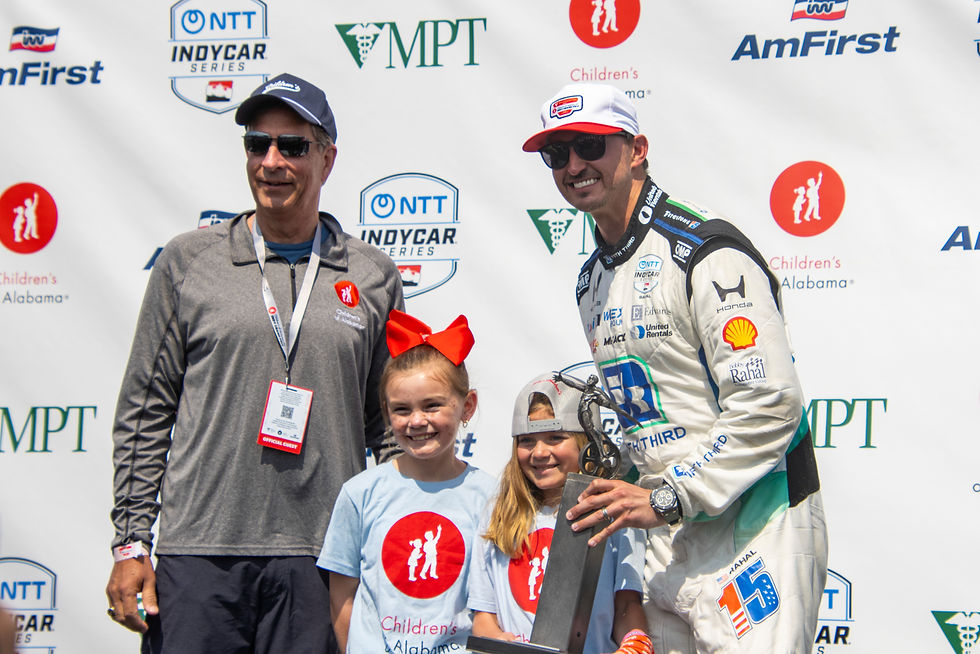
“It’s a great reward for the guys and gals,” said Rahal. “Everybody has worked so hard to be back here, heard all the noise and BS that we get to hear all the time. All weekend the car was in really good shape - very, very competitive, very comfortable.
“The race is actually the most challenging it was. It [had been] extremely stable. In the race, I was losing the rear a lot, no matter what I felt like I could do on tyre degradation. That’s been our Achilles’ heel so far this year. We’ve got some work to do.
“[But] I’m super happy for everybody on the No.15. Great pit stops, great strategy. It’s a good relief this early in the year to have a good result.”
On Saturday, a third-place qualifying result for the second time in four races - after a stunning second-row lockout for RLL at Phoenix Raceway in Round 2 after years of short-oval struggles - could easily have been pole.
Compared to Álex Palou and David Malukas ahead on new alternate tyres, Rahal had used a slower, used set of the softer compound. Like many, he had expected the race to be alternate-dominated, hence opting to keep a fresh set in hand, when in reality it seemed the harder primary tyre emerged favourable on Sunday.
Maybe if Rahal was clearer on the rule - only having to run one stint on new alternates on road courses, compared to two soft stints on street courses - he would have opted for the same strategy as the front row, given how close he was on used rubber.

“I was really surprised they ran new reds in Fast Six,” Rahal admitted. “I was a little bit shocked. Even Álex said it to me… I think if we ran new reds in qualifying we would have been on pole. We were only two tenths off - that is nothing.
“I’m not sure that it hurt us that much or gained us that much by keeping that extra new set of reds. Our thinking was it was a red race; we were going to be in the catbird seat. I’ll be honest, I screwed up because I thought the rule was you had to run two alts [in the race], but that’s only a street course thing. It hit me after. We’ll live and we’ll learn. We’ll be alright.”
Rahal spent much of the early part of the race at Barber remaining put in third, having initially fended off Kyle Kirkwood, until he passed Malukas late in the stint. At that point, validating his qualifying speed, he had even started to close on race-leading Palou.
“Early in the race, I was feeling pretty good,” Rahal recalled. “The first stint I felt in total control. The balance was good, the rear-tyre wear was good, we were catching Palou. I had big hopes at that point. Really the difference was only at the end of stint two. I lost too much.
“I felt pretty good to hang on with [Palou] that long because not many people do. At the end of stint two, I started to lose the rears, lost too much.”
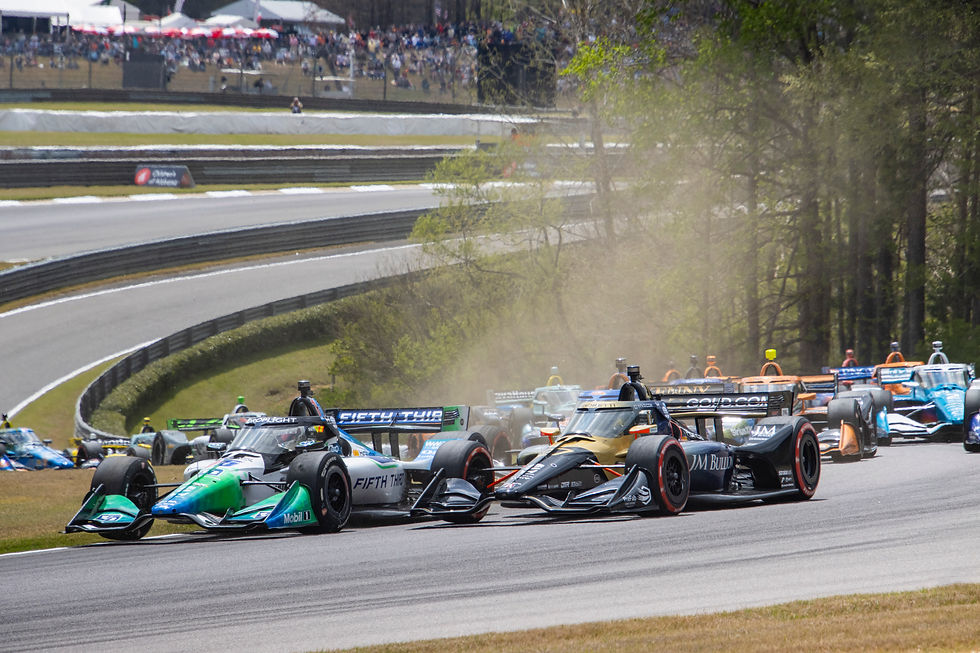
Prospects of a first victory in nine years - a long shot against the omnipotence of Palou - eventually faded and attention turned to preserving a valuable, long-awaited podium result.
Ahead of the final round of pit stops, Rahal had also fallen behind former teammate Christian Lundgaard. And by the time the pit cycle came around, the Dane was poised to challenge Palou out of the pits after the race leader found himself compromised by traffic.
But a bobble in the pits from Arrow McLaren instead brought Lundgaard back into Rahal’s grasp, allowing him to elevate himself back into second. Though Lundgaard was promptly in eager pursuit and Rahal began to suffer.
“My last out lap wasn’t very good [and] I couldn’t get the rears to come in on the last set of tyres,” he explained. “I just couldn’t gain the gap that I needed to. That killed my enthusiasm fairly quick…”
Rahal was able to hold valiantly onto second until Lap 88 of the 90. But the driver of the No.7 Chevrolet was clinical, pouncing on his rival’s shortfalls and, with more push-to-pass assistance in hand, completing a re-pass for second into Turn 5.
“His strength was my weakness,” Rahal assessed. “I was dying in Turn 2 and 3; that was the best part of the track he had. We did the best that we could. He was on a charge and we had done a few more laps than him on those tyres. I knew it was going to take everything.”
Ultimately, “a big moment” from Rahal into Turn 13 on the lap prior gave Lundgaard the momentum he needed. And Rahal was never going to fight unduly aggressively and risk jeopardising any podium finish, even if second was preferable to third.

“I didn’t block that hard. People may say: ‘Why?’ I still wanted the podium,” he affirmed. “I didn’t want us both to go sailing off doing something stupid. I just wanted not to lose that much time. Trust me, I wanted the podium badly. I really wanted to be P2 [but] I wanted the podium badly to go into this break. A little pressure off the guys.
“Spirit’s high for the team. Really important. We can go off to Long Beach; it’s going to be great. Indy GP we should be very strong. Some of the stuff we did this weekend should be even better for us. I’m excited for the opportunities ahead for our team right now.”
There was yet more pressure pending from Malukas in the final two laps. But while he had closed to within a car length on the final tour, Rahal used his inferior push-to-pass expertly and was always confident he had the Penske driver covered.
“We were quicker than David all day. He did make a good charge at the end [but] I wasn’t so worried about him. Obviously I passed him earlier in the race. I kind of knew his strengths and weaknesses. I wasn’t overly bothered.”
The next port of call for RLL is to figure out why they performed so exceedingly well on the No.15 car. Their road course package has often been the shining light across a number of turbulent years, but this weekend in particular, there was not an immediately clear understanding of where the somewhat surprising level of performance came from.
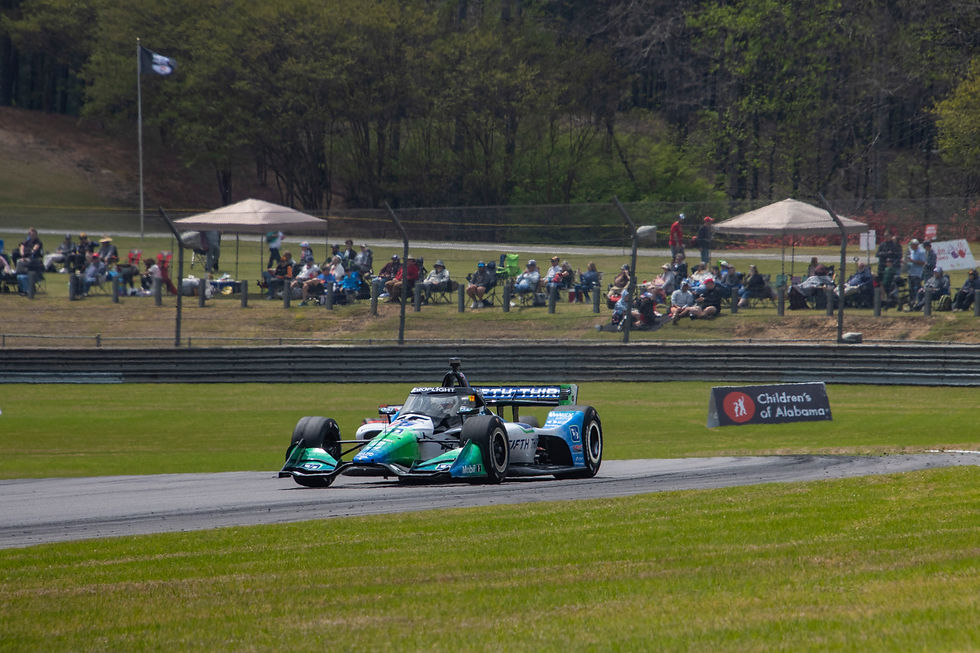
“Now our job is to go analyse and figure out why,” Rahal acknowledged. “What changes did we make to put our car so much further into the window than most other road course races? And how can we take that to the GP and Indy in particular?”
Part of that effort will be to translate the performance across the team’s three cars. A cause of some confusion, despite copying Rahal’s setup, teammates Mick Schumacher and Louis Foster finished in the final two positions on the road on Sunday.
“We’ve all got to sit down and try to understand,” Rahal said. “I think Louis ran a different gear strategy but that was kind of small. I know it sounds simple; you’d all think we should know what we did that worked. It’s not quite that simple.
“We need to understand what the changes were that the No.15 made coming into the weekend that got us off on a good foot, then try to carry that into the others. I’m a much heavier driver than they are; that does move the centre of gravity, weight distribution and stuff. We all need to go back and try to understand where the variances may be.”
But the positive for RLL, should they find the silver bullet, is that they appear to have unlocked something again. And Rahal has proved some points in the process.





Comments