
WEC Season Preview: BMW Hypercar


BMW faces a ‘’do or die’’ season in the World Endurance Championship (WEC) after last season’s early highs subsequently turned into disappointing lows.
Promising start, lackluster finish
Last season was supposed to be a breakthrough year in Hypercar for BMW. The M Hybrid V8 Hypercar, already in its third active season of racing, had shown promise and the driver lineup was deemed by many as capable of achieving glory.
But while the campaign started out strongly, with promising showings from both cars in the Qatar season-opener and then a second-place finish for the No.20 car of Robin Frijns, René Rast and Sheldon van der Linde in Imola, it quickly turned sour.
A potential Spa victory or at the very least a podium, was taken away by a brake problem for the No.20 car. After that, the car’s performance rapidly declined with Le Mans being a relative low point for BMW’s season, despite a promising qualifying session, pace was lacking and both cars faced technical issues.

The second half of the season proved nearly disastrous for BMW, as more technical issues struck in São Paulo and Austin and it became evident that BMW and WRT had trouble extracting the maximum from their package.
Speaking to DIVEBOMB ahead of the upcoming season, Sheldon van der Linde affirmed that the team faced execution issues, stating: ‘’We also feel like we didn't exploit the potential of the car that we had’’.
A measly points tally of 24 across the final six races (equal to Aston Martin’s tally), compared to the 63 scored in the first two races, draws every conclusion needed, especially given that for much of the season, BMW had relatively favorable Balance of Performance (BoP).
An honest reaction from within
The heads at BMW and WRT knew this and were honest about the team’s struggles. ‘’We still have a lot of work ahead of us in the Hypercar class to improve for next year.’’ quoted WRT boss, Vincent Vosse after the Bahrain finale, whilst admitting that ‘’We have a lot of work ahead of us for 2026’’, as there was a need from within to understand why the performance dropped so much after Le Mans.

Even the Head of BMW M Motorsport, Andreas Roos, concluded -in BMW’s 2025 Motorsport review- that the team ‘’generally had higher expectations’’ in regards to the second half of the season and that the team ‘’ will analyse in detail over the winter what caused this, so we can return much stronger in 2026 with the updated version of our car.’’
Given the lack of notable success so far, speculation about the future may be on the horizon, should BMW fail to achieve its first Hypercar victory in this season, seeing that Cadillac and the - now departing - Alpine already managed to secure their breakthrough victories.
Sheldon van der Linde summarized things by saying: ‘’I don't think we underestimated it {the competition}, but I think it was also just the wake-up call we needed at some point to say ’Listen, we're up against the best here.’ If we want to win and be in the top three at the end of the year, we need to raise our game in all levels’’.
A huge upgrade for the M Hybrid V8
In order to achieve their targets, BMW has used at least one Evo joker to perform a substantial evolution of its LMDh.
The car has received revised aerodynamics, with around half of the bodywork being changed, aimed at improving driveability and consistency of the car for the drivers, a key ingredient for success in a BoP championship.

BMW M Motorsport project leader Achim Klein has explained that the team is still seeking to find overall car concept advantages, ‘’This step is about opening up new set-up and more or less performance directions’’ he has stated. The car appears largely new and that is due to the primary changes being an ‘’aerodynamic update with a visual styling’’ as Klein put it.
The most striking change to the BMW M Hybrid V8 will be its front end. An adjusted splitter optimises airflow, while the BMW kidney grille will be slightly smaller. Additionally, the BMW M Hybrid V8 will receive new headlights. Still though a pretty big part of the improvements is under the bodywork. ‘’It's mechanical parts, so it's mainly cooling and internal airflows’’, Klein explained.
The car has already completed plenty of test mileage in Paul Ricard, Austin, the IMSA-sanctioned test at Daytona and the opening two rounds of the IMSA season in Daytona and Sebring.
Consistency on the driver front
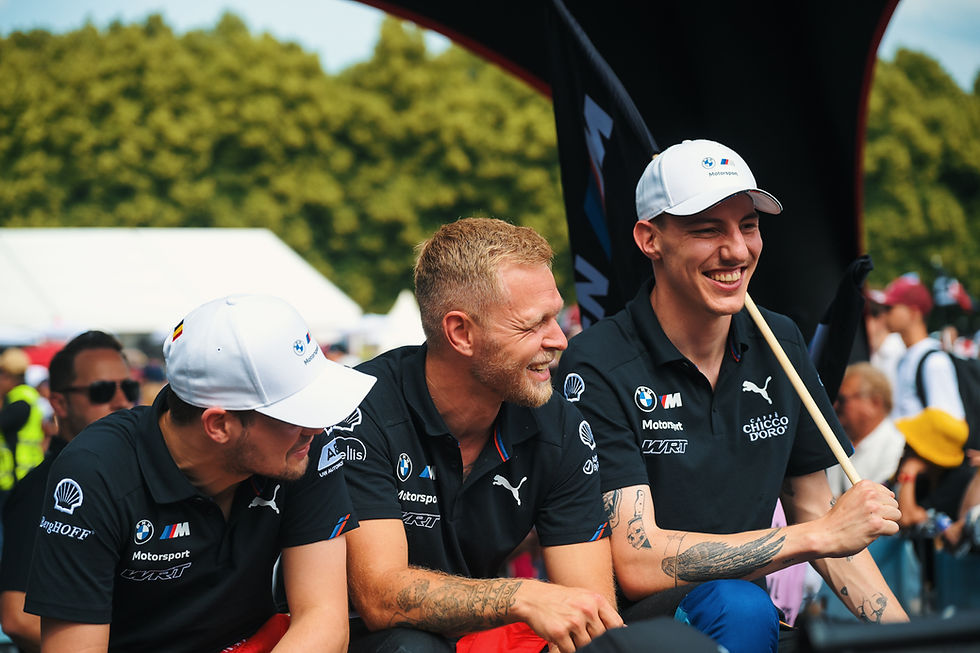
If BMW had an area which needed no tinkering, it was the drivers. Many inside and outside the paddock regard them highly and suggest that they have the ability required to get wins.
The No.15 BMW will once again be driven by Kevin Magnussen, with the former Formula 1 driver beginning his second season with the team, alongside the ever dependable duo of Raffaele Marciello and Dries Vanthoor.
As for the other side of the garage, the familiar trio of René Rast, Robin Frijns and Sheldon van der Linde will share the No.20 car for a third straight season.
About the continuation of their partnership, Van der Linde mentioned that ‘’The good thing between us three is that the car that we need is very similar’’, while also stating ‘’We just get along super well off the track as well, which I think is often underrated and and really adds to it’’.
BMW find themselves ahead of a make or break season, with the need for a marked improvement and a maiden win in the Hypercar class. Whether the upgraded M Hybrid V8 can deliver in the hands of capable drivers across the entire season remains to be seen.







Our family has followed endurance racing for years, and the BMW M Hybrid V8 always catches our eye with its sleek looks and strong potential. Watching the Evo upgrade this season, with the revised aerodynamics and improved driveability, gives real hope for more consistent results across the long races. The team at WRT seems focused on turning things around after some tough stretches last year. It’s exciting to see them aiming for that first Hypercar win with the same solid driver line-ups – familiar names like van der Linde, Rast and Magnussen bring continuity that often pays off. Long weekends tracking the WEC mean plenty of travel and time in the car. When sorting maintenance for our daily driver, honest…