
What makes Portimão special? Revisiting five historic Portuguese Grands Prix

Written by Maham Mir
Formula One has announced that Autódromo Internacional do Algarve, better known as Portimão, will be returning to the F1 calendar for 2027 and 2028 as the Portuguese Grand Prix.

Replacing the Dutch Grand Prix held in Zandvoort, when the event returns, it will be for the first time in six years after it was last held in 2021.
Over the years, the event has been held at various circuits including Estoril which held the last Portuguese Grand Prix in 1996. Events were planned for 1997 and 1998 however were cancelled after planned improvements never took place.
While the current circuit is a more recent addition designed for modern F1 cars, the Portuguese Grand Prix has witnessed some iconic races and victories over the years.

1984 - Close margins in Lauda’s championship win
Appearing as the venue for the season finale for the first time in F1 history, this edition of the Portuguese Grand Prix was held at Estoril. It was the first Portuguese Grand Prix since 1960.
Arriving into the race, Niki Lauda only needed to finish second in order to seal his championship. Comparatively, his rival and teammate Alain Prost needed to win and for Lauda to finish P2 or lower to secure his own title.
With Lauda having qualified P11 and Prost P2, it seemed as though the job was half complete for the French driver arriving for Sunday’s Grand Prix. However, when Nigel Mansell spun in his Lotus and was forced to retire from the race due to issues with his brakes, Lauda moved from P3 to P2 and gained the crucial track position for his championship.
In the end, although Prost did what was required of him and took the chequered flag, Lauda’s P2 finish denied him the championship title for that season. The podium, with the teammates coming 1-2, was completed by Ayrton Senna, a future world champion himself.
Lauda’s championship win was guaranteed by half a point, the closest margin in F1 history. It remains, till date, a record that has yet to be broken.

1985 - Senna’s spectacular maiden win
The expectation of phenomenal racing at Estoril was upheld the following year as Ayrton Senna took his maiden win in wet conditions. The Brazilian driver, who went on to win three championship titles, became renowned for succeeding in wet and treacherous conditions which can be traced back to this race.
Rain had been steadily falling since the start of the day, affecting driving conditions and visibility. For Senna, who had qualified on pole with a gap of 0.431s to P2, it was an opportunity for success in only his second race with Lotus.
The conditions, causing drivers to spin and be forced to retire, saw Senna flourish and steadily pull out impressive gaps to all the drivers behind him. Seasoned drivers such as Keke Rosberg and Prost, who would go on to be one of Senna’s fiercest rivals, spun and were forced to retire from the race.
Although the race was scheduled to be 70 laps, the two-hour time limit meant that Senna took the chequered flag a few laps earlier than planned. On this occasion, only 9 cars crossed the final line with the last runner, Piercarlo Ghinzani six laps down on the race leader and eventual winner.
In the end, Senna led every lap of the race and had a gap of over one minute to Ferrari’s Michele Alboreto who finished P2 and was the only car not to be lapped. Renault’s Patrick Tamblay completed the podium on this occasion.
In only his 17th Grand Prix, Senna flourished where others had faltered and delivered a masterclass performance in wet-weather driving. It would be the first of two race victories in 1985 and the first of 41 victories in his F1 career.

1987 - Prost’s record-breaking victory
If F1 during the 1980s and early 1990s were to be defined by names then Prost’s name would certainly be on that list and nothing proved this more than his victory at Estoril in 1987. Taking the chequered flag in his McLaren-TAG, he broke Jackie Stewart’s record of most Grand Prix victories.
Having qualified in P3 behind Ferrari’s Gerhard Berger and Williams’ Mansell, Prost’s eventual victory seemed entirely unlikely considering Berger led the race from pole for a majority of the 70 laps. Despite a chaotic opening lap which saw nine drivers involved in collisions, only one failed to rejoin the race.
With only three laps remaining in the race, an unfortunate spin from Berger saw him lose the lead to Prost and rejoin in P2. For those final three laps, Prost led the race and took the chequered flag for the 28th victory of his career.
Prost, with this win, broke Stewart’s then-record of 27 victories. The French driver would go on to win a total of 51 races, retiring with the record before it was subsequently broken by Michael Schumacher. On this occasion, Prost also equalled Lauda’s record by taking his 54th career podium.
This victory became the second of his third victories at the circuit. He is only one of four drivers to record multiple wins at the Portuguese Grand Prix, regardless of the venue for the actual event. This list also includes Stirling Moss, Mansell and Lewis Hamilton.

1993 - Schumacher’s beginning
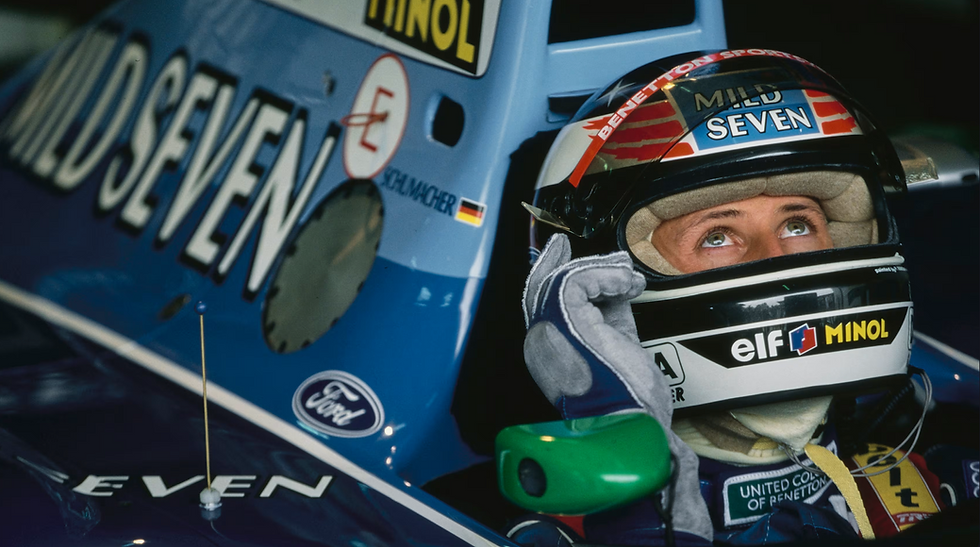
Coming into the event, Prost had already announced his retirement from the sport and yet it was Schumacher’s win that made headlines at the end of that weekend.
Williams locked out the front-row, Damon Hill getting the better of his championship winning teammate by just under 0.2s. Adding into the mix that the faster McLarens were also ahead, Häkkinen getting the better of Senna by a small margin, Schumacher’s P6 position meant a victory was an unlikely outcome.
However, after engine difficulties for Hill which saw him start at the back of the grid, it was all to play for at the front. Split strategies between the one stop and two stop meant that the drivers were focused on covering each other.
After Senna’s engine problems saw him retire from the race, a succession of drivers including Häkkinen and Berger faced issues and were also forced to retire. In the end, only 14 drivers crossed the finish line with Schumacher leading the pack from Prost.
A 2nd place finish was enough for Prost to be crowned champion for the first time but Schumacher’s drive to give him his 2nd victory was championship worthy. The win extended Benetton-Ford’s lead in the Constructors’ Championship, they sat securely in P2 on 72 points ahead of McLaren in P3.
2020 - Hamilton redefines greatness
F1’s last two visits to Portugal occurred in 2020 and 2021, seasons affected by the global COVID-19 pandemic. On both occasions, the event was defined by a single driver, Hamilton, who took one pole position and both race wins.
While both wins came at the end of chaotic races, it was the 2020 victory that made the history books. Hamilton, 14 years after the record was created, broke the long-standing F1 record of 91 victories set by Schumacher by taking his 92nd.
Saturday’s qualifying saw Hamilton take pole despite not leading a single free practice session in the weekend’s build-up. He and former teammate Valtteri Bottas locked out the front-row with Red Bull’s Max Verstappen completing the top three.
The opening lap saw much excitement as light rain cleared the track of any grip. The difference in grip between the soft and medium tyres meant that drivers such as Carlos Sainz were able to capitalise on the occasion. Sainz briefly took the lead of the race while Kimi Raikkonen moved up six places on Lap 1.
Despite a collision between himself and Perez on the opening lap, Verstappen recovered back to his qualifying position of P3 to complete the podium. Bottas finished P2 behind Hamilton with a gap of 25.592s, the second-largest win margin of the season.

What makes Portimão special?
Despite racing in Portugal happening across various circuits in all the years that the country has hosted an F1 race, the magic of Portimão is unrivalled. As a circuit, the layout provides drivers with ample overtaking opportunity.
Despite only making sporadic appearances on the calendar in recent years, the news that it would be returning for a two-year stint was met with positive reactions. For some F1 fans, the return of the circuit is welcome because it is not a street circuit like other recent additions to the calendar such as the Madrid Grand Prix.
Although the announcement was a surprise with other potential venues including South Africa thought to be more likely to host an F1 weekend, Jaime Costa, Chairman and CEO of Autódromo Internacional do Algarve, said: “Portimão’s unique “rollercoaster” layout will challenge the best drivers in the world and create a spectacle that fans will love.
With a new set of regulations set to begin in 2026, promising cars that are better designed for overtaking and racing, there can be no doubt that the Portuguese Grand Prix will have all F1 fans on the edge of their seats.






Comments