
Woman Spotlight Wednesday: Claire Schönborn


Women have played an influential role throughout the history of motor racing. Many have taken to the wheels of motorsport machines, while numerous figures have worked tirelessly on the sidelines in various roles, shaping the motor racing world to the present day.
Woman Spotlight Wednesday aims to take a look at the tales of these superwomen, who have surpassed various hurdles to reach where they are today. In this article, we spotlight a titanic name in the world of rallying, a forerunner for women in motorsport today.
Claire Schönborn’s entry into the FIA Junior World Rally Championship (JWRC) marks a significant departure from her roots in hillclimb racing. While her previous competitive experience focused on status ribbons of asphalt, her involvement in the Beyond Rally programme in late 2024 catalysed a more volatile professional environment.
“It’s been a turning point,” Schönborn said, speaking to DIVEBOMB. “Before that, rallying was something I was dreaming of and was working towards step-by-step, but this programme accelerated everything.
“On the stages, it put me into an environment where I had to learn quickly and perform under pressure. Off the stages, it gave me exposure, structure and access to people who really understand the sport. It made things feel more real - and more possible.”

This pressure peaked during the selection process at the 2024 Central European Rally. When judges could not separate Schönborn from Lyssia Baudet, it forced a final shootout in the snow-clad forests of Sweden in early 2025 to determine her seat.
For a driver still getting used to the world of rallying, the scrutiny was a test of psychological composure and adaptability. “The experience taught me a lot about staying composed when everything is being evaluated,” she reflected.
“You can’t control the outcome, only your performance. It also showed me the importance of consistency, not just one good moment, but delivering under pressure repeatedly.”
Racing against experience
The primary obstacle in the WRC paddock is often the experience gap. Schönborn frequently competed against drivers who had trained on gravel since childhood during the 2025 season. This has created a deficit in ingrained muscle memory that engineering logic cannot easily replace.
She identified this gap in the micro-details of the stage rather than the outright pace. “It’s those instinctive decisions - reading grip levels, adapting to changing conditions, knowing how far you can push without overstepping,” she explained.

“Drivers who’ve grown up on gravel just have that embedded. For me, it’s more conscious and more deliberate. But that’s also motivating, because you can feel it improving rally by rally.”
However, bridging this gap required a deliberate mental reframe. Instead of viewing the high level of competition as a source of stress, she treated it as an accelerated learning tool.
“I try to reframe it as an opportunity rather than pressure. Yes, I’m learning at a high level, but that also means I’m improving quickly,” she said.
“What really drives me is seeing progress - suddenly being able to keep up with such experienced rally drivers. That feeling, knowing that your hard work is paying off, is what really counts and keeps me pushing.”
Learning the language of surfaces
A constant shift in driving logic is required when adapting to the variety of WRC terrains, be it snow, tarmac, or gravel. The tarmac offers predictable grip levels, similar to Schönborn’s hillclimbing background, but gravel has proved the most difficult surface for her to master in her 2025 campaign.

“Gravel has probably pushed me the most so far,” she admitted. “It’s such a different mindset compared to asphalt. You have to be comfortable with the car moving around underneath you and trust the group that isn’t always obvious.
“It forces you to let go of a bit of control, which is something I’ve had to learn. And gravel is not always the same gravel. Greece requires completely different instincts than in Finland.”
Rewriting instincts inside the car
Schönborn’s background as an engineer provides technical clarity, but mechanical understanding does not always solve the problem of instinctive response.
Inside the Ford Fiesta Rally3, she was required to learn how to use a handbrake, a tool she had never used when becoming the first woman to win a German hillclimb outright in 2024.
“It sounds a bit strange, but one thing that definitely took time was understanding how to properly use the handbrake,” she said. “In hillclimb racing, you don’t have a handbrake in your car, so suddenly have to rely on it in tight sections felt completely counterintuitive.
“My instinct was always to keep speed and avoid disrupting the car too much. In rallying, you need to use the handbrake and it’s not just about pulling it - it’s about timing, weight transfer and setting up the car for the exit.”
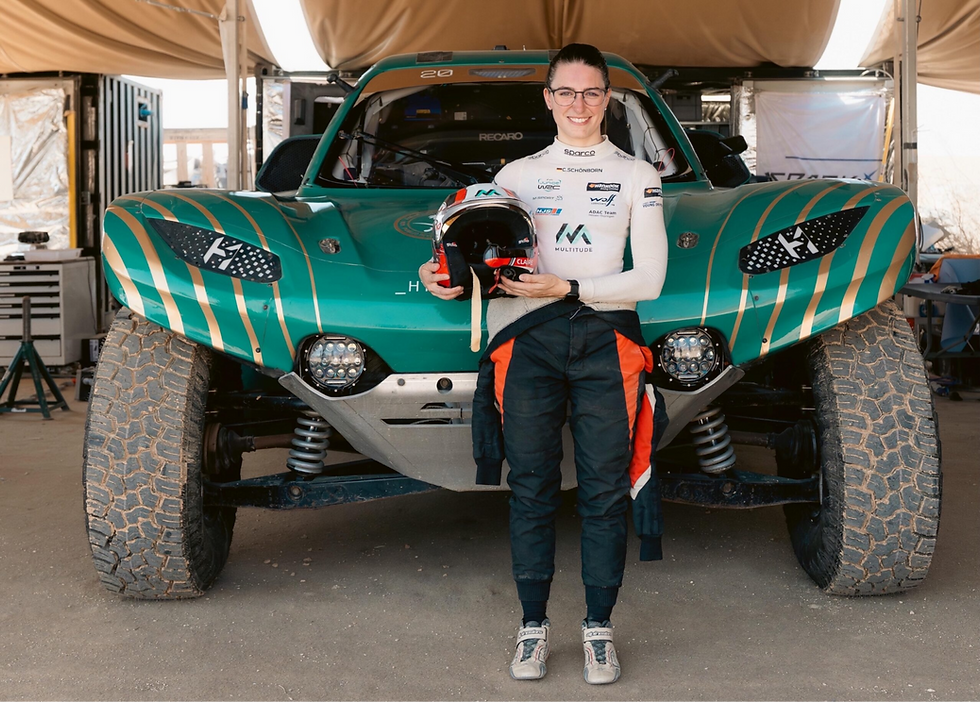
This adaptability is also tested in her role as a reserve driver for Extreme E and Extreme H. The Odyssey 21 electric SUV offers a vastly different mechanical profile compared to the turbocharged, four-wheel-drive Rally3 car.
“The biggest difference is how immediate everything feels in the Extreme H car,” she noted. “The torque delivery is instant, so throttle control becomes even more critical.
“The weight is also higher, which affects how the car moves and transfers load. From an engineering perspective, it’s fascinating because the way you manage energy and traction is completely different, even if the goal, maximising performance, is the same.”
From solo runs to shared responsibility
Transitioning from the KW Berg Cup, where she was the youngest winner, to the JWRC involves moving from a solo effort to a partnership. In hillclimbing, the driver carries the burden of perfection alone; in rallying, they must rely on a co-driver’s pace notes at high speeds.
While working with a co-driver felt natural to Schönborn, she struggled initially with the technical validity of her own notes. “Hillclimbing really teaches you precision. You have one run, and everything has to be right,” she said.

“With the co-driver, I actually felt comfortable quite naturally from the beginning. What was more difficult was trusting my own pacenotes. Writing them was completely new to me, so at first I wasn’t always confident that what I had written would be accurate enough, especially at high speed.
“And on top of that, there’s a mental shift: you’re no longer alone in the car. You’re responsible for two people, not just yourself, and that’s something that took time to fully sink in.”
The invisible 80% of rallying
Schönborn approaches a rally weekend as a complex system where driving speed is only the final component. Her best finish of fifth at the Central European Rally in 2025 was the result of mastering the “invisible” work that happens during the recce.
“There are so many small details: writing pacenotes (in my opinion the most important part, if your recce was good, the rally is done by 80%), managing recce efficiently, making tyre choices based on evolving conditions,” she explained.
“Those are the areas where experience really shows, and where I’ve had to learn quickly. It’s not just about driving fast, it’s about putting together a complete rally.”
Live two lives at full speed
Alongside her WRC career, Schönborn maintains a full-time engineering role with a schedule that creates significant physical and emotional strain. The transition from a professional systems engineer on Monday to a competitive rally stage by Thursday leaves almost no room for recovery.
“Last year was one of the hardest so far,” she said. “Trying to manage everything meant making sacrifices: I didn’t get to see my family and friends much, sometimes only at races. There were moments where I’d leave a rally and be on a plane for work the next day.
“That kind of transition is challenging, both mentally and physically. Overall, there was very little time to catch my breath.”

The motivation to maintain this pace comes from a sense of urgency regarding the opportunity. “What really helped me was having a clear goal and fighting for it every day. I see this as a once-in-a-lifetime opportunity, and for that, you have to give everything and keep pushing, no matter how tough it gets.
“Also, the small moments with my family and friends meant even more because of that, and the support from fans and my supporters gave me the energy to keep going.”
Identity, ambition and what comes next
Schönborn is one of the few women in her field, and is often asked about her role in the sport. She remains focused on the purity of her performance while also acknowledging that visibility is important.
“My main focus is always performance. At the same time, I’m aware that visibility matters, and if my journey can inspire others, that’s something I’m proud of. But ultimately, I want to be judged on what I do behind the wheel,” she said.
Her long-term path remains focused on building as much experience as possible and continuing to grow within rallying. “WRC is definitely a big goal, but I also think there’s value in being versatile. Motorsport has so many disciplines, and each one teaches you something different.”

She concluded with a note of gratitude for the infrastructure that made this leap from the hills to the forest possible. “I am simply grateful for this opportunity that the WRC promoter has created for us women. It was an incredible journey that I had the chance to experience last year, which was anything but a given.
“Therefore, a huge thank you to the WRC promoter and my sponsors and supporters who gave me this opportunity and made it possible.”
For Schönborn, the transition from the solitary precision of hillclimbing to the collaborative endurance of the WRC is more than a career movie. It is a live-action engineering problem.
Every stage is a data set, and every surface change is a variable to be accounted for. While the experience gap remains a mathematical reality, her trajectory suggests that the “deliberate and conscious” approach of an engineer might just be the most efficient way to close it.
In a high-pressure environment of the forest, Schönborn is building a foundation for a long-term future at the pinnacle of the sport.
Edited by Vyas Ponnuri








Comments