
Five Winners, Five Losers: Italian Grand Prix


It was a performance for the ages from our race winner at Monza, but who else had a weekend to remember?
Winner – Kimi Antonelli
It is no exaggeration to say that Kimi Antonelli’s performance at Monza was generational.
No home winner of the Italian Grand Prix since 1966? No worries. Nobody won from as low as his starting position this century? Not a problem. Antonelli won Sunday’s race in a manner many F1 fans will not have seen in our lifetimes.
He may have had a couple of instances of good fortune, not least the early red flag and a cheap second stop under the virtual safety car, but that does not detract in the slightest from the 20-year-old’s romp to the chequered flag.

Starting 19th after an engine penalty, Antonelli gained an average of one position a lap to be in the lead by Lap 18. A ten-lap battle with teammate and championship rival George Russell ensued, with Antonelli’s phenomenal move around the outside at the Della Roggia chicane on Lap 22 the pick of the bunch.
The virtual safety car caused by Lance Stroll’s stricken Aston Martin allowed him to pit for new medium tyres, but Mercedes boss Toto Wolff admitted the team’s numbers suggested there was no way back to the front from fifth in the laps remaining.
No matter what the data said, Antonelli set off on another charge, and despite a lairy moment on Lap 49 as he found the gravel at the first chicane, he made his 26th and final overtake of the race to pass Russell for the lead a lap later.
In doing so, he achieved something that only John Watson, who won from 22nd at the 1983 United States West Grand Prix, has ever bettered in the sport’s 76 year history.
Now leading the championship by 66 points with ten races to go, Antonelli’s nearest challengers – Russell and Lewis Hamilton – both admitted after the race that their title ambitions were gone.
If there were any lingering doubt, we are now surely looking at our champion elect.
Winner – Pierre Gasly
There are very few better drivers in F1 than Pierre Gasly when he is down on the canvas.
The Frenchman has a remarkable knack of achieving his greatest career highs directly off the back of his worst lows.
Following his demotion from Red Bull in 2019, which came just days before the fatal crash of his great friend Anthoine Hubert, Gasly turned in a series of commendable performances for Toro Rosso which culminated in a staggering second-placed finish at that year’s Brazilian Grand Prix.
He went one better less than a year later, winning his first race at the 2020 Italian Grand Prix.

Six years to the day after that famous win, Gasly found himself once again in first place at Monza, albeit at the start of the race rather than the end.
The Frenchman delivered a sensational pole lap on Saturday to score his, and indeed Alpine’s, best ever qualifying result. Not since the days of Renault had the team from Enstone secured a pole position.
This was all against the backdrop of McLaren and Red Bull winning their appeal to the FIA International Court of Appeal to have Gasly’s rescinded time penalties in Monaco reapplied. The decision lost him a podium that for the best part of three months he had believed to be his.
No matter, though, because Gasly’s on-track response in Italy said more than any controversial pitlane speeding penalty ever could.
The Frenchman was fastest in Q1 and fourth in Q2, before being the only driver in the top 10 to execute a tidy Q3 and taking a thoroughly deserved pole position.
Talk about generational results, it was the first pole for a French driver since Jean Alesi in 1997 – also at Monza.
Alpine may have fancied a hatful more points than they eventually scored on Sunday, especially with Franco Colapinto running up in fourth before his early mistake at the Lesmos sent him tumbling down the order.
However, Gasly’s qualifying lap was such a special moment, at the end of such a difficult week, that it is impossible to begrudge him that.
Winner – Yuki Tsunoda
It looks like Isack Hadjar’s wrist injury will keep him sidelined for at least one more Grand Prix, but no matter how many opportunities remain for Yuki Tsunoda, he has certainly already made an impression.
The Japanese driver has filled in superbly at Racing Bulls for Liam Lawson, who himself is covering for Hadjar at Red Bull, and got himself a point to show for it on Sunday.
After suffering a Q1 elimination, Tsunoda gained a couple of places on the grid due to penalties for Antonelli and Lawson, and continued to gain ground after lights out.

Initially under investigation for a starting infringement after he lost his bearings lining up on the grid for a restart, Tsunoda avoided any penalty, although Audi have launched an appeal.
He eventually came home tenth to score a valuable point for Racing Bulls in their fight with Alpine, and even caught the eye of Fernando Alonso, who praised his “phenomenal drive.”
The two-time world champion said he “missed” Tsunoda on the grid and wished him a full-time return for next year. That’s not bad PR for somebody looking for a drive.
Winner – McLaren
Credit is due to McLaren after the team bounced back from a miserable Qualifying to get both cars into the top five on Sunday.
Lando Norris spent all weekend complaining about his brakes and even reported issues once again on his way to the grid on Sunday. Starting down in eighth, he was two places behind teammate Oscar Piastri, who was given a three-place grid penalty for blocking Liam Lawson in Q2.
As the race unfolded, both were involved in lengthy tussles; Piastri slogged it out with Hamilton over fourth place for most of the race and eventually prevailed, while Norris finally broke clear of Gasly’s Alpine and also passed the Ferrari himself.

The pair even fought each other for fourth place in the closing laps, with the world champion prevailing.
Unlike in Hungary and the Netherlands, there was to be no pole position or race win this weekend, but McLaren once again looked competitive and scored a chunk more points than either Ferrari or Red Bull, which at this stage of the season constitutes a good result.
Winner – Arvid Lindblad
Another weekend, another impressive performance by 2026’s only rookie.
Arvid Lindblad reached Q3 for a sixth race in a row on Saturday, and made up a place on Sunday to finish eighth, just one place behind polesitter Pierre Gasly.

If the Frenchman’s lost podium was good news for anybody, it was surely Lindblad’s Racing Bulls, who are battling Alpine for fifth in the constructors’ standings. His haul of four points kept Alpine’s gains to an absolute minimum, and marked a return to the top ten for the rookie after a rare blank at Zandvoort.
Were it not for Hadjar finally proving a stable number two driver at Red Bull, Lindblad would be a shoo-in for that seat in the near future.
Loser – Charles Leclerc
If Kimi Antonelli’s weekend were a perfect ten, Charles Leclerc’s was perhaps the complete opposite.
The Monégasque was fastest in Friday’s FP1, but things unravelled and then some thereafter. Yes, Ferrari’s pace evaporated – more on that below – but from a driver’s perspective Leclerc got it all wrong.

Opinions on the opening lap incident with teammate Lewis Hamilton will no doubt be influenced by the opinion holder’s feelings towards the drivers involved, but any chance the Brit had of victory were all but extinguished by Leclerc’s stern defence of third place which sent him into the gravel.
Whether Hamilton ought to have been on his teammate’s outside or not is a debate in itself, but former world champion turned pundit Nico Rosberg was adamant that by the letter of the law Leclerc ought to have given the Brit more space once he was there.
Any debate over a potential penalty – which given the “Lap 1” nature of the incident was surely unlikely – was null and void by the following lap anyway, as Leclerc’s car speared into the barriers on the exit of Parabolica with a force of over 50G.
The Monégasque cited problems with his throttle, and was arguably unfortunate given Max Verstappen took an even wider line up ahead but did not lose his car in the same way.
However, it is the second time Leclerc has had such an accident at Monza, following his almost identical crash in 2020. For a driver who so clearly possesses such natural skill, it was yet another moment to add to his ever-growing showreel of costly mistakes.
Leclerc now stares down the barrel of being beaten by his teammate over a full season for the first time in his career, and one can only wonder if this may be a factor in his edgy – and arguably selfish – driving that we have seen at the last couple of races.
Loser – George Russell
Kimi Antonelli’s lowly grid spot for Sunday’s Grand Prix was the chance of all chances for George Russell to fight back in the world championship battle.
Excluding retirements, the Brit has only beaten Antonelli in two races all season – Australia and Austria – and had to reverse that trend as a matter of urgency, with a grid penalty of his own due in the next couple of races.
Following antics from Verstappen to disrupt the Mercedes duo’s final runs in Q3, he had to settle for second place on the grid behind Gasly, much to Toto Wolff’s disgust.
This near miss foreshadowed what was to come on Sunday, and truthfully Russell could have done little to stop it.

After taking the lead from the Frenchman, the man from King’s Lynn would have expected to romp clear, but given the advantage afforded to drivers in the slipstream of cars in front, he was never able to do so.
One thing Russell could absolutely not have countenanced, though, was seeing his teammate – who had started 17 places behind him – in his mirrors by Lap 13.
Switching to hard tyres under the red flag, as opposed to Antonelli, who had to fit the less durable mediums, would have played into Russell’s hands by the chequered flag had the virtual safety car on Lap 28 not intervened.
However, once racing resumed with the Italian in fifth and on fresh rubber, Russell soon became a sitting duck with pace around a second a lap slower than his pursuer. The eventual overtake was inevitable, and may have proved terminal to the Brit’s title hopes.
Loser – Ferrari
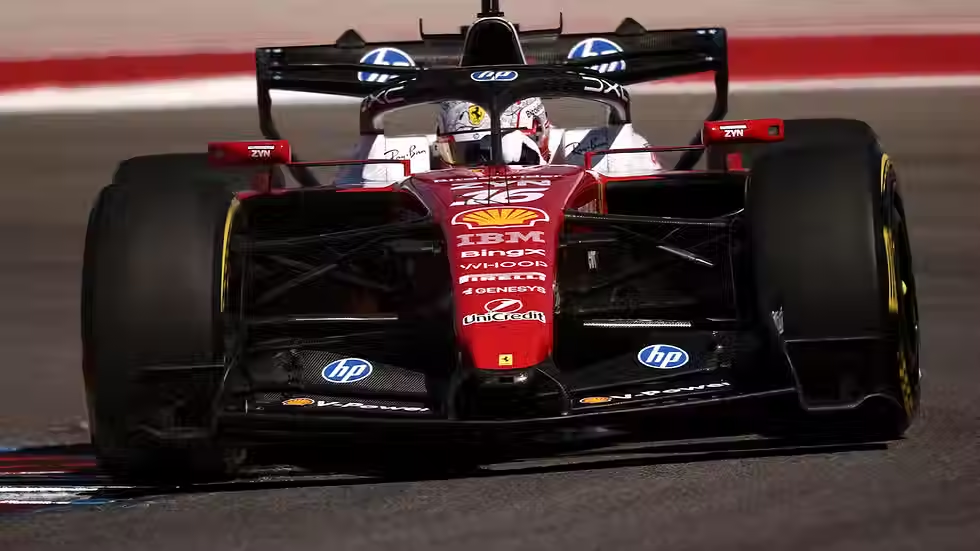
As disappointing as Charles Leclerc’s lap-and-a-half of action on Sunday was, it was a chastening weekend for the team as a whole. Lewis Hamilton reflected on the weekend as “devastating”.
After leading FP1 with both drivers, the SF-26’s pace gradually eroded over the weekend, to the point where Leclerc and Hamilton made it through to Q3 by 0.008 and 0.001 seconds respectively.

On Sunday, Hamilton briefly showed good pace to recover from tenth after the restart, but soon began to complain about his medium tyres. Ferrari’s strategy, which has long been an achilles heel, proved so once again as the team passed up the opportunity to put the Brit on a new set of hard tyres during the virtual safety car.
The seven-time champion soon faded in his battle with Piastri, and lost further positions to Norris and the charging Antonelli to come home in sixth for his joint-worst finish of the season.
However, the main takeaway from the weekend is the team’s inability or unwillingness – it is as yet unclear which – to introduce rules of engagement between its two drivers.
The culture of Ferrari is unique in F1 – more so than anywhere else in the paddock do the drivers drive for the team, not themselves. In the aftermath of the Dutch Grand Prix, during which both Hamilton and Leclerc were aggrieved by the other’s conduct, surely both should have been sat down by Fred Vasseur to remind them of that fact.
The result was what happened at the opening chicane, when both drivers touched yet were able to carry on, albeit with Hamilton compromised. Whoever was more at fault is almost beside the point – with clear guidelines to follow, one of them would have known when to yield.
While it is unlikely to have any consequence in either the drivers’ or teams’ standings by Abu Dhabi, Vasseur needs to get his house in order.
Loser – Aston Martin
Despite Aston Martin’s catalogue of promising upgrades before the summer break, Monza exposed an inescapable truth. You cannot hope to be competitive in F1 with a sub-standard engine.
The Silverstone team clawed back over a second a lap of performance in Hungary and Zandvoort, with an almost entirely new aerodynamic philosophy. Such was the quality of the upgrades that Fernando Alonso finished a season-best ninth in the Netherlands.
However, the less power-sensitive nature of those circuits masked the deficiencies of the team’s Honda engine.

At Monza, the fastest circuit on the calendar, Alonso and Stroll were once again the slowest two drivers in Qualifying, over 3.3 seconds down on Gasly’s pole time.
For the third time this season neither finished the race, although the power unit was not responsible for either retirement. Stroll withdrew with a suspension problem and Alonso was forced to stop with damage.
The Spaniard also said during the weekend that he backs Honda “100%” to turn things around.
As it stands, though, of the remaining tracks this season, perhaps only Singapore and Mexico City will be particularly forgiving towards Aston’s lack of power.
Adrian Newey may be a design guru, but his genius can only take the team so far as long as the engine is so far off the pace.
Loser – Williams
Carlos Sainz and Alex Albon’s recent contract announcements offered a rare glimmer of positivity for Williams during what is otherwise a pretty miserable run for the team.
Team Principal James Vowles was vocal for a couple of years about how his team was building for something big in 2026, but after an underwhelming start to the season his squad has only fallen backwards.
Sainz’s bizarre lunge on his teammate at Zandvoort coupled with Albon’s complete loss of pace over recent races paints a picture of two drivers who are lost and frustrated.

The pair qualified 15th and 18th respectively at Monza, finishing 13th and 17th, with no sign of improvement.
They have now gone seven races without a point between them, and have by some distance the slowest of the Mercedes-powered cars.
Vowles was clearly banking on the power unit moving his team up the grid, but the FW48 is clearly still lacking in almost every other department.
Edited by Marit Everett






Comments