
Formula One Preview: Japanese Grand Prix

Updated: Mar 28
Written by Peter Johnson, Edited by Benjamin Crundwell

After a gripping double header to kickstart the new season, Formula One is staying in Asia, to visit one of the greatest tracks of them all.
Circuit guide
You can identify the great racetracks from the good by the fact that their corners are named, not numbered. Suzuka is one of just six circuits on the current calendar to which this applies.
The Esses, Degners, Spoon Curve and the legendary 130R are all corners with their own iconic status within Formula One, fused together to create one of the most special circuits of them all.
Suzuka first hosted a Grand Prix in 1987 and quickly found its place in F1 folklore thanks to Ayrton Senna and Alain Prost, who locked horns in two infamous title deciders in 1989 and 1990.

The circuit has since gone on to host a total of 35 races, ranking it 13th in the all-time list. The sweeping downhill right-hander of Turn 1 blends into the ever-tightening Turn 2, a fiendish opening to the lap which sets the tone for everything that follows.
The iconic Esses of Turns 3 to 7 form one of the most fearsome sections of racetrack on the planet, where downforce and grip are important, but bravery is essential.
The right-handed pair of Degners completes the first part of the lap, before the drivers sweep under the crossover - yes, Suzuka is also the only figure-of-eight circuit on the calendar.
The left-handed hairpin follows, before some brief respite through the gradual Turn 12 spits you out at the devilish Spoon curve at the bottom of the track. A good exit is essential, with a drag up the circuit’s longest straight to 130R following.
The flat-out left-hander of 130R is the circuit’s ultimate test of bravery, with Fernando Alonso’s legendary pass around the outside of Michael Schumacher in 2005 regarded as one of the sport’s greatest-ever overtakes.
A tricky little chicane and long right hander complete a lap of Suzuka, and then the drivers have to do it all again a further 52 times.

Weather forecast
Friday at Suzuka is forecast to be cloudy and mild, with temperatures between 13 and 17 degrees Celsius.
A 35-55% chance of rain across Saturday may spice up Qualifying, while it should be dry again for the race. However, with lights out at 2pm local time (06:00 BST) and rain forecast from around 5pm, it could be touch and go in the closing laps.
Major talking points
Wheatley leaves Audi: The biggest story since the Chinese Grand Prix is Jonathan Wheatley’s shock departure from Audi. The former Team Principal had not necessarily enjoyed the same authority as other bosses up and down the paddock, sharing responsibility with Mattia Binotto, the Head of Audi’s F1 Project, and has reportedly stepped away for “personal reasons”.
Binotto, who was Ferrari Team Principal between 2019 and 2022, will now resume the role, while Wheatley has been strongly linked with Aston Martin, who themselves are now reportedly recruiting amidst rumours Adrian Newey has turned his attention specifically to the car’s performance.

Suzuka success for the Scuderia?: A theme of the first two rounds of the season has been the superior performance of both Mercedes and Ferrari, although both teams appear to excel in different areas.
While Mercedes’ engine, which is clearly the strongest on the grid, offers a significant power advantage, Lewis Hamilton and Charles Leclerc have been able to remain in touching distance due to Ferrari’s cornering speeds.
Given the twisting nature of Suzuka, with its Esses often regarded as the toughest section of race track on the calendar, will Ferrari have enough aerodynamic performance to shift the balance in their favour?
Impromptu Spring Break: Given the recent political developments in the Middle East, Formula One Management reached the only decision it could in announcing the cancellation of April’s Bahrain and Saudi Arabian Grands Prix.
How this helps or hinders any of the teams remains to be seen, although Andrea Stella has said the five-week break will not affect McLaren given the team’s development programme was scheduled months in advance. Teams like Aston Martin, for example, may be a little more welcoming of the break.

New deputy at Mercedes: It’s a slightly less significant staffing change than Wheatley’s Audi departure, but Bradley Lord’s promotion to Deputy Team Principal is still noteworthy. Lord joined the Brackley team in 2013 as Communications Manager and has since held the roles of Team Representative and Communications Officer. He will now officially be second in command to Team Principal and CEO Toto Wolff.
McLaren’s malaise: It has been a disastrous start to the season for McLaren, with Lando Norris and Oscar Piastri enjoying just one Grand Prix start between them in the first two rounds. An alarming lack of pace relative to the top two teams was evident in Australia, while an apparent slight improvement in China counted for nothing when neither driver was able to take the start.
The constructors’ champions remarkably still sit third in the championship, but significant early points losses for Norris already make it likely that 2026 will be just the fifth season since 2010 that a competing champion has not managed to defend their title.
Past Japanese Grands Prix
The Japanese Grand Prix was a relatively late entry to the Formula One World Championship, with Fuji hosting the first two events in 1976 and 1977 before a ten-year wait until the sport returned to the country, this time at Suzuka.
The first-ever Japanese Grand Prix in 1976 could have been the only Japanese Grand Prix and it would still have gone down in history, as James Hunt defeated Niki Lauda by a solitary point to claim his only world title.
Lauda had previously suffered a life-changing accident in the wet at that year’s German Grand Prix, and facing similar conditions in Japan pulled over in the pit lane and refused to continue. That race, and indeed the legendary season as a whole, were immortalised in Ron Howard’s 2013 movie Rush, starring Daniel Brühl and Chris Hemsworth.
For decades, the Japanese Grand Prix continued as it started - in 39 races at both Suzuka and Fuji, 13 have crowned that season’s world champion.
The 1989 and 1990 races saw Ayrton Senna and Alain Prost lock horns, both metaphorically and physically. A crash at the final chicane in 1989, from which Senna managed to continue before being disqualified, ruled the title in Prost’s favour.
In 1990, the Brazilian, unhappy about his pole position being on the dirty side of the grid, instigated a first-lap collision with his rival to hand himself the championship. Facing the thunder in his post-race media duties, Senna uttered his immortal line, “If you no longer go for a gap that exists, you are no longer a racing driver.”
Drivers would continue to go for gaps that existed and win world championships for several years at Suzuka, with Damon Hill famously winning his only title at the circuit in 1996.
In 2005, Kimi Räikönnen mounted a logic-defying comeback from 17th on the grid, sweeping around the outside of Giancarlo Fisichella to win for McLaren.

The most recent title decider in Japan came in 2022, Max Verstappen won a rain-soaked race to steal his second title amid much confusion as nearest challenger Charles Leclerc received a post-race penalty.
The Japanese Grand Prix has since been brought forward to a spring slot, meaning the races are slightly less decisive, but no less dramatic.
Verstappen won for the fourth time at Suzuka last year, holding off the fast-charging McLarens of Lando Norris and Oscar Piastri to win in his inferior Red Bull.
It would be a shock to see either team challenging for victory 12 months on.
Drivers to watch
George Russell: The championship leader hasn’t got the best record in Japan, recording his highest finish at Suzuka last year with fifth place. A strong showing from Russell this weekend, on a circuit where Ferrari may fancy their chances, would offer further support for his and Mercedes’ title prospects this year.
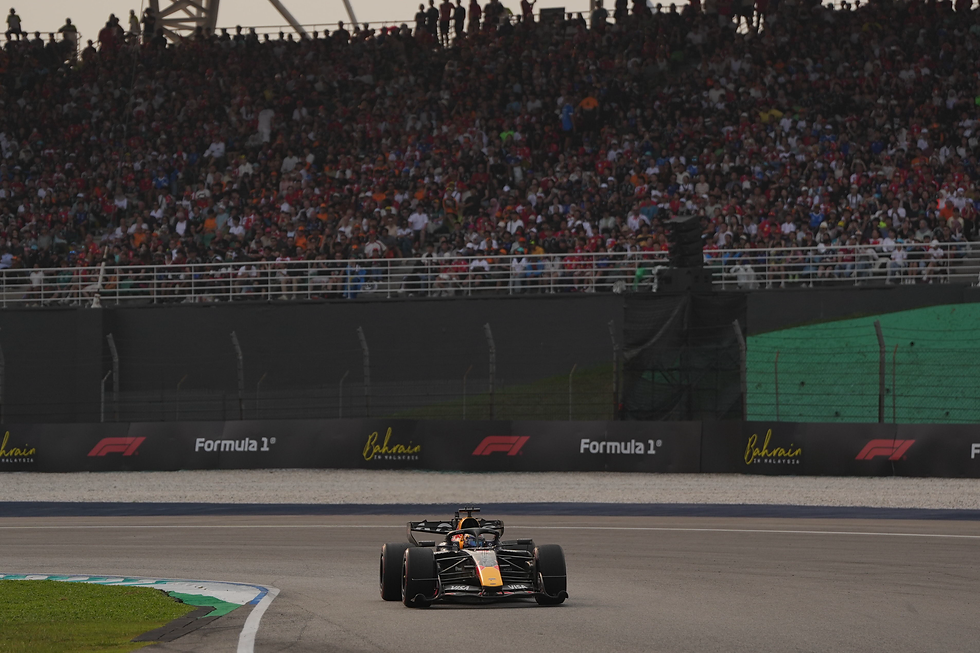
Max Verstappen: 2026 obviously hasn’t been kind to Verstappen or Red Bull so far, but the Dutchman has taken both pole and race victory every year at Suzuka since 2022, when he sealed his second world title.

Arvid Lindblad: The British rookie has impressed in his first two race weekends with Racing Bulls, but has never previously tackled Suzuka. One of motorsport’s greatest challenges, will the 18-year-old conquer it?
Session times
Remember the clocks go forward by an hour heading into Sunday - make sure you don’t miss the start of the race!
Practice 1 Fri 02:30 - 03:30 UKT
Practice 2 Fri 06:00 - 07:00 UKT
Practice 3 Fri 02:30 - 03:30 UKT
Qualifying Sat 06:00 - 07:00 UKT
Race Sun 06:00 BST*
*05:00 if your alarm doesn’t factor in the clock change!




Comments