
IndyCar drivers hail “character” of track ahead of bumpy Washington D.C. “street fight”


Drivers are relishing the nature of the Washington D.C. streets, as IndyCar’s unique Freedom 250 Grand Prix weekend got underway on Saturday morning.
The defining takeaway from the opening practice session on the 1.7-mile (2.74-kilometre), seven-turn circuit was the bumpiness of the track, which navigates the National Mall and boasts striking views such as those of the Washington Monument and United States Capitol.
“It’s got a lot of character, man. It’s obviously a very short layout [but] it was exciting out there,” said Arrow McLaren’s Pato O’Ward after a wet-to-dry first session, which was led by Andretti Global’s Kyle Kirkwood. “I’d say the biggest factor that we were considering - but obviously didn’t really know how it was going to be - was the bumps.
“We’ve got quite a bit of bumps on the exit of Turn 1, quite a bit of bumps going into [Turn] 2, the straightaway. That’s taken over a little bit of what the characteristic of this track is. There’s certain ones that are right where maybe the car doesn’t love it all the time. That’s a little bit of probably what we’re going to be working around.”
Championship leader Álex Palou also earmarked Turn 6 as being particularly bumpy, with many of these bumps being unavoidable. That considered, O’Ward suggested Saturday’s pair of practice outings will be especially important to gauge the most troublesome locations.
“That’s huge for us, just knowing,” the Mexican driver said. “There’s quite a few that really throw the car into a hard limiter in the shift. That can be very damaging to the speed of the straightaway. You need to be quite aware of where to place the car.
“But also [with] ride heights, we were one of the cars [that] went out like: ‘Oh my God, the front is way too low. We have to start raising the car.’ The strikes were extremely aggressive. It’s about getting all the small details right.”
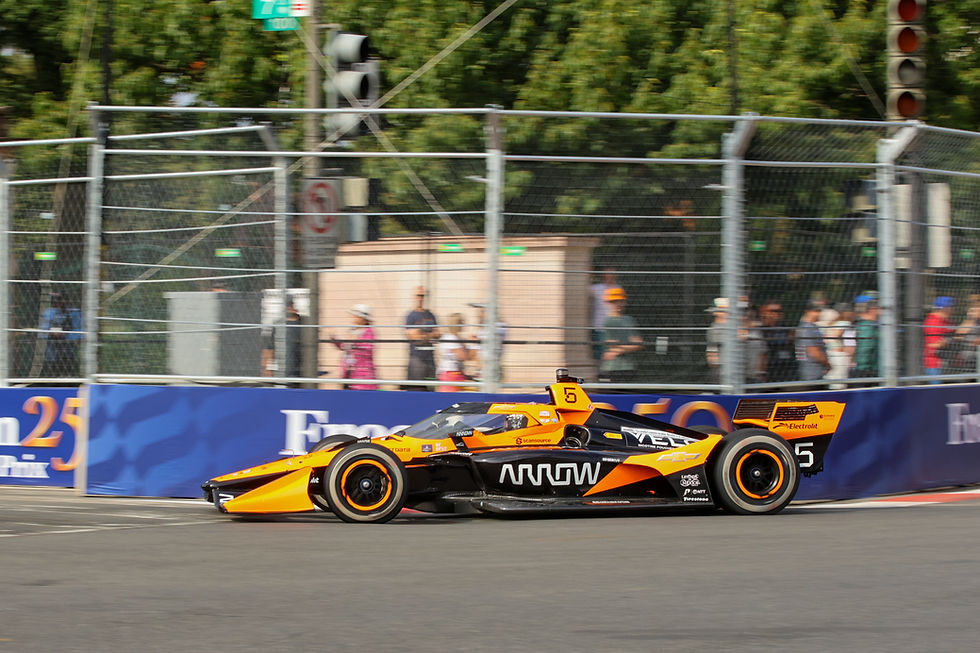
It is not unusual for IndyCar’s street circuits to be defined by their roughness, which drivers often praise as part of tracks’ character. While last weekend’s new street circuit in Markham, Ontario had been repaved, March’s inaugural Grand Prix of Arlington also featured a particularly bumpy surface, which caught some teams off-guard.
There will now be a balance to strike as teams set their cars up for the weekend with a goal of avoiding the most aggressive bumps without sacrificing lap time.
“Tough. I don’t know,” Palou said on the topic of car setup. “I think the bumps are so big, there’s not much you can do. You need to have a car that is alright over bumps, that it’s not trying to kill you every time. Once it’s manageable, you just need to go over them and try and make the car as fast as possible. It will be fine. We just need to find the best driving lines.
“Going to try to see if we can get a better balance in the corners, not focus so much on the bumps. They’re not going to disappear. If you move a little bit on lanes, might be a little bit better. But it’s not going to completely go away from that. Same for everyone.”
Chip Ganassi Racing’s four-time champion believes the presence of the bumps could enhance the racing product on Sunday, with several drivers finding the runoff areas in Practice 1 owing to bumps on corner entry. The multiple straights into heavier braking zones also provide enticing overtaking opportunities in their own right.
Palou is enjoying the challenge from a driving perspective on a push lap, too, contrary to some skepticism ahead of the weekend.
“It’s a blast, super fun,” he said. “Massive bumps are going to spice things up. I think it’s actually going to create good racing just because it’s quite tough to go over there and have good braking and also have good traction when the bumps are on exits.

“I think there’s quite a lot of passing places. Turn 2, you can brake deep - super deep; that could be a passing opportunity. I think Turn 3 and 4, it’s too optimistic. Heading to Turn 5, that’s for sure a passing place. Turn 6, no. Turn 1, probably. [So] here’s two really good chances with Turn 2 and Turn 5. There could be an extra one if you go heading to Turn 1.
“I think there’s going to be a lot of action. I see that just having a wide track, it’s just going to allow us to have more passing than, for example, Detroit. Here, if you’re not going to have the pace, they’re going to overtake you.”
Extended to 250 miles across 147 laps, Sunday will mark the second-longest temporary-circuit race in IndyCar’s history. While qualifying up front will be important to avoid mid-pack incidents at the race start, there is ample time for drivers to recover through the field in what may become something of a race of attrition.
There is an unknown element with strategy across that distance and its greater number of pit stops, while O’Ward theorises that managing use of the overtake-assisting push-to-pass will also be critical, given drivers only have 150 seconds at their disposal across the 147 laps.
“Oh man, long race,” he said. “Obviously the strategies are going to be all over the place. You don’t really know what to expect the strategy to look like. Is traffic going to be easy or difficult to handle? How much time are you going to lose if you get stuck behind a slower car? All those things will then lead to the strategy decisions that we make.

“It’s going to be quite interesting to see how people strategise their push-to-pass because we’ve only got 150 seconds of push-to-pass and we basically have 150 laps. If you use it every lap, you only have one second per lap-ish. You definitely don’t want to do that.
“You also want to attack but also want to save some towards the end. There are quite a lot of straightaways where you will see a lot of passing opportunities. It’s going to be a good race.”
Naturally, given the bumps and that temperatures are expected to rise to over 80F (almost 30C), physicality will also be part of the ‘survival’ element to the race.
“It’s humid out there, man,” O’Ward said. “We’re going to lose a lot of water. We need to be well-hydrated. It’s the lightest I’ve weighed in all year right now at the weigh-in. It’s going to be physical [with] every challenge that a street course usually throws at you: it’s bumpy, you got a bunch of sweat inside of the helmet [and] you’re bouncing up and down in there.
“It gets pretty rough, gets pretty aggressive. I expect it to be a tough race. I’m ready for the street fight, man. I train really hard when I’m home and I train really hard in the off-season. I feel like these situations are what I try and prepare myself to be able to withstand.”







Comments