
Rossi standout as lessons intensify at Phoenix IndyCar test
- Archie O’Reilly

- Feb 19
- 5 min read

Alexander Rossi dominated the second day of IndyCar’s two-day test at Phoenix Raceway, topping both sessions on Wednesday, including an Ed Carpenter Racing (ECR) 1-2 ahead of Christian Rasmussen in the afternoon.
The Ed Carpenter Racing driver’s pace-setting 174.444 mph and 174.542 mph laps were the two quickest of the test as speeds ramped up on the second day of running. Team Penske’s David Malukas led Tuesday’s outing with a 172.605 mph quickest lap but all bar Juncos Hollinger Racing (JHR)’s Sting Ray Robb improved their best time on Wednesday
“We got through everything we wanted. And when you can do that, it’s a good day,” said Rossi, one of only five current drivers to have raced at Phoenix in IndyCar. “Christian’s car is also strong so there’s nothing more I could ask for. We have a good baseline and it feels like we are on top of it.”
In the morning order, Rossi was followed by Penske’s Josef Newgarden and Chip Ganassi Racing (CGR)’s reigning champion Álex Palou as the only drivers to break the 174 mph mark in the test. Malukas, Arrow McLaren’s Pato O’Ward and Andretti pair Kyle Kirkwood and Marcus Ericsson edged into the 173 mph range and rounded out the top seven.
Rasmussen, Andretti newbie Will Power and Penske’s Scott McLaughlin rounded out the morning’s top 10. Rahal Letterman Lanigan Racing (RLL)’s Mick Schumacher was the pick of the rookie trio as he continues his oval adaptation, rising to 16th in the order.

Rain arrived in the afternoon as the second intended-three-hour session was set to get underway. A shortened two-hour session was ultimately designated, though it continued to be truncated by occasional drizzle and a rearwards crash in Turn 4 for Ericsson, who climbed out of his No.28 machine without assistance, suspecting a mechanical issue.
Following leaders Rossi and Rasmussen, Palou and Power were the only other drivers to surpass a 173 mph lap in the afternoon. Behind them, Meyer Shank Racing’s Marcus Armstrong and Felix Rosenqvist sandwiched CGR’s Scott Dixon, with Arrow McLaren’s Nolan Siegel, RLL’s Graham Rahal and JHR’s Rinus VeeKay completing the top 10.
Power takes the crown for most laps logged across the entire two-day test with 259, followed by Andretti teammate Kirkwood (242) and CGR’s Kyffin Simpson (234). With only 121 laps of the mile-long oval on the board, AJ Foyt Racing’s Santino Ferrucci clocked the lowest tally, 34 laps behind Armstrong’s total of 155.
A “messy” second test day
With rain delaying the afternoon session by an hour-and-a-half, then Ericsson’s crash and more moisture causing another 38-minute stoppage and dampness curtailing the session eight minutes before its planning conclusion, it was a disrupted final period of running.
“In the end, it was kind of messy,” Rosenqvist said. “We didn’t end up doing half of the stuff we wanted to do. But it’s probably the same for everybody. We pushed some of our stuff really late and got kind of screwed by it. But I think we got plenty of running. Two days is kind of rare that we’re getting so we feel pretty happy about our programme.”
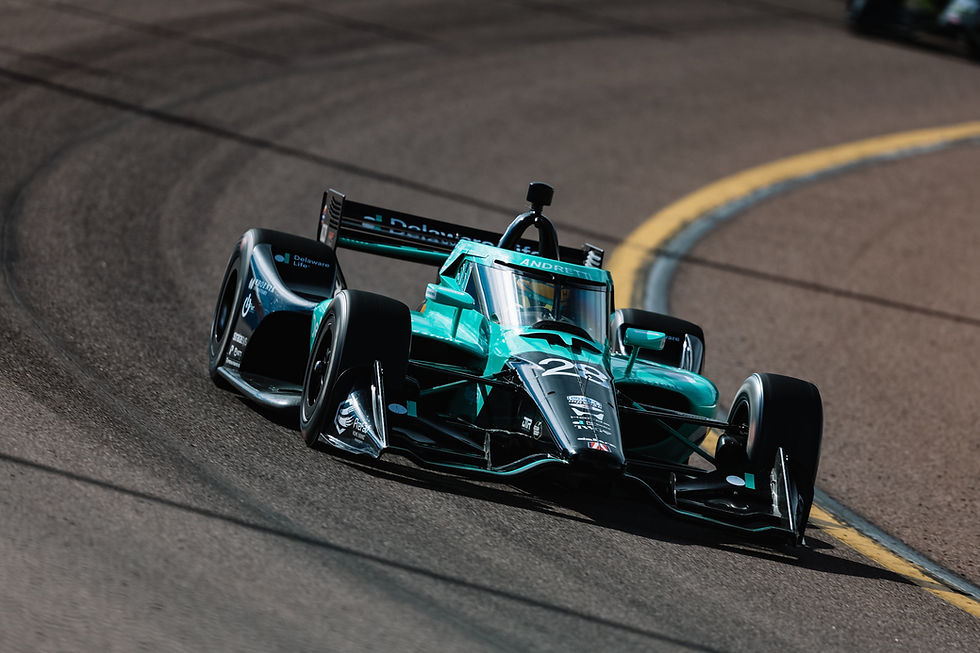
Weather was a hot topic at the climax of the test, with Rosenqvist assessing that the changing conditions was one of the main takeaways from two days on the desert oval.
“We learned that the weather affects a lot,” he said. “Even from the morning to the afternoon, which I thought was seemingly similar wind, similar-ish track conditions, the track really flipped around. Now it seems like everyone was struggling in [Turns] 3 and 4, not [Turns] 1 and 2, which had been the case for two days.
“You’re just trying to have a car setup that is consistent and doesn’t change so much on you, depending on wind and weather. The time that you get from here to the race [on 7th March], you’re probably going to be able to discover a lot of things, looking at data and stuff. It was good to definitely be here and learn some things and come back.”
What could the race look like?
With IndyCar not having raced at Phoenix since 2018, which was before the addition of the aeroscreen and further added weight of the hybrid system, there is uncertainty surrounding how the track, which has since been modified in parts, may race. And even after the test, much of that uncertainty remains.
“I don’t know… I think probably similar to most short ovals the last two years,” Rosenqvist said. “After we started running the high line, it seems like it could appear in the middle to the end of the race. When everyone starts on new tyres, it’s going to be hard to make anything work unless people start running it immediately.

“But I think as the race goes on and you have people on different strategies, if there’s a two-second [tyre] delta, you’re going to have so much more speed than other guys so you pretty much have to make the other line work, especially in [Turns] 1 and 2. [Turns] 3 and 4, I’m not sure; it’s like a 90-degree so it kind of messes up your radius by going wide.”
With temperatures expected to be warmer when IndyCar races at Phoenix in two-and-a-half weeks’ time, there is at least an expectation of tyre degradation, which has factored into some of IndyCar’s better short oval races in recent years.
“There is definitely deg,” Rosenqvist said. “In this [cooler] condition, it’s probably a second, second-and-a-half. But I wouldn’t be surprised if we had a two-second delta from new tyres to old tyres. The new [build of wider right-front] tyre was interesting. It’s a bit harder to feel; it feels pretty stiff. I think that one probably won’t deg a lot - but the other three will.”
“You can take a big swing”
The early impression is that it is a challenge to get car balance right at Phoenix, combining changing weather conditions and two drastically different ends to the track. But there is a unanimous gratitude for the opportunity to have tested before IndyCar returns to the Arizona-located track, eight years on from its last race.
“Nobody has been here in a long time so having the opportunity to try tonnes of things across all three cars is super helpful,” Siegel reflected from an Arrow McLaren perspective. “You get to a race weekend and sometimes you’re hesitant to take big swings at things and try more experimental items.

“You don’t have the time to get yourself way out of the window and then work your way back, whereas [in testing] you can take a big swing at something and if it doesn’t work, you come back and try something else. It allows people to get a little bit more creative. We found some big, big things and got a good chunk better as a team over these two days.”
Siegel is one of the 20 drivers with no prior IndyCar experience at Phoenix, but he has quickly realised why it was a staple of schedules past.
“It’s a very fun track to drive, very unique. It’s a challenge setup-wise, a challenge driving-wise,” he said. “This is kind of the heart of IndyCar racing, these short ovals. It’s going to be a fun race and it does definitely feel like it’s back to the roots of the series, which is really cool. It just feels like this is what IndyCar was meant for.”



After such adrenaline-filled days, I like to take a break from the track and check the crypto market — it's a quick way to switch my brain and feel the same drive from growth. That's why I often visit https://paybis.com/buy-bitcoin-with-neteller/ — I buy Bitcoin through Neteller in 15 minutes without any hassle, and it's like a successful lap: fast, reliable, no surprises. Now I'm waiting for Rossi to finally win the oval again — I feel like 2026 will be his year.