
Why an early end to the F2 season has greater consequences for the championship’s future


With reports of Formula 2’s finale in Abu Dhabi still in doubt due to conflict in the Middle East, the championship faces an unexpected setback, one it may not have prepared for at the beginning of the season: A premature ending, a champion decided in retrospect.
If the 2026 F2 season ends as early as predicted, with its final rounds in Qatar and Abu Dhabi facing the axe, it can have wide-ranging consequences for the championship’s future.
As the drivers battle to claim the 2026 Formula 2 championship, the consequences of an unfinished season could extend far beyond who holds the title.
With the final decision still looming, if the FIA officially announces a premature end to the F2 season, it will impact the larger picture of the driver-development ecosystem, raising questions about whether contingency plans should have been put in place for such circumstances.
Effects of a title battle that could have been
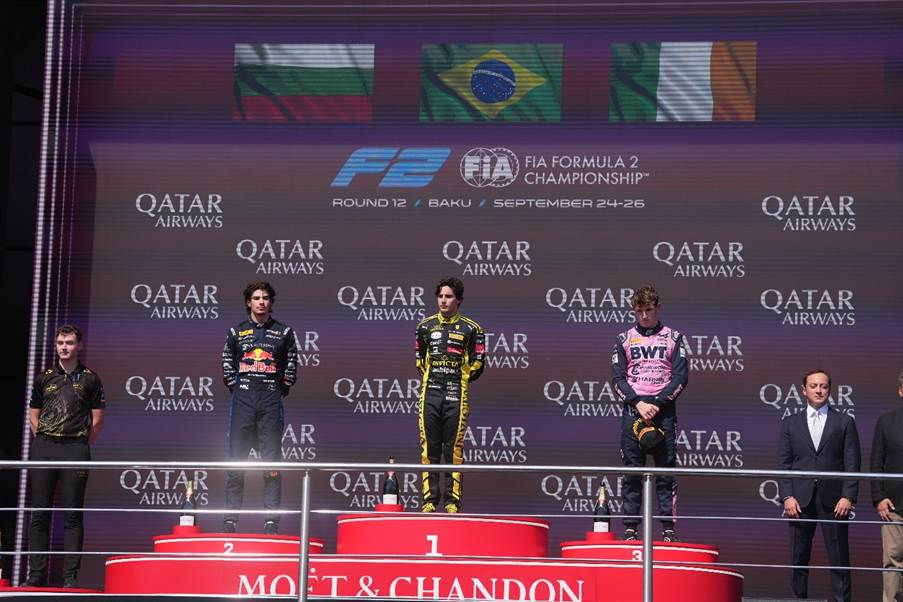
Current leader and Ferrari Junior Rafael Camara may be crowned the 2026 F2 champion. The Brazilian climbed to 207 points in Baku, taking a seven-point lead over Red Bull junior rival Nikola Tsolov, who now sits on 200 points.
After leading the championship for just under 12 weeks following an impressive streak of podiums, including three back-to-back wins after the Spielberg Feature Race, Tsolov may have to settle for second best once again after losing out to Camara last year in the Formula 3 championship.
Trailing close behind is Alex Dunne, who is a current junior driver in the Alpine Academy. After finding himself back on top in Baku, Dunne has surged to being a proper contender to the two leaders in the championship.
After securing the win in Feature Race 1 and podium finishes in the Sprint and Feature Race 2, the Irishman has climbed within 18 points of the leader. With such positive trajectories for Tsolov and Dunne, four races could change everything.
For Tsolov and Dunne, losing the championship could mean more than just losing the championship title. F2 championship winners are prohibited from competing in the series the following year. For drivers such as Tsolov and Dunne, it can increase pressure to secure promotion and offer them a permanent seat for the following season.
While it’s uncertain whether the Bulgarian or Irishman will make their move to Formula 1 next year, a championship title would have potentially strengthened their chances of solidifying a promotion come 2027.
With Alpine’s long list of reserve drivers, and Racing Bulls’ lineup undetermined, a championship title in F2 may have given them both a strategic edge in claiming either a reserve or full-time driver seat in the 2027 F1 season. We saw this with Leonardo Fornaroli joining McLaren, and Oscar Piastri joining Alpine as reserves after their respective F2 titles.
Missed Super Licence points for the best of the rest
While there is a championship to debate over, F2 also serves as a critical step towards obtaining an FIA Super Licence. These points are accumulated over a set three-year period throughout a driver’s racing career, and help them move closer to obtaining the dream of racing in Formula 1.
A Super Licence is an important qualification that signals the driver is ready to compete on the big stage.
With the 2026 season possibly ending early, drivers are unable to use the last four races to better their championship standing, directly impacting the amount of Super Licence points they take home come the end of the season.
Campos driver Noel Leon could potentially finish sixth this year. With only four points separating him and Dino Beganovic, the premature season ending leaves him unable to fight for fifth in the driver standings.
Fifth is awarded 20 points, while sixth is only awarded 10. For Leon, who is currently sitting on 15 Super Licence points, the potential 10-point difference may be detrimental come 2027 when points from the previous season leave his three-year eligibility window.
Then there is also a ferocious fight for the lower reaches of the top 10, with as many as three drivers level on points, and fighting over precious Super Licence points that can prove crucial going into the next stage of their careers.
No exposure for the drivers within a growing series
Earlier this year, Formula 2 reported exponential results in viewership and engagement for the series. F2 is broadcast in over 170 territories, with its reach extending to almost 60 million viewers, simultaneously reporting a social media growth of 3.5 million followers across all platforms.
As costs increase for F2 year-on-year, visibility will continue to prove an important stepping stone for a driver’s opportunity to obtain sponsors. Broadcasts help showcase driver talent, allowing them to prove their potential to onlookers, and therefore secure appropriate funding to progress up the motorsport ladder.
However, it’s not only sponsors who are watching these race broadcasts. F2 races quickly become platforms for driver academies, team principals, managers and teams within alternative racing categories to better understand existing driver talent and scout new drivers that could form part of future team lineups.
In a championship where every overtake, podium, and race matter, the elimination of the final four races removes four opportunities for drivers to change or better the trajectory of their careers.
Why not do it twice?
The introduction of the North American rounds in Miami and Montreal earlier this year to replace the Bahrain and Saudi Arabian rounds demonstrates that F2 is capable of replacement rounds with appropriate planning.
If contingency planning had been considered earlier in the season, could another suitable venue have provided an alternative host for F2’s final race?
With F1 Academy hosted alongside the F1 in Austin and Las Vegas, venues like these have the capacity to hold multiple series at once. In Montreal, F1, F1 Academy and Formula 2 were all held at the same venue, demonstrating the FIA has the infrastructure to accommodate multi-series capacity at short notice.
With the increasing likelihood that F2 can logistically replace the Lusail and Abu Dhabi rounds for 2026, the likelihood of a 12-round season is increasing. That begs the broader question:
For a championship operating at such a high level, should contingency planning for cancelled rounds form a part of F2 architecture? Not only to protect the championship, but to prevent the season from ending early and impacting the career trajectory of the drivers who compete within it.
Edited by Vyas Ponnuri






Comments