
Why Verstappen chose Red Bull – and why that might have been his only real choice


Zandvoort woke up on Thursday morning to a Red Bull announcement that ended the most drawn-out storyline of Formula One’s 2026 silly season. Max Verstappen, sitting down alongside team principal Laurent Mekies, confirmed what had been circling for months: he was staying.
Not just through 2027, when his old contract’s performance clauses would have kicked in, but all the way to 2030 – a four-year extension announced, fittingly, on the eve of the final Dutch Grand Prix, in front of the home crowd that has willed him through four world championships.
A decade in, and the weakest season of it
It’s a decision that, on paper, shouldn’t have needed this much drama. Verstappen has been at Red Bull since a promotion from the junior team vaulted him into the senior car mid-2016. This move produced the sport’s youngest-ever race winner in Barcelona, and eventually, four consecutive titles between 2021 and 2024.
However, 2026 has been the strangest season of that decade-long relationship. New regulations have left Red Bull’s RB22 a difficult, unpredictable car – one Verstappen has repeatedly called “undriveable” – and results that once looked automatic have become a genuine fight just to stay inside the top six.
He sits there now, more than a 100 points off championship leader Kimi Antonelli, with a pair of second-place finishes his best return in a year Mercedes has run away with a hefty lead in both championships.
The clause that made the rumours real
That gap is precisely what made this summer’s speculation credible rather than a reflexive noise. Verstappen’s contract, technically running to 2028, carried a performance-linked exit clause: stay inside the top two in the standings by the summer break, or the door opens.
He didn’t come close. Which meant that for the first time since his rookie promotion, Verstappen could genuinely have walked into any of F1’s front-running garages this winter without penalty – and two of them spent much of the year publicly circling him.
None of this was entirely new – a similar clause put his future in the headlines through the back half of the 2025 season too, before he shut it down at the Hungaroring, insisting it had “always been quite clear” that he was staying. However, the difference this time was the car underneath him.

In 2025, Red Bull was still fundamentally competitive; the speculation was about mood and politics in the aftermath of Christian Horner’s exit. In 2026, it was about performance – a team that has visibly slipped down the order, and a driver publicly venting his frustration with it on team radio.
Twice in two years, Verstappen talked his way out of leaving. Only one of those years gave him a real reason to go.
Mercedes: The seat that wasn’t really there
Mercedes was the obvious one, if only because it’s been the obvious one for years now. Toto Wolff’s interest in Verstappen predates this season by a long way – he was chasing him even in 2025, before Antonelli had raced a single lap for the team.
This time, though, the interest reportedly came with a catch. Ralf Schumacher claimed on Sky Deutschland’s Backstage Boxengasse podcast that Wolff had put an offer on the table, but a lowball one, because Mercedes already has its next generation sorted. Antonelli leads the championship in his second season; George Russell, re-signed and entrenched alongside him, sits third.
On performance alone, Mercedes has been the fastest team on the grid this year – genuinely the most tempting seat in the paddock. But as one insider close to the situation put it, “if Max [Verstappen] goes somewhere, he wants to go to the best team around,” and Mercedes, for all its pace, wasn’t offering him that kind of seat. It was more of a squeeze into a lineup that didn’t truly need any rearranging.
McLaren: A rumour with a specific shape
McLaren’s version of the rumour ran deeper, and for longer, and it took a more specific shape than the Mercedes rumours ever did. Rather than simply adding Verstappen to an already stacked lineup, reports repeatedly floated an outright swap: Verstappen in, Oscar Piastri out to Red Bull.
The logic wasn’t hard to follow. Piastri had led the championship for months in 2025 before a hard second-half slump cost him the title, then spent the start of 2026 struggling to match reigning world champion Lando Norris again – while Red Bull had an obvious gap for a proven race winner alongside Isack Hadjar.
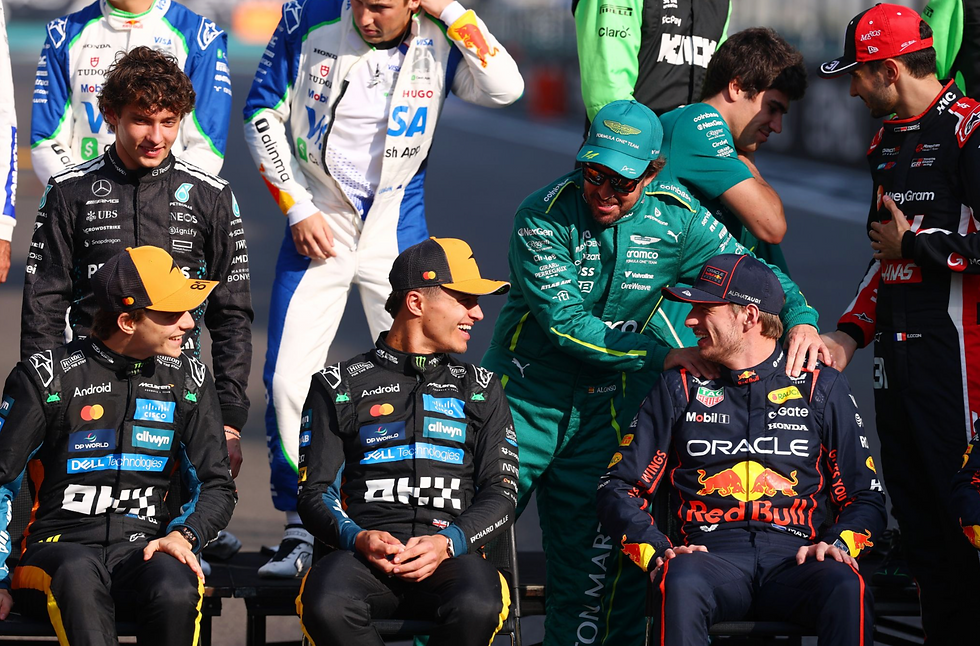
Verstappen had reportedly held confidential talks with McLaren in June about exactly this scenario, and that the team itself was keen to pursue it.
Parallel news at the same time also saw the Dutchman’s own venture, Verstappen Racing, bring 15-year-old McLaren junior Dries van Langendonck under his wing. The Belgian driver currently leads the way in British F4, having already shown his speed in the preceding Formula Winter Series (FWS) campaign earlier in 2026.
Verstappen hasn’t publicly backed any youngster before, or hasn’t signed a rising star under his wing, but this move also delivered plenty of reason to believe a switch to the papaya team was on the cards.
Yet, every party involved spent the following weeks shutting it down. Piastri, asked about it repeatedly through July, said flatly that “Max [Verstappen] doesn’t need to be spoken about much in terms of talent,” before pointing to his own contract running through 2028 and the reassurances he’d had from the team.
His manager at the time, Mark Webber, dismissed it just as bluntly, insisting Piastri was “contracted to McLaren for the foreseeable future.” McLaren CEO Zak Brown also backed both his drivers with equal firmness, saying he “couldn’t be happier with our driver line-up.”
Even Sky Sports’ David Croft, while cautious about giving the rumours too much weight, understood exactly where they kept coming from: “You are going to hear those rumours because his race engineer has gone there.”
GP’s shadow
He wasn’t wrong to flag it. Gianpiero Lambiase, also known as ‘GP’ to a decade of race-radio broadcasts, has been Verstappen’s race engineer since 2016, the voice on the other end of every title-winning lap.
Back in April, Red Bull confirmed that Lambiase will leave the team for McLaren, in a senior chief racing officer role, once his contract expires in 2028. This mattered especially because Verstappen had previously said, more than once, that he’d stop racing in F1 the day Lambiase wasn’t the voice on his radio.
For a few months, that gave the McLaren rumours a credibility the others never had – the possibility that Verstappen might eventually follow his engineer there. Verstappen himself, though, chose not to lean into it.
When questioned about trying to keep Lambiase at Red Bull, he said standing in his way “would be stupid from my side” – a small yet telling line. It suggests that Verstappen had already accepted that Lambiase won’t be at Red Bull with him for the rest of his contract since he wasn’t planning to follow Lambiase to McLaren.
A thinner market than the rumours suggested
Ferrari barely got a mention, and for good reason – Lewis Hamilton and Charles Leclerc are both under contract, leaving no realistic door open there either.
Precisely why this whole saga kept circling back to: for all the noise, the actual market for Verstappen this winter was thinner than the speculation suggested.
Mercedes wasn’t offering a real seat. McLaren wasn’t moving Norris or Piastri. Ferrari was never in play. Red Bull, underperforming as it currently is, was still his best functioning option.
Loyalty, perhaps, had very little to do with it. There simply wasn’t anywhere better to go.
The case against
That doesn’t mean it was a risk-free call. Red Bull sits fourth in the Constructors’ Championship this year, behind Mercedes, Ferrari and McLaren – a truly humbling position for a team that won four straight constructors’ titles not long ago.

The exodus around Verstappen hasn’t stopped at Lambiase, either; technical director Pierre Wache has reportedly grown less forthcoming with his McLaren-bound colleague, and Red Bull has lost senior personnel steadily since Adrian Newey’s departure a few years back.
There are green shoots – three podiums in the last four races, and reporting that the FIA’s own power unit benchmarking rates Red Bull’s engine as the strongest on the grid heading into a new engine formula – but green shoots aren’t the same as proof.
And notably, nobody outside the negotiating room yet knows whether this new deal even carries an exit clause; there was reportedly a genuine impasse in talks, with Verstappen wanting a significant pay rise and Red Bull wanting the clause gone entirely. For now, all anyone’s actually been told is how long the deal lasts – not how easy it would be to leave.
So, what is the right call?
Given what was actually available to him – not what the rumour mill wanted to be available – yes, probably. Verstappen said it himself: the team is “like a second family” to him.
There’s real weight behind that when you consider Mekies has now had over a year to build trust with him post-Horner. Mekies leaned on that trust hard in his own statement, calling the pairing one of the few partnerships in sport that “achieve what Max [Verstappen] and this team have.”
Yet, the more useful way to read this contract isn’t as Verstappen betting everything on sentiment. It’s a driver who has said, in his own words, that he trusts Red Bull to get back to winning – a bet on what the team can still build for him, not just an acknowledgement of what wasn’t available elsewhere.
Mercedes’ limited availability, McLaren’s locked-in seats and Ferrari’s closed lineup only made that trust easier to act on.
It also resets the rest of the market. Verstappen was the biggest of this winter’s dominoes, and with him gone, the remaining 2027 puzzle simplifies considerably. There’s no seat to be freed up at the front for whoever might have been squeezed out to make room for him, and no reshuffle down the grid triggered by his departure.
Whether that calculation ages well for Verstappen himself depends entirely on what Red Bull actually produces under this set of regulations, and on whether the version of this contract nobody has seen yet gives him a way out if it doesn’t.
For now, the loudest storyline of the silly season has found an ending. Whether it’s the right one won’t really be known until the car underneath him has a story to tell in the second half of the season.
Edited by Vyas Ponnuri







Comments