
Five winners, five losers: Japanese Grand Prix

Written by Peter Johnson, Edited by Vyas Ponnuri

A mid-race safety car undoubtedly altered the outcome of the Japanese Grand Prix, but whose luck was in - and whose was out?
Winner - Kimi Antonelli
Once you acknowledge the obvious fact that the safety car on Lap 22, moments after George Russell had pitted in the lead Mercedes, swung the Japanese Grand Prix hugely in Kimi Antonelli’s favour, you can then also accept that it was nevertheless a thoroughly merited result for the young Italian.
Antonelli stormed to pole position for a second successive race, this time on a completely level playing field with Russell, neither Mercedes affected by any of the gremlins that beset both cars to varying degrees in Shanghai.
His third poor start in four races across 2026 saw him plunge to sixth place, though, before he fought back through to third and was several tenths a lap faster than either race leader Oscar Piastri or Russell ahead of him.
The fortuitous timing of the safety car, necessitated by Ollie Bearman’s frightening accident, allowed Antonelli a cheap stop to fault him to the front of the field - a stroke of luck, yes, but the pace he showed in the final 26 laps to win by 14 seconds proved his victory was no fluke.

As was the case in China, several long-standing records fell when Antonelli crossed the line. He became the first Italian to win two consecutive races since Alberto Ascari in 1953: his compatriot went on to win the title that year, too.
Antonelli also became just the third driver this century to win their first two races consecutively, following in the footsteps of Lewis Hamilton in 2007 and Charles Leclerc in 2019.
Most crucially of all, at 19 years and 216 days old, he becomes the sport’s youngest ever championship leader, holding a nine-point advantage over his teammate.
If George Russell thought he had this year’s world title in the bag, he now has five weeks until the Miami Grand Prix to digest that this is far from the case.
Winner - Oscar Piastri

For all the travails of several other teams and drivers further down the field, there was not a single individual to have had a more frustrating start to the season than Oscar Piastri.
Finally completing a racing lap three rounds into the season, the Australian made his presence felt by jumping both Mercedes at the start and taking the lead of the race.
Piastri led reasonably comfortably, and his radio conversations with engineer Tom Stallard gave the impression of a man who felt he was more than capable of keeping the Silver Arrows behind him.
Following the safety car intervention, Piastri kept his position over Russell but lost out to Antonelli. As Russell and the Ferraris squabbled behind him, he was content to run in an unchallenged P2 and bag his first serious points of the season.
The fact that he comprehensively outperformed his world champion teammate Lando Norris all weekend should not go unnoticed either.
Winner - Charles Leclerc

It would be fair to say that after two rounds of the 2026 season, Charles Leclerc had, on average, been outperformed by teammate Lewis Hamilton.
Yes, he led the seven-time world champion in the standings by a single point, but Hamilton had shown better race pace in the two Grands Prix and the Chinese sprint.
In Japan, the shoe was quite clearly on the other foot. While Hamilton struggled throughout Practice, Leclerc knuckled down and was clearly the faster driver the whole weekend.
Starting two places ahead of Hamilton, the Monégasque was jumped by the veteran Brit during the safety car, but wrestled the position back to take P3.
A staunch defence against George Russell in the closing stages, while Hamilton faded to sixth, yielded a thoroughly deserved podium at the end of what was a much-needed strong weekend for Leclerc.
Winner - Pierre Gasly

It was another strong showing at Suzuka for Pierre Gasly, who, with a seventh-placed finish, remains the only driver besides the Mercedes and Ferrari men to score points at every Grand Prix this season.
While Red Bull and Max Verstappen’s troubles have been well-documented, it is also highly commendable that the Alpine driver, whose team finished bottom in last year’s Constructors’ Championship, has outqualified the four-time world champion at every race so far.
The Frenchman’s six-point haul in Japan even moved his team up to fifth in the teams’ standings, above Red Bull and Racing Bulls.
On a weekend when fellow Mercedes customers McLaren also showed a marked increase in performance, Gasly and Alpine are clearly feeling rejuvenated this year.
Winner - Esteban Ocon
Another man who really needed to outperform his teammate this weekend, Esteban Ocon collected a very welcome first point of the season in his Haas.
Ollie Bearman in the sister car, who sat fifth in the standings before this weekend, had comprehensively outperformed the Frenchman at the first two events of the season.
However, notwithstanding Bearman’s huge crash on Lap 22, Ocon truly had the upper hand on his junior teammate all weekend.
While the young Brit suffered a lacklustre Q1 elimination on Saturday, Ocon qualified a respectable 12th and was running four positions ahead of Bearman at the time of the latter’s race-ending accident.
It will take more than a solitary P10 finish for Ocon to recover what is becoming a slightly bruised reputation, but it was a solid start. Driving for the “Toyota Gazoo Racing” Haas team, there were certainly worse places to perform than at the Japanese brand’s home race.
Loser - George Russell

It is fair to say that the Japanese Grand Prix fell away somewhat spectacularly from George Russell’s grip. Yes, he never actually led the race at any point, but he certainly had the pace to challenge Oscar Piastri in what would have been the battle for victory, all things being equal.
Pitting on Lap 21 to put on hard tyres three laps younger than the Australian’s, Russell looked like the man to beat, albeit for only half a lap.
Cue the safety car moments later, and Russell found himself behind his teammate. He then also lost a place to Hamilton at the restart, before suffering a temporary loss in power output from his battery approaching Spoon curve, losing a further position to Leclerc.
Following the Monégasque past Hamilton, Russell couldn’t quite make a move on the lead Ferrari to earn a podium place. At one stage, potentially on track to outscore Antonelli by three or ten points to extend his championship lead, the Brit ultimately lost a colossal 12 in relation to the young Italian, falling nine points behind him.
In a season when you would expect both Mercedes drivers to be on the podium more often than not, it will surely be rare for either driver to take that many points out of the other in one fell swoop.
Loser - Max Verstappen

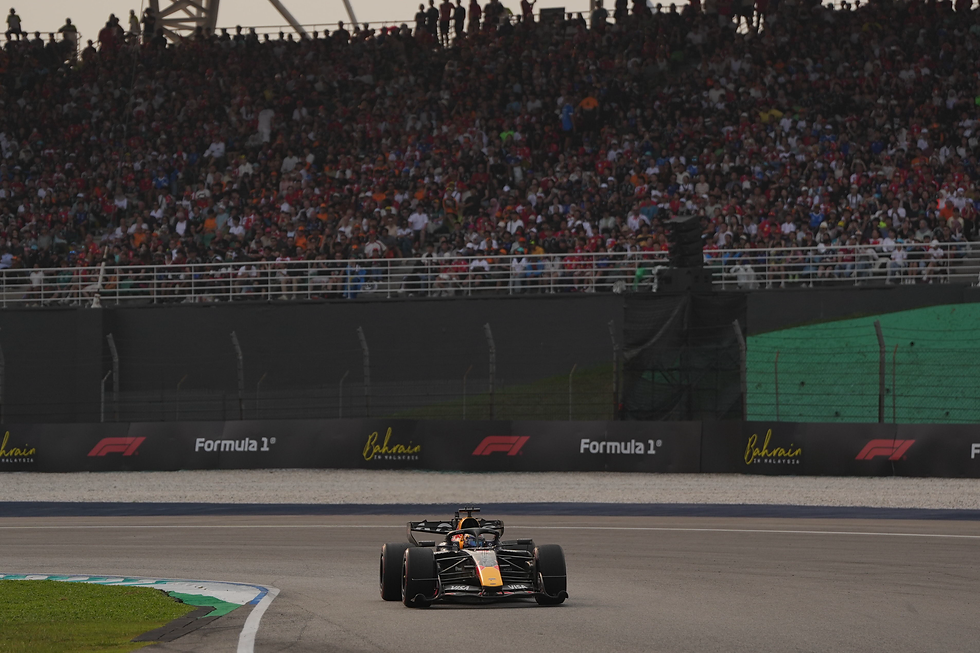
It has been clear since this iteration of regulations was first suggested back in 2023 that Max Verstappen was not a fan. So vocal has he been in his criticism of the new rules, following a Q2 elimination at Suzuka, the Dutchman admitted he had finally run out of words.
A race-long battle with Pierre Gasly, in which the four-time champion fell slightly short, resulted in a P8 finish and leaves Verstappen ninth in the standings.
In his post-race comments, the Dutchman cast doubt over both his current commitment and his future in the sport.
He said: “It all starts with actually enjoying what you’re doing before you can actually commit to it 100%.
“Now I think I’m committing 100% and still trying, but the way that I am telling myself to give it 100%, I think is not very healthy at the moment because I’m not enjoying what I’m doing.”
With his interest and increasingly common forays into other racing categories well documented, there are suggestions every passing weekend that Verstappen’s F1 career may be over sooner rather than later.
It is unclear in that situation who the biggest loser would be should that be the case - Verstappen, Red Bull, or the sport as a whole? There certainly wouldn’t be many winners.
Loser - Ollie Bearman

After such a fine start to the season for Ollie Bearman, there was always going to come a weekend where he would struggle slightly.
With 17 points from the first two rounds, the young Brit can be forgiven for the odd weekend in which he is outperformed by Esteban Ocon.
Of bigger concern was rather the aftermath of his huge shunt on Lap 22, Bearman limping away from his 50G shunt and requiring the help of a marshal to sit down.
An obligatory check over at the medical centre confirmed the Brit had fortunately not fractured his right knee, but he will certainly benefit from a five-week break to recover before the Miami Grand Prix.
Loser - Aston Martin

There is no need once again to lay out all of Aston Martin’s trials and tribulations, but it was actually an event that occurred thousands of miles away from the race track that may pile more misery on the struggling team.
Fernando Alonso has long mooted that 2026 could be his final season in the sport, and becoming a father for the first time on the eve of the Japanese Grand Prix will surely be a pivotal factor in any decision to walk away.
Arriving late at Suzuka following the birth of his child, the Spaniard saw the chequered flag in Japan, the first time either Aston driver has done so this season. However, while that may mark a step in the right direction for the team, it is hardly groundbreaking progress.
The superteam Lawrence Stroll had assembled to try and win championships has already been sold seriously short by Honda, and a potential departure for Alonso, which must now be a real possibility, would further rock the team’s foundations.
Loser - New Regulations

As striking as the new cars may look, as easy as it may be for drivers to follow one another and however many overtakes there may be, Formula One’s brand new regulations continue to be severely undermined by the comments of the drivers.
Lewis Hamilton has virtually been a lone voice in support of the new rules, although even he admitted over the weekend that he hates the emphasis placed upon battery deployment.
The FIA did make a concession heading into the Japanese Grand Prix that battery recovery would be reduced during Qualifying, theoretically reducing the dependence on battery deployment to produce a competitive lap time.
However, on Saturday evening, Carlos Sainz, Charles Leclerc and Lando Norris were among those to join Verstappen in staunch criticism. A common theme throughout their feedback was that any attempt to push the car’s limit through the corners would be punished exponentially on the straights with a lack of grunt from the battery.
The reason for this is that drivers need to lift off throughout corners to help recharge their battery, but by not doing so can lose several tenths of a second in a straight line.
Norris said: “It hurts your soul when you see your speed dropping so much, 56 km/h down the straight. Does it feel as amazing as last year? No, I don’t think any track will.”
Leclerc concurred: “We want to be at the limit of the car and whenever you play with those limits not only do you pay the price of a small snap but you also pay triple the price in the straight.”
Ollie Bearman’s crash showed that potentially enormous speed differentials between cars could also have severe safety repercussions, with the Brit’s huge shunt caused after he took evasive action to avoid Franco Colapinto’s Alpine, which was 50 kph slower due to a depleted battery.
The FIA has confirmed it will use the five-week break before Miami to amend the new regulations further.




The races were incredibly intense.
Poor Bunny