
The cultural keys behind Chip Ganassi’s historic IndyCar success


Chip Ganassi has a legend in his ranks. And not for the first time.
In 2025, sealing his fourth championship in only five years with Chip Ganassi Racing (CGR) in his sixth year in IndyCar, further crowned by a legacy-defining Indianapolis 500 win in May, Álex Palou has elevated himself firmly into the conversation of all-time greats.
And the 28-year-old from Barcelona, Spain has done so in record time.
Clinching with two races to spare in 2025, at 28 years and 131 days, Palou became the youngest driver to win four IndyCar championships. In doing so, he has elevated himself into a club of only six drivers, tying Mario Andretti, Sébastien Bourdais and Dario Franchitti’s four successes. He now only trails teammate Scott Dixon’s six and AJ Foyt’s record seven titles.
Usurping the field for a third season in succession, he also became only the fourth driver to ‘three-peat’ in IndyCar history, after Ted Horn, Bourdais (who won four consecutive titles) and Franchitti. His eight wins are eclipsed only by Andretti’s nine in 1969 and the joint-record single-season tally of 10 from Foyt in 1964 and Al Unser in 1970.
Across the course of the 17 races, building a 196-point title-winning margin, Palou was only absent from the top five on three occasions. He also became only the fourth driver to reach the 13-podium milestone in a solitary season, alongside Alex Zanardi (15 in 1998), Unser (15 in 1970) and Andretti (13 in 1967 and 1969; 16 in 1968).
“We obviously knew going into the season we thought we had a good package,” Ganassi said in August. “Quite frankly, none of us could have dreamed this type of year. You would have thought I was a little boisterous had I predicted this in the beginning of the year.”
It is nothing new for CGR to be housing such a driver. But across the last half-decade, Palou has taken an illustrious team into yet another stratosphere of dominance.

When he came onboard from Dale Coyne Racing in 2021, CGR still trailed Team Penske 16-to-13 by way of IndyCar titles. But five years on, they are now tied with Roger Penske’s legendary organisation, having only entered the sport in 1990, after which they have achieved eight more championships than any other team.
At the very start of the season, team owner Chip Ganassi suggested Palou was still only at the base of showcasing his ultimate talent. Those comments from St. Petersburg did the rounds season-long but, inexplicably given Palou’s level, only continued to be vindicated.
“We may have scratched the surface,” Ganassi reaffirmed in the aftermath of Palou’s 2025 success. “Unfortunately for everyone else, I don’t think he’s hit the ceiling.”
It only speaks to Palou’s generational greatness that he continues to find ways to improve even further. This year, for instance, he earmarked pure pace as one area yet to be maximised, along with winning for the first time on an oval and mastering the short oval craft.
But he enters 2026 having doubled his pole positions tally in 2025 - from six to 12, spanning road courses, street courses and ovals - and with a record of 15 top-five and 10 top-three starts across 17 rounds. Quashing another ‘weakness’, he notched his elusive first oval win (at Indianapolis, no less) and maiden short oval victory, clinching the oval championship.
You would be hard-pressed to find many more complete seasons, which combined with Palou’s existing success has triggered inevitable talk of where he ranks among the greats.
“Certainly in modern times, his name’s with everybody, whether it’s Dixon, Zanardi, [Jimmy] Vasser - our guys and champions of other ones,” Ganassi said. “I feel fortunate to know a lot of champions, have known a lot of champions.
“You can only compare these guys in the years they’re in to other great drivers they’re competing directly against. You’ll never be able to compare how Álex stacks up against AJ Foyt or Mario or Parnelli [Jones] - any of these guys.
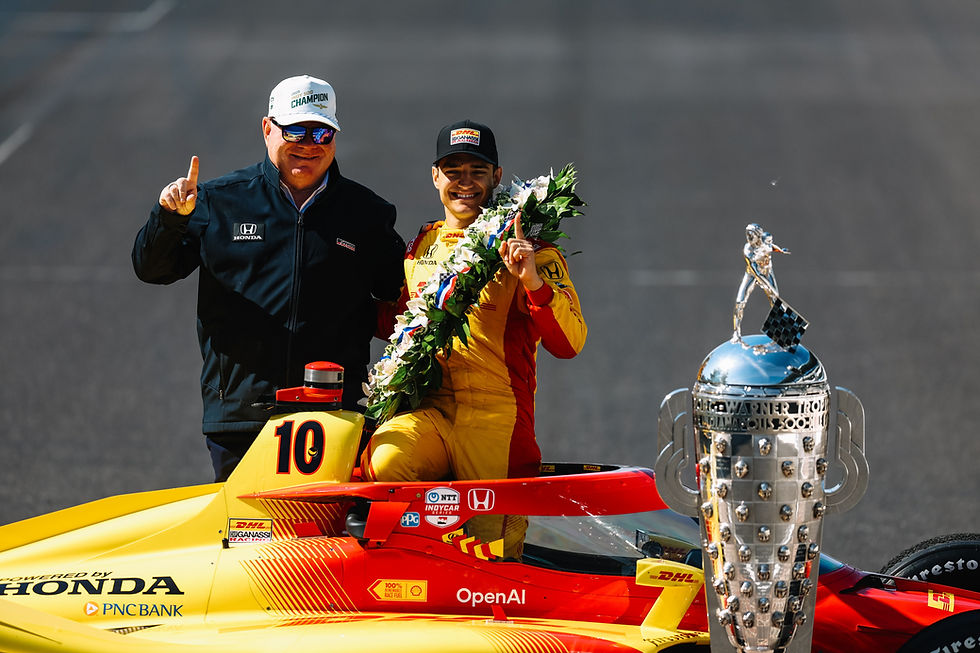
“We can always talk about it; that’s the great thing about sports. We’re never going to know the answers to those things. For all these guys, the car’s different, the tyre’s different, the engines are different, the weight transfer is different. You have a team that’s adapted to that over time and engineering that’s been able to change.”
CGR’s level of success since their introduction into the sport, spanning different eras of IndyCar racing, has been well-earned team-wide. Throughout 2025, Palou’s repetition of the fact the team made him “look so good on track” after every victory was telling.
Led by strategist Barry Wanser, engineer Julian Robertson and crew chief Ricky Davis, the Palou iteration of the No.10 team is quickly emerging as one of IndyCar’s greatest.
“It takes a team to win these days. It takes everybody and everything to do it the way we do it,” Ganassi explained. “When you have this many accolades, you start to realise you don’t do this stuff by yourself, Just like [Palou] said, he’s lucky enough to drive that car. I’m lucky enough to be that guy whose name is on the front door.
“You have no idea the amount of hard work and late nights, questions, experiments that go on in the race shop; the hard work that goes on back there trying to find a millisecond difference between our car and some of the other cars.
“The team back in Indianapolis, the young men and women who stay there in the dark hours of the night, out of bed at 5:00 in the morning, the travelling they do, the things they put up with on the road to bring a champion to this point, is really fun to be a part of.”

For Palou and his team to have separated themselves from the field so emphatically is an exceptional achievement in a series so widely renowned for its competitiveness.
In 2025, they brought unique inevitability to a sport famed for its unpredictability. And so unprecedented was the level across the six-month season, it continually felt fascinating in its history-making splendour, superseding any hints of boredom at the hands of such rare, seemingly almost-metronomic repeatability.
But even from Palou, who in 2023 became the first driver in the best part of two decades to wrap the championship up before the final round, nobody could have quite expected the standard of season that unfolded. How could they?
But when you look inside the CGR operation, you cannot be totally surprised. The successes, stemming from that relentless drive to win, are no coincidence.
“To have the season we had this year is something I never thought I would see, let alone be a part of,” said Davis, a three-decade veteran crew chief at CGR. “It took everybody every day and every hour from the time January 1st rolled around to make these things happen.
“The effort that our entire squad, the Nos. 8, 9 and 10 guys, put out every week - pit stop practice, trying to get better, working out, lifting weights, working on the car - however long it took to get everything done, that’s the key for the team to be able to move forward and not live off of the last race we won.”
That work ethic and single-minded determination from within sets the culture at CGR, spanning the mechanics’ preparation, to the work done by the leadership to get the most out of the drivers. Beyond that, there is an air of personability within the ranks which also feeds into the team’s DNA, trickling down from Ganassi himself at the top.
This all amounts to being able to maximise every aspect of the organisation. No stone is ever left unturned.
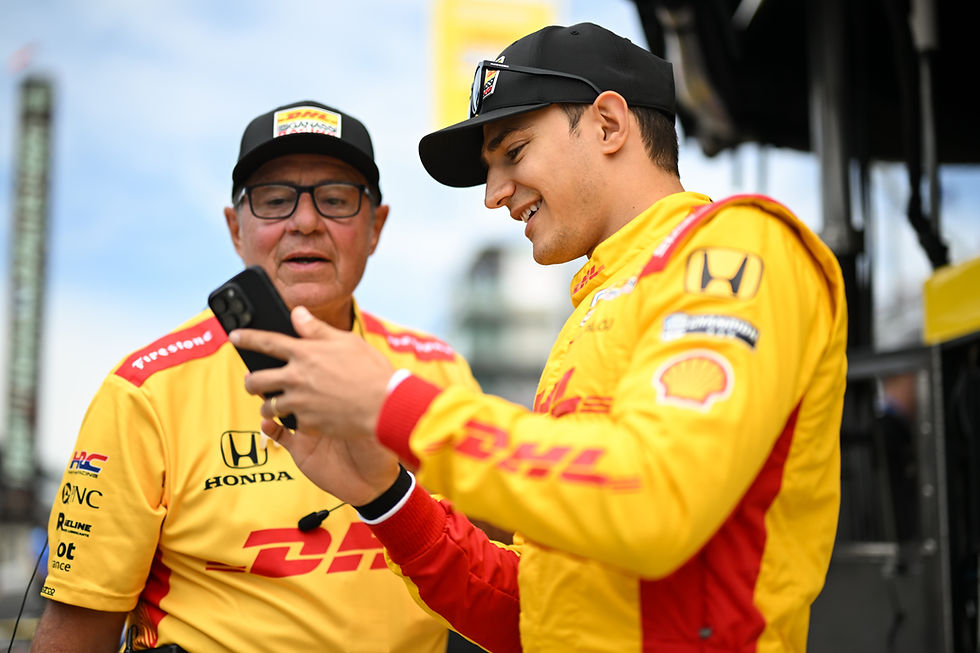
“If you take out the obvious things like talent and ability and good engineering, I’d like to think in our team we work a little harder at giving drivers what they need,” Ganassi acknowledged. “That might be different for Palou than it is Dixon - or different than Kyffin [Simpson]. Different people need different things.
“We’re not etched in granite with every single thing we do on the team. We personalise, whether it’s the setups or treatment of people. Everyone’s not the same. I’d like to think we do a good job of getting the most out of our people from top to bottom, from the drivers all through the organisation. It’s because I think I take the time to talk to these people.”
It has helped CGR to have the continuity of figures with 30-plus years of experience at the team. Adding to that, tapping into those with knowledge of the team has also included using a network of former champions to act as support for the current drivers - also pertinent given CGR’s expansion back into Indy NXT for the 2025 season, running four cars in 2026.
Serving as mentors, Bourdais has been occasionally present in recent years, while Franchitti is more regularly in the paddock adorned with CGR gear. His exact role? Modern titles matter little to Ganassi, so long as the team is being benefitted.
“Call Dario what you want… the sporting director? They have these fancy names nowadays,” Ganassi dismissed. “I just thought he was a good guy to talk to the other drivers, help them out a little bit. Seems to be working.”
Many of the values inherent within modern-day CGR were learned in early life by Ganassi. From his twenties and thirties, and as early as in school and college, he learned lessons that he still carries today, as a richly successful 67-year-old.

Even through his years of illustrious team ownership, he has continued to fuel the powerhouse by gleaning from those close by, even competitors.
“I had this architect friend of mine tell me one time: ‘You get to a point in life where you’re not emulating everyone else; you’re emulating yourself now. That’s who you become one day,’” Ganassi recited. “I’d like to think I’ve taken a lot from a lot of people.
“I took a lot from my father. I took a lot from great relationships I’ve had with people at Target. I’ve taken parts of Roger Penske. I learned a lot from Mario Andretti. I’ve been fortunate over the years to come in contact with a lot of great people. When you’re in contact with a lot of great people, those things rub off on you.
“Joe Montana; having Jimmie Johnson on the team for a couple years. There’s little things of each and every one of these successful people that I’ve been around over the years. A combination of all those is what makes up this championship team.”
While the quest for more success is unrelenting, there is also a realisation that success has to be enjoyed. That only further ignites the hunger, which was the case after Palou’s Indy 500 success this May, after which emphasis was placed on letting it sink in across the team.
After every race win, CGR hold a luncheon back at the workshop, where they will talk about and celebrate each victory before getting back to work. Following the 500, Ganassi was taken aback by how many people were tasting success at the Speedway for the first time.
“I took a little extra time in the meeting to explain: ‘Don’t take this stuff for granted because it doesn’t happen that often. It looks easy but it’s not,’” he described. “You can tell me how many times we won the Indy 500; I can tell you how many times we’ve lost it.
“These things don’t happen often - and they don’t happen matter-of-factly. It takes a lot of work on a lot of people’s part.”

That winning feeling quickly becomes infectious. As a result, plenty who have opted for pastures new - away from CGR - have learned that the grass is not always greener on the other side, where winning is much more of a rarity.
“I don’t think we pay the most money,” Ganassi admitted. “You have to like to win. There’s plenty of people that have left our team; a lot of them come back after. They go: ‘Geez, I didn’t know what that meant, winning all those races, and what it’s like when you don’t.’ I’ve heard that story more than 10 times.
“You have to have a will to win and a will to be a part of the team. A lot of teams say they’re a team but they sure don’t look like it to me. I can’t worry about everybody else’s team. I have to worry about my own.
“I try to do the best job for our people. It’s all I know how to do. It’s all I know what to do. I try to treat everybody right, treat everybody like I want to be treated.”
In 2025, Ganassi believes a perfect storm, of sorts, led to a year which panned out to be just about as perfect as one could hope for. That included some of his fiercest rivals falling by the wayside as CGR’s bulletproof consistency rose to the fore.
“We obviously have a driver that understands what makes the car work. We have a group of people that understand what makes the car work,” he asserted. “I’ve got to be honest with you too, not each championship but certainly the few of them here and there, I’m not blind to the fact that some of my strongest competitors are in disarray right now.”
Of course, in the year where Ganassi tied Penske for IndyCar championships, Penske’s best-placed driver in the standings, Will Power, was ninth, followed by Scott McLaughlin in 10th and Josef Newgarden in 12th. A 15-race winless run was their worst since 2007/2008, while they failed to have a driver finish top three in points for the first time in 18 years.

All in all, owing plentifully to bewildering misfortune, it was Penske’s worst campaign since 1999 - the last time their best-placed driver finished below ninth in the standings.
As it is, CGR consequently enter 2026 with the opportunity to break clear of Penske as the team with the single-most championships in IndyCar. For Ganassi himself, near enough lifelong commitment to the sport is paying the most fruitful of dividends.
“This is all I do. That’s all I want to do,” he insisted. “I love racing. I love being at the front. I love all forms of racing - I can appreciate every form. I love the business. Our team is not overloaded with money but we get the most out of the money we spend.
“We’re not the most well-funded team out there [but] I’ve got a great group of people that know how to get the most out of what they work with. We have a lot of Swiss Army knives around the race shop that we get the most out of our people. I’m really proud of them.
“This is another championship for them.”
At the heart of it all, doing the job on-track to reward the endless efforts behind the scenes, is a humble Spaniard still, alarmingly, only in the infant years of an already-legendary career. And as it stands, nobody appears to possess the solution for stopping him.
“Did we see four championships in five years in him? Absolutely not,” Ganassi divulged after Palou’s fourth crown. “You would have thought I was off my rocker if I said that in 2020.”
But right now, there feel no limits to where Palou’s - and the No.10 team’s - generational greatness could take them as record books continue to be rewritten.




Comments