
The forgotten rivalry: Biaggi vs. Rossi

Written by Aaratrika Gupta, Edited by Vyas Ponnuri

Even before contemporary MotoGP battles such as Rossi vs. Lorenzo or Marquez vs. Rossi dominated the headlines, another bitter and personal rivalry between Valentino Rossi and Max Biaggi took shape in the late 1990s and early 2000s.
Their rivalry was much more than the race tracks and world titles. It was a battle of personalities, national pride and generational change, as two Italians scrapped hard, not just over victories, but also to control the narrative of the sport.
The confrontation turned out to be one of the most emotionally charged conflicts which MotoGP had ever witnessed, the impact of which is still felt whenever the sport talks about the most memorable fights.
Two Italians, two opposites
The contrast between Rossi and Biaggi could hardly have been sharper. Biaggi was already an established star when Rossi arrived in the premier class. Known as the “Roman Emperor,” Biaggi had built his reputation with four consecutive 250cc world championships and carried himself with a composed, almost aristocratic demeanour.
Rossi, too, was of a totally different generation. Full throttle, jovial, and possessing a charismatic approach to racing, he approached it with an irreverent approach that left fans exasperated, yet annoyed some of his competitors.
While Biaggi projected authority and discipline, Rossi brought humour, mind games, and a rebellious energy to the paddock. As exciting as it was off the track, this clash of personalities would soon spill onto the track.
The spark: Suzuka 2001
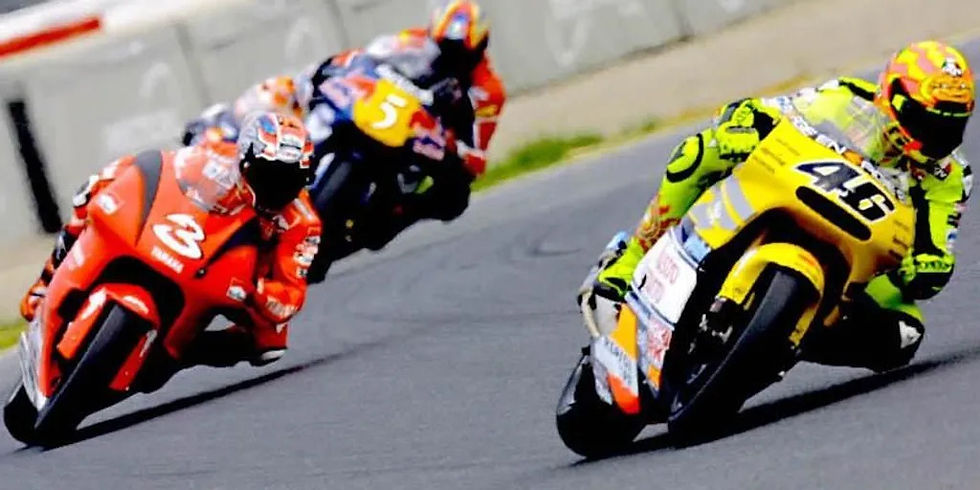
The competition really began to heat up with the first round of the 2001 season at the Suzuka Circuit, when Rossi boldly passed his fellow Italian on the start-finish straight before giving him a dramatic gesture in the middle of Turn 1.
The relocation was not merely offensive; it was melodramatic, a fact that the young competitor was about to overthrow the old star.
Biaggi was undoubtedly furious, and tensions only worsened after the race. The two allegedly even fought each other after the race, with team members coming in to the rescue. Since then, their competition has grown more personal.
A battle for supremacy
The early 2000s saw both riders emerge among the fastest in the premier class. Biaggi rode for Yamaha and later Honda, consistently fighting for victories and championships. Rossi, meanwhile, had kicked off one of the most dominant periods in MotoGP history.
On track, their encounters were intense. When they met on the circuit, neither rider was willing to yield an inch. The fights were characterised by the late braking, passionate passing and obvious tension even when the chequered flag was raised.
Off the circuit, the rivalry was even more intense. Rossi often employed humour and psychological tricks to leave his rival nervous, while Biaggi got back at him by making biting remarks in the interviews. Their remarks in the media kept the feud active as every race weekend was a story of confrontation, and a dramatic storyline for fans to follow across the seasons.
The psychological war

The psychological aspect was one of the characteristics of the Rossi-Biaggi rivalry. Rossi, a master of mind games, would frequently employ mischievous moves and comments to the crowd to annoy his opponent.
Biaggi, a serious-looking man, would at times be frustrated with Rossi's theatrics. The striking contrast just added to the story: Rossi as the charismatic conqueror, Biaggi as the arrogant representative who defends his position.
Their rivalry split the opinion of Italian fans. Others loved the technical accuracy and professionalism of Biaggi, whilst others were attracted to the charisma and fearless racing techniques of a young Rossi.
The competition was not merely a case of sporting competition but a cultural issue on what type of champion MotoGP was to embrace.
The turning point
Rossi slowly started to establish his domination in the sport in the early 2000s. He won championships in 2001, 2002 and later, slowly overtaking his rival in terms of results and popularity in the entire world.
Biaggi was still competitive and won races, though he wouldn’t match Rossi’s consistency throughout a season. Power was no longer as it was.
Nevertheless, the competition never really subsided. Whenever Rossi and Biaggi were near each other on the track, tension was felt. They had become the identity of MotoGP, and their struggles were now part of the fights.
The two riders even admitted how the war made them perform to the best of their abilities. The degree of their competition only increased the intensity of the racing and attracted the vast interest towards the sport.
A rivalry that shaped MotoGP
Despite new riders arriving in the series in the 2000s, this rivalry still remained in focus. Biaggi later transferred out of MotoGP, but later achieved success in Superbike racing. Rossi’s phenomenal career only continued to grow from strength to strength. He emerged as one of the most acclaimed personalities in the history of motorsport.
Even still, the Rossi-Biaggi rivalry is one of the most significant ones in the history of MotoGP. It has contributed to the increased popularity of the sport around the world and demonstrated how character can create racing stories as effectively as the lap time.
To most fans following on at the time, races embodied the unfiltered feeling of motorcycle racing: pride, passion and an uncompromising need to win.
Conclusion
Today, when MotoGP fans discuss the sport’s fiercest rivalries, the Rossi–Biaggi feud deserves a place near the top of the list. It was not just a sports event, but a battle of identities, style and ego at high speeds.
Although time has eased the tension and both riders have since moved on from the series, the memories are still fresh. Their field wars and cutting-edge personalities contributed to the era when MotoGP sport was more character than speed.
And in the heat of their battles, two Italian heroes left a heritage which still echoes in the paddock today.








This is a brilliant piece! I love how you highlighted the "battle of personalities, national pride and generational cha" beyond just the track. It really captures the essence of their rivalry.
test my beauty