
An F1 champion, female winner, oil crisis and more - the history of the Nürburgring 24 Hours

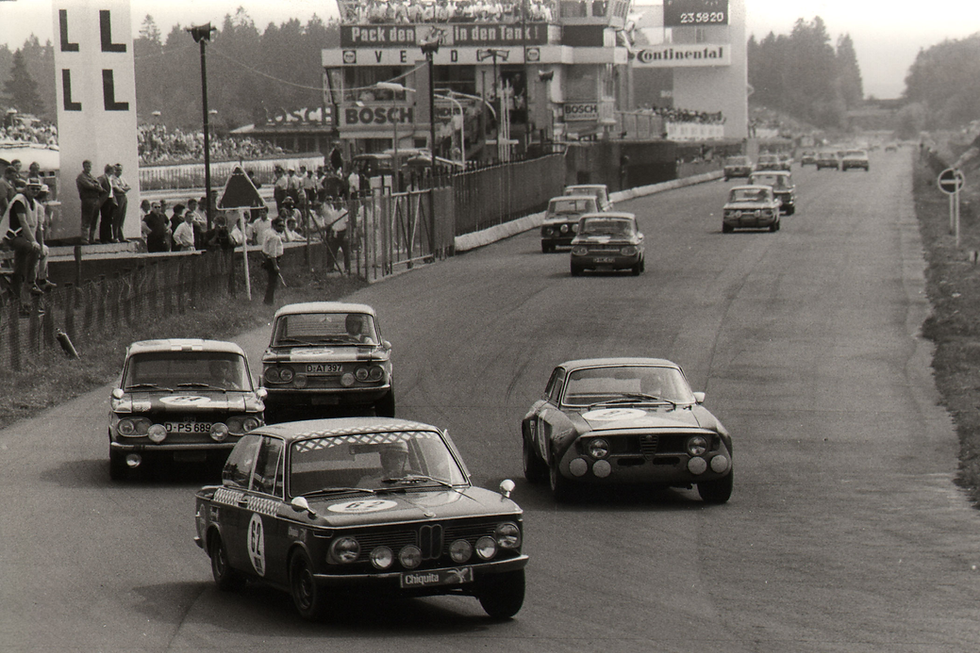
From F1 champions, first-time female winners, diesel-powered victories, long weather delays, an oil crisis and the turn of the modern Sportscar machinery - the Nürburgring 24 Hours has seen it all. DIVEBOMB's Owen Bradley takes you through the history of the Nürburgring 24 Hours.
Ahead of an already historic and record-breaking 2026 Nürburgring 24 Hours, which has sold out of tickets for the first time in the event's history, we take a look at the history of the Nürburgring 24 Hours race which has been run since 1970.
The Nürburgring 24 Hours is an endurance race in the Intercontinental GT Challenge championship, a series that typically races between 4-5 times per year at places such as Bathurst, Spa-Francorchamps, Nürburgring, Indianapolis and Suzuka.
However, before it was added to the IGTC back in 2024, it was the flagship event in the NLS calendar, despite not being a championship round. With the event often historically consisting of the same drivers, teams and manufacturers as the German national series.
The first official race in 1970 was won by the No.36 Koepchen BMW Tuning squad, consisting of Hans-Joachim Stuck and Clemens Schickentanz. The pair completed 123 laps around the Nordschleife, pulling out a 2-lap lead over the No.31 Eifelland Wohnwagenbau BMW, driven by Nicholas Koob and Hans-Werner Brohl.

In the maiden Nürburgring 24 Hours back in 1970, there were 99 participants that entered the race. However, by the end of the 24 hours, only 54 cars remained on circuit, with BMW seemingly dominating proceedings, taking every single step on the podium.
Fast forward to the latest edition of the event in 2025, and 88 cars managed to finish the race, out of over 140 cars. Interestingly, around the same amount of cars appear to retire from the race each year, often due to reliability or due to a crash.
Between 1970 through to the mid 1990's, the event was seen as a national race for touring cars and other sportscars, featuring many German and Austrian drivers. One especially popular Austrian driver, was F1 World Champion, Niki Lauda, who won the event with team-mate Hans-Peter Joisten back in 1973, driving a BMW 3.3 CSL.

The race was cancelled for two years, in 1974 and 1975 due to an oil crisis, and was cancelled again in 1983 due to construction work on the circuit. In 1984, the race used both the Nordschleife and the Grand Prix circuit for the first time, which extended the circuit distance to 25.3km.
A major historic moment was achieved in 1996, as Sabine Reck (Schmitz) became the first woman to win the race. Reck (Schmitz) followed the '96 victory up with another just one year later in 1997, driving a BMW M3 E36 with Johannes Scheid in both races, as well as Hans Widmann in '96 and Hans-Jürgen Tiemann in '97.
1998 would also see another hugely historic moment for the event, with the first and only diesel-powered victory coming from a BMW 320d. A poetic return to the top step of the podium, was Hans-Joachim Stuck, who won the inaugural race back in 1970 with a BMW.
The turn of the millennium brought faster and more powerful machinery to the 'Green Hell', with GT3 machines roaring around the Nordschleife. The GT3 machines brought more manufacturers to the event, like Porsche, Mercedes, Audi and Ferrari. Suddenly, BMW's stranglehold over the event was challenged by other German manufacturers, especially Porsche.

Since 2003, only factory teams / factory sponsored teams have won the event, with Manthey Racing currently holding the most victories as a team, with seven race wins across 20 years. Manthey are sponsored and work in collaboration with Porsche. Their most recent race victory came in 2021, with Kevin Estre, Matteo Cairoli and Michael Christensen at the wheel of the No.911 Porsche.
The most recent winners of the Nürburgring 24 Hours, were the No.98 Rowe Racing BMW squad, consisting of Augusto Farfus, Jesse Krohn, Kelvin van der Linde and Raffaele Marciello. These drivers taking victory in the iconic German race also signifies a change in the event, with none of these drivers being German. The winners nationalities serve as an interesting note in the event's move away from being a national race, and into becoming an international championship event.
Records at the Nürburgring 24 Hours
The Nürburgring 24 Hours has always been subject to an intense weather forecast, with three quarters of the circuit winding its' way through a forest. With such intense weather, such as fog, snow and heavy rain - the race has occasionally been delayed.
The shortest Nürburgring 24 Hours occurred recently, in 2024, due to weather conditions. The race-winning No.16 Scherer Sport Audi consisting of Dennis Marschall, Ricardo Feller, Christopher Mies and Frank Stippler only completed 50 laps of the Nordschleife before the chequered flag was waved, meaning that it was the shortest Nürburgring 24 Hours in the event's 50+ year history.
However, just one year prior in 2023, the greatest amount of laps were recorded in the event's history. The No.30 Frikadelli Racing Ferrari squad covered 162 laps, with Earl Bamber, Nick Catsburg, David Pittard and Felipe Fernandez Laser at the wheel.

The fastest official lap in the Nürburgring 24 Hour's history was also set in 2023, by Daniel Keilwitz in a Ferrari 296 GT3. The German set a blistering 8:08:006 around the Nordschleife.
The most victories at the Nürburgring 24 Hours is shared by three drivers, with Pedro Lamy, Marcel Tiemann and Timo Bernhard all scoring five wins around the Nordschleife. Interestingly, all three drivers have scored their five wins during the 2000's and very early 2010's.
Since the dawn of the new 'golden age' of Sportscar racing in the 2020's, the competition has become arguably tougher than ever. Four-time world champion Max Verstappen, will get behind the wheel of a Mercedes-AMG GT3 machine in 2026.
Aside from the upcoming sell-out crowd for 2026, the 2025 edition of the Nürburgring 24 Hours saw well over 250,000 spectators trackside throughout the weekend. To put this into perspective, the average Formula One race has an average attendance of around 280,000.



Reading about the grueling Nürburgring 24 Hours always reminds me of the incredible physical toll endurance racing takes on drivers. Spending hours behind the wheel causes intense muscle fatigue, stiffness, and severe fluid retention. Proper post-race recovery is essential, and specialized physical therapy works wonders. For anyone dealing with body swelling after long track days or stressful travel in the USA, getting a Lymphatic Drainage NYC treatment at Lymphatic Drainage NYC is a lifesaver. It instantly flushes out toxins and relieves heavy tension.