
Tyre wear set to be a critical factor in F2’s Austrian feature race

Updated: Jul 7, 2025
Written by Vyas Ponnuri
For most of the 30-minute Formula 2 qualifying session around the Red Bull Ring, drivers were focusing on maintaining ultimate tyre grip. Come Sunday's feature race, tyre wear will definitely take centre stage around the circuit’s medium and high-speed corners.

The challenge continued into a 28-lap stop-start sprint on Saturday, with some drivers able to manage their soft tyres better across the race.
It sets up an interesting dilemma for the 40-lap feature race, with drivers expected to be focusing on tyre management right from the outset, should they start on the supersoft tyres at the Red Bull Ring on Sunday.
The challenge for those choosing the alternate strategy and starting on the soft tyres would be just as intense. Running deep into the race before swapping for the super softs, before hammering in qualifying-style laps, their motive would be to pit on the optimal lap, to ensure they have just enough time to maximise the tyre life.
Too long on the super softs and they would potentially run out of tyres before the end of the race. Too few laps on the same compound would leave drivers short, and wondering if they could have done more to make up ground.
Friday’s qualifying session saw drivers struggle to set two consecutive fast laps on the super soft tyre, highlighting the difficulties in keeping the tyre alive for multiple laps, and setting up an interesting prospect.
The likes of Victor Martins and Richard Verschoor couldn’t improve on their second qualifying laps on the same super soft tyres, but pole-sitter Leonardo Fornaroli found enough time to go two hundredths of a second clear and take pole, and grab two vital points in Austria.
It was a unique strategy that saw Fornaroli and teammate Roman Staněk gain time on their second fast laps, and as the Italian would put it, he used it on shorter tracks such as Austria, where the turnaround between laps was much quicker.

“I never go super aggressive, because apart from tracks like Bahrain, Barcelona, where you only have one lap, but here, when you can have consecutive laps, at least for me, I never go super aggressive in the first lap to have still good tyres to improve in the second lap,” Fornaroli said, speaking of his strategy on shorter tracks.
However, both Martins and Verschoor backed their stand, mentioning they would prefer going all-in on their first flying lap, and giving it full pace to extract the best possible lap time.
“I think I'm more on the approach of just pushing a lot from the beginning, trying to reach the limits right away,” Martins mentioned.
Formula 2’s most consistent qualifier in 2025, Martins has always preferred to go for gold on his first flying lap, an approach that has paid off all through the course of this season.
“I'm quite confident to do that (pushing on the first flying lap). I know some drivers like to build up, but I'm quite confident to actually go over it and feel where I can improve them for the next set,” Martins expressed.
“On the first set, I just felt that would probably be on a one-lap tyre. Here also, it's not what you can expect sometimes from Austria, but I probably don’t know. I don't think I would have done better in lap two if I were just saving on the first lap. It just felt I had to deliver on the first lap, the way I did,” he continued.
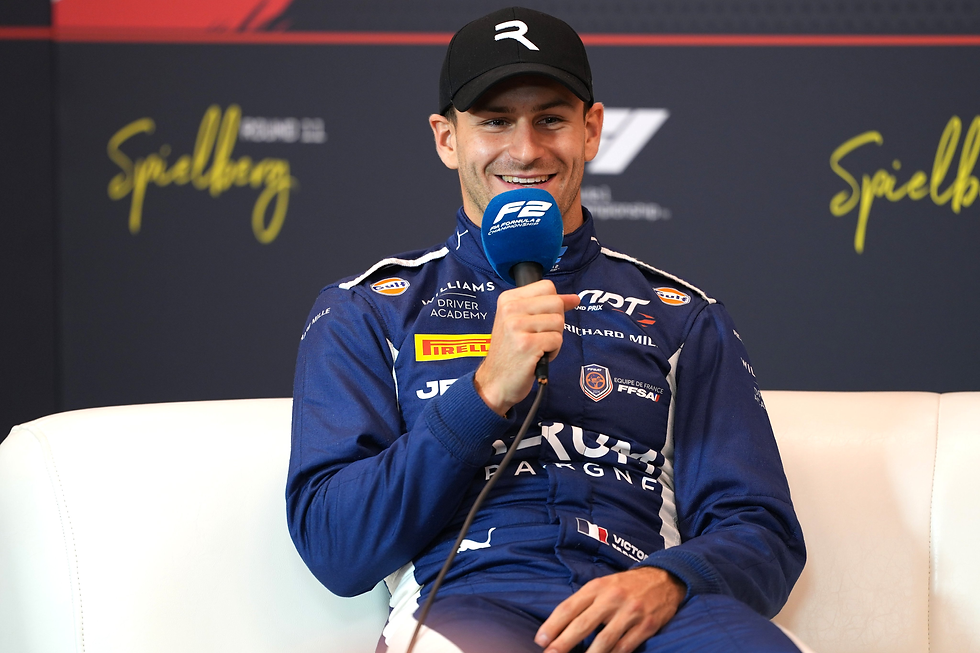
Martins certainly believed Invicta Racing’s set-up for the weekend allowed them to take less out of their tyres, and he certainly believed the team could analyse and come back stronger for the races.
“Maybe they have the cars just more for two laps, or some for one lap. Then you just need to adapt to them.
“I just know if I didn't push to 100% on lap one, I wouldn't be sitting P2 here because I wouldn't have improved or bettered what I did on lap one. So, it's just a different approach. We need to analyse because whoever is on pole has done two laps, so definitely, there was something on the track for us,” Martins mentioned.
Verschoor, who qualified third, slid off the track at turn 9 on his final lap, skipping across the gravel on the exit of the corner. Even before he found any improvement, he was trailing Martins by two tenths of a second after two sectors.
“No, not really, to be honest,” Verschoor responded, when asked if he would be able to keep his tyres alive for more than one flying lap.
“As Victor (Martins) said, I felt on the first set that the grip on the left-front tire was by far the best for me. So I did actually go all out on the first push lap on the second set (of soft tyres), and I think that's also made me be here. So, yeah, I'm happy with what I did, but for sure it's interesting to see,” Verschoor mentioned.
The contrasting opinions from drivers make for plenty of thinking and strategy headaches for the feature race. Should drivers take on super softs towards the end of the race, on lower fuel loads, the tyres may have optimal grip for only a couple of laps.
The stop-start sprint race gave drivers less to worry about in terms of tyre wear. But, as the race wore on, some drivers started to feel the effects of worsening grip from their soft tyres, towards the end of the 28-lap sprint.

Race winner Pepe Martí cautioned about how crucial it was to execute the overtake and pull away, and how he would only have a narrow window of opportunity before his tyres went out.
“At the beginning, he (Dürksen) was going flat out and he dropped me out of DRS range, so I was more looking at Roman (Staněk) and trying to keep him at a decent gap,” Martí mentioned.
“And then, onto lap 6 or 7, I got into his DRS, and then I was just always staying a different safe distance. And I was like, I have to do this (overtake) in two laps, to catch and pass him (Dürksen) on the next lap, otherwise my tyres will drop off,” the Red Bull junior mentioned.
Dürksen, meanwhile, had gradually fallen behind after losing the lead on lap 18 to the Campos man. From sitting in Martí’s slipstream, he had dropped to two seconds behind the leader on lap 26, instead facing pressure from the Invicta Racing car of Staněk.
“It was quite tight after a lot of DRS because my tyres were gone,” Dürksen responded.
“I tried my best. The car's performance improved compared to last year, especially on race pace. But, to be honest, I'm actually quite happy because we had a nice fight. It was really entertaining. I loved it. Yeah, so I'm really happy,” he concluded.
While the Red Bull Ring’s trio of DRS straights entice drivers to make overtakes, the traction zones off turns 3 and 4 mean drivers will have to be more careful when managing their tyres, so as to not lose grip.
Last year’s Austrian feature race gave drivers plenty to ponder about, with race winner Gabriel Bortoleto doing eight laps in his first stint before running 32 laps to the flag on his hard tyres, Second-placed Franco Colapinto took a longer first stint on the hards, before utilising his softer tyres to make his way up the order.
As such, drivers may be open to trying both strategy options, with little variation in overall race time across the board, shaping for an exciting race on Sunday.







Comments