
A lack of high-speed ovals and no return to Washington: Breaking down IndyCar's 2027 calendar


IndyCar's return to Europe at the Circuit de Barcelona-Catalunya was the marquee announcement in the second phase of IndyCar's 2027 calendar confirmation, as the series' heads to Álex Palou's hometown in their latest attempt at building further events outside the Indianapolis 500. That deservedly took the headlines, but there are plenty more stories to break down from the other 16 races that will make up the 2027 IndyCar season.
The removal of IndyCar's last 'traditional' oval
Barcelona's addition to the IndyCar calendar was unsurprisingly received warmly as the series heads international for the first time in 14 seasons. The event cut at its expense though may not be received as warmly.
Ever since works to Tennessee Titans' NFL stadium started to take place in 2024, the possibility of continuing to host a race in downtown Nashville proved impossible. The heads-up work of Scott Borchetta meant that the Nashville area could still continue to hold an IndyCar race with the Music City Grand Prix moved to the Nashville Superspeedway in Lebanon, Tennessee, about 40 minutes away from the downtown venue.
The race proved an immediate hit. After the loss of Texas Motor Speedway from the 2024 calendar, IndyCar was suddenly left without a high-speed oval outside of Indianapolis, but despite the unexpected circumstances, Nashville was immediately able to fill the void that Texas had left on the calendar.
A high-speed oval, with regular side-by-side battles with a marquee event status was the golden ticket for making a successful IndyCar race, so much so that the event was chosen as the lead-in race after the FIFA World Cup Final. Although those plans didn't pan out as hoped, it proved IndyCar's faith in Nashville Superspeedway and the strength of the product on the only 'traditional' oval of the year.
Less than six months later and with seemingly little explanation why, IndyCar will not return to Nashville in 2027. There was always an inevitability that the Superspeedway would not be hosting IndyCar in the long-term future with Borchetta's ambitions always being to return downtown, but few could have expected such a successful race to be dropped prior to IndyCar being ready to return to the city streets.
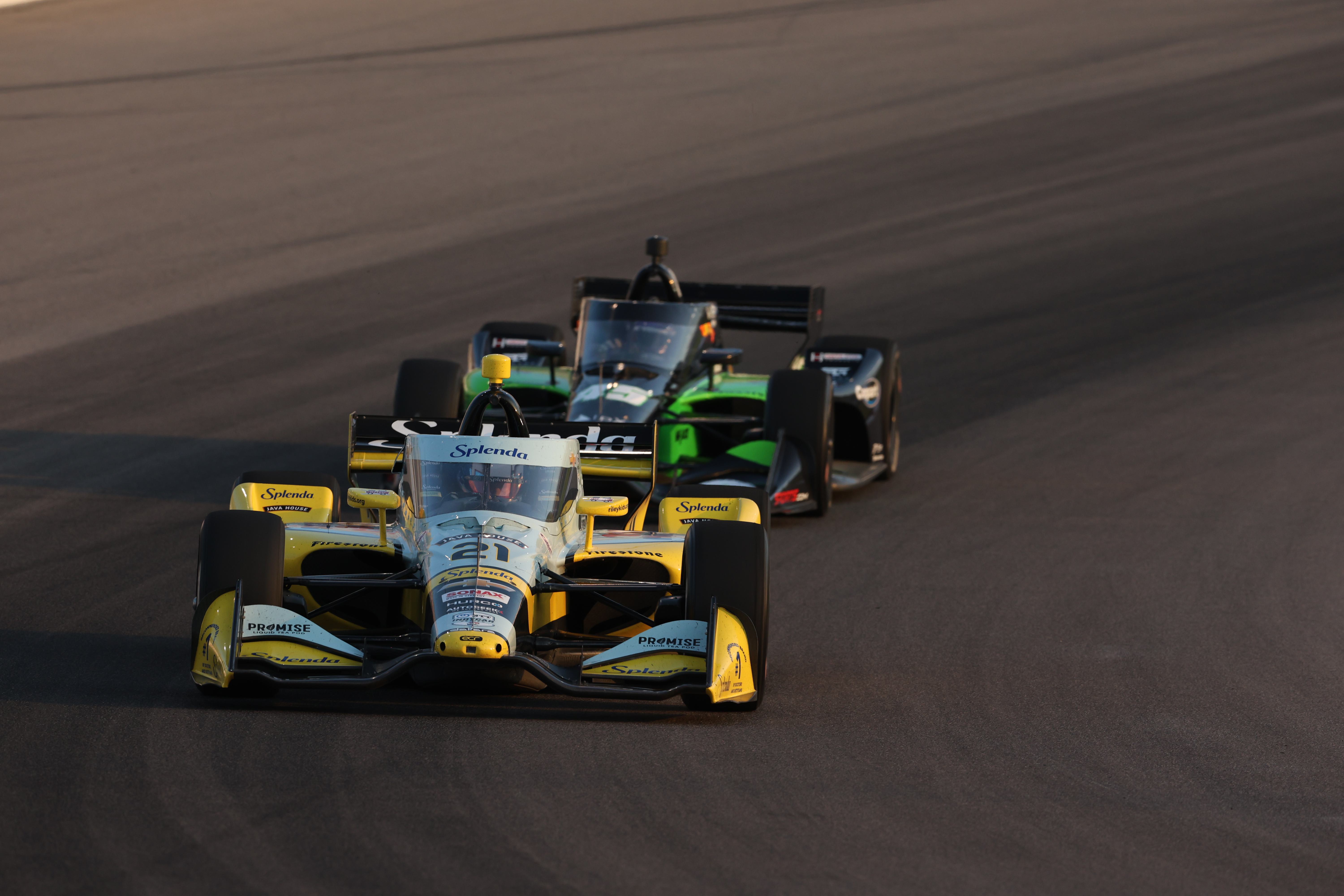
It also re-opens the void that was once looming before the race was moved in 2024, with the series visiting no oval longer than 1.25 miles outside of Indianapolis, with visits to 1-mile ovals at both Phoenix and Milwaukee and the 1.25 mile oval at Gateway.
That said, all three ovals are relatively different in characteristic, but none meet the high-speed, multi-lane, 1.5 mile ovals that IndyCar's product has so successfully built up over decades. Their popularity has continued to show in recent seasons at both Nashville and Texas, with IndyCar's best racing on display at such ovals.
Doug Boles has stated that adding more ovals remains a "massive priority" to the series, but for many, it feels like the same horn that has been tooted for several years with little tangible evidence to show for it.
The plans for Nashville's future still remain clear, IndyCar's plan to showcase their product on their best track type remain more murky.
A four-week gap remains prior to the 'Month of May'

Although the four-week gap between the series' visits to Long Beach and the Indianapolis Motor Speedway road course were already known at the release of Phase One for 2027, there was newfound hope in recent weeks, after suggestions that IndyCar were exploring a return to Texas Motor Speedway on May 1st, holding another double-header weekend with NASCAR.
A return to Texas would have meant that the four-week break would be broken up in half, but instead IndyCar continues to face a four week gap ahead of their biggest month of the year. The gap is somewhat softened by the Indianapolis 500 Open Test, which will take place between May 4th and 5th, but it leaves a glaring break right as IndyCar needs to build momentum for their marquee event.
In many ways though, it is still a far better outcome what had become the norm prior to 2026, where seasons started extremely slowly, which made any momentum difficult to achieve prior to the Month of May. 2025 saw the first three races take place over nine weeks while 2024 had a six-week gap between the opening two races.
Like was the case in 2026, there is no such sluggish start to 2027, with St. Petersburg, Phoenix and Arlington all taking place in consecutive weekends to kick off the season, before things slow down in April and May with just two races in seven weeks.
It is admittedly hard to believe that a lack of races immediately building up to the Indianapolis 500 will turn casual viewers away, but consistent races in the build-up to IndyCar's most significant two weeks of the year can only help their cause.
The absence of IndyCar's latest marquee event

The Freedom 250 had always been billed as a once-in-a-lifetime event to celebrate America's 250th birthday, with a race of 250 miles taking place around the streets of the nation's capital. It marked a landmark weekend for the series, with the highest viewership figure outside of the Indianapolis 500 since re-unification and a level of attention has been unprecedented outside of May.
What was not so clear though was if the once-in-a-lifetime event solely referred to the concept of the Freedom 250 or IndyCar racing on the Streets of Washington, D.C. from a more general perspective. With no return scheduled on the calendar, it rather seems that the latter is also correct.
The success of the event had ignited such discussions, with both the President and the First Lady earmarking to Penske Corporation officials their desire for the event to return. That said, a return would always be far easier said than done.
The event was almost fully funded by Roger Penske and corporate sponsors, with the cost of staging the race estimated around the $35 million mark. It could have been justified as a one-off event in a landmark year for the nation but any further races with a similar hosting cost could have been seen as financially irresponsible.
The series has certainly gained a new marquee event in Barcelona, but says goodbye to another with Washington's absence from the calendar. It may be less of a bitter pill to swallow than Nashville though given that the prior expectation was that the Freedom 250 was always promoted as a one-and-done event, but what was IndyCar's largest promotional asset outside of Indianapolis for decades is now no more.
Milwaukee continues as a double-header weekend

Double-header weekends have always been a sticking point on recent calendars, and Milwaukee's continuation as a double-header weekend will only continue to re-ignite discussions about their value on the calendar.
Generally, such events have become less frequent in the last decade-and-a-half, with Milwaukee being the only double-header in 2027, like was the case in 2026. The circuit took the slot of Iowa Speedway, which had hosted double-headers between 2020 and 2025 and proved a popular event, due to the high-profile concerts that would take place between the races.
As time has gone on, the appeal of double-headers has only seemed to diminish, with the value of two races in Milwaukee proving low compared to the previous precedent set at Iowa. By having two races in a weekend, the appeal of each individual race only decreases and the product only risks being diluted as the series tries to shoehorn in 17 races into its schedule.
It can also be argued that the race is held at a questionable time of year to host a double-header. Hosting the penultimate round of the season, a significant points swing is easily able to occur prior to the finale, with one small incident potentially having further consequences than would be the case on a normal weekend - just look at Kyle Kirkwood's Milwaukee weekend this season.
In the hypothetical scenario where a champion is crowned on Race 1, it also means that their moment in the spotlight is short-lived with the tight turnaround to Sunday's race, an unjust situation among a star's shining moment.
However, in some ways, it felt like a necessity. Having four oval races, including the Indianapolis 500 would have been a catastrophe for the series, especially when ovals are when the product shows best in its current form. Is another oval race in a double-header format better than another single race at a road course venue? Given the circumstances, possibly.
It is not the ideal solution for anyone though, given the increased burden on teams and drivers. The popularity of these weekends internally seems to be minimal and although there is less emphasis on such weekends, they continue to feel an emergency stop-gap solution when putting a calendar together, rather than creating the events the series wish to put such an emphasis on.
Season finale remains at Laguna Seca

In some ways, it was almost a blessing that IndyCar's championship fight did not go down to the wire in 2026. After WeatherTech Raceway Laguna Seca surprisingly returned to hosting the season finale after a two-year absence in 2026, the move was met with skepticism. The doubts proved correct. There finale proved to be a processional and uninspiring way to end the season as cars trundled round the California desert for 95 laps, as fans simply waited for the laps to tick by.
It has been difficult to see many real strengths that Laguna Seca holds to make it suitable as a season finale. It's not in a major market or metropolitan area, attendance is inconsistent and the racing is often poor, barring a ridiculous crash-filled race in 2023. As Scott Dixon best described it in his press release prior to the weekend, it is a "sleepy" way to end a season.
It proved quite the parallel to the events that were put on by Nashville Superspeedway in the two years prior. Not only did it have the appeal of the Nashville area, with many of the promotional efforts held downtown despite the track being 40 minutes away and an event-like feel through the work of Borchetta, it also created a racing product that was being craved for and fit the bill of a traditional IndyCar oval race. It ticked all the boxes that were wanted in the methodology of crowning an IndyCar champion. It is hard to say that Laguna Seca ticks many.
Given Palou's recent dominance, it feels that a last-race title battle seems unlikely, even prior to cars hitting the track in 2027. However, should the finale go down to Laguna Seca, it is hard to envision that a champion will be crowned in a send-off that a championship battle deserves. It was a move that puzzled many with the announcement of the 2026 calendar and only continues to bemuse with the continuation of the race.




Comments