
Aston Martin 2026 Preview: Will the new era launch them out of mediocrity?

As we count down to Formula One's 2026 season opener, our F1 writers preview each team's potential, expectations and goals ahead of the start of a new regulatory era for the sport. Aston Martin's testing performance has been extremely concerning. Will they be able to fulfill their potential and deliver a competitive car at any point this year?

Back in 2023, Aston Martin surprised everyone when they rolled out of pre-season testing with the second-fastest car. After struggling in the midfield for years, the newly rebranded team emerged as Red Bull’s closest contender, generating an exciting buzz about their potential in coming years.
This energy was only amplified by the presence of two-time world champion and Formula One legend Fernando Alonso, whom many had been hoping would be able to drive in competitive machinery once more.
Yet, since then, the team has only regressed. While Alonso was able to deliver some flashes of brilliance in 2023, securing eight podiums, development missteps saw the Silverstone-based team fall back into the pack. They finished an extremely distant fifth in 2024, and slipped to seventh in 2025.

However, with on-track results faltering, team owner Lawrence Stroll’s ambition off it has only intensified.
In anticipation of the engine-based regulation change, he secured a works partnership with Honda, who had just powered Red Bull to four Constructors’ Championships. Most significantly, Stroll was also able to sign the most successful engineer and car designer in F1 history: Adrian Newey.
Newey’s designs have won 14 Drivers’ Championships and 12 Constructors’ Championships. Stroll will be hoping he adds more titles to his tally under Aston Martin.

On paper, all the ingredients are there: state-of-the art facilities, a works engine deal, and perhaps the greatest technical mind to ever grace the sport. However, with all this comes the expectation to finally translate the promise of this meticulously assembled team onto the track.
A lopsided driver lineup
If Aston Martin has a structural weakness, it lies in their driver pairing.
Even at the age of 44, Alonso’s ability in the car remains elite. He showed in 2023 that, given competitive machinery, he can still battle wheel-to-wheel with the very best. His racecraft, tyre management and technical feedback is still among the best in F1.
Yet, even the best athletes eventually falter to time. The longer Aston Martin takes to produce a genuine title-contending car, the narrower Alonso’s championship window becomes. The Spaniard may still possess the skillset required to mount a title challenge, but for how much longer will he still have that edge?
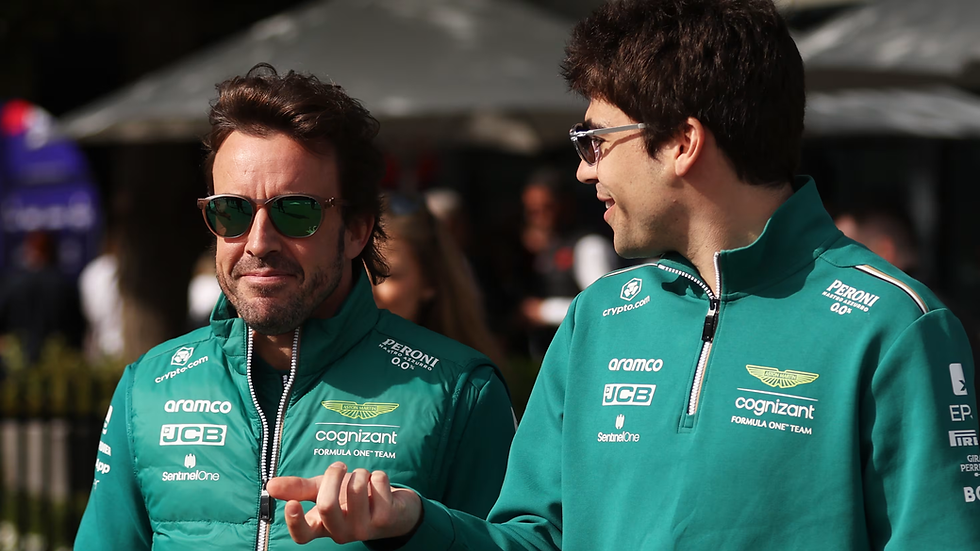
In the other car sits Lance Stroll, who is glaringly the weak-link of the lineup. On pure merit, Stroll continues to face scrutiny as arguably the least convincing driver on the grid. It is quite obvious to everyone in the paddock that he remains in the seat due to his nature as the CEO’s son.
The irony is difficult to ignore. Lawrence Stroll has poured extraordinary resources into transforming Aston Martin into a championship-calibre operation. Yet, his efforts have all been for his son’s career, who remains perhaps the team’s biggest liability.
Last season, Alonso outperformed Stroll in every single Grand Prix qualifying session, a clear indication that Stroll’s pace is not up to par. This conundrum leaves the team in a very difficult position; as Red Bull has shown, Constructors' title cannot be won with one car.

Aston Martin may not yet be in a position where this imbalance costs them titles. But if, or when, they close the performance gap, will they consider replacing Stroll? And if not, what would the repercussions be?
What we learned from testing
Pre-season testing has offered little encouragement for Aston Martin.

Their delayed arrival to the Barcelona shakedown immediately raised eyebrows and the AMR26’s distinctive design philosophy stood apart from the rest of the field. At first glance, it hinted at bold, Newey-like innovation, but as running progressed in both Barcelona and Bahrain, that divergence has looked more worrying than visionary.
While testing times are never a definitive or clear indication of the grid, the underlying signs have been concerning. In Bahrain, Aston Martin looked rooted to the bottom of the order, reportedly slower even than the new Cadillac team. For a works outfit entering a fresh regulation cycle, that is not the statement they would have hoped to make.

Beyond outright pace, reliability has also emerged as a potential issue. The Honda power unit has not held up, leaving their total mileage count a measly 2111km. This problem would have interrupted their ability to further understand their package to improve it for Australia.
The AMR26’s limited and interrupted running suggests a package that is not yet fully understood, let alone optimised. Testing may not define a season, but for Aston Martin, it has set an uneasy tone heading into 2026.
Team expectations for 2026
After the conclusion of testing, expectations for Aston Martin are at an all-time low. On outright pace, they have looked alarmingly adrift and arguably in a worse position than last year, when they slumped to seventh in the standings. For a project with the amount of investment that they have had, that is a worrying baseline.

If they are truly as slow as testing times show, it would be a significant blow to Stroll’s long-term vision. Few owners have invested as aggressively or as publicly in transforming a midfield operation into a championship contender. A slow start under brand-new regulations would not just be disappointing but would raise uncomfortable questions about whether the pieces of this carefully assembled puzzle are truly aligning.
Additionally, there is a significant reputational risk at play. With new entrants in Audi and Cadillac joining the grid in 2026, Aston Martin cannot afford to be drawn into battles at the very back of the field. Being overtaken by a fresh operation still finding its feet would be deeply embarrassing; at this stage and with their personnel, Aston Martin should be setting benchmarks, not scrapping it out with new teams.

On the more optimistic end, Aston Martin may well prove themselves in the development race. Newey’s arrival was never about delivering an instant miracle, but long-term architectural excellence. His track record suggests that even if the baseline car is flawed, development will be relentless. Aston Martin may begin 2026 on the back foot, but few would bet against them making steady gains as the season unfolds.
Ultimately, 2026 does not need to deliver a title challenge, but it must show a clear trajectory. By the second half of the season, Aston Martin needs to show clear upward momentum and evidence that this new regulatory era is one in which they can genuinely compete.




Comments