
The making of Marcus Armstrong in IndyCar: Racing intellect, the Dixon factor & NFL fandom


As much as he may mock the monotony of his own delivery, you would be hard-pressed to have a dull conversation with Marcus Armstrong. In one way or another, his brain is always ticking.
Take the NFL, for instance. Since watching the New England Patriots’ all-time great comeback against the Atlanta Falcons in Super Bowl LI on television in 2017, he has become utterly obsessed with the sport. Days on end will be spent listening to Pat McAfee, Colin Cowherd and much else NFL-adjacent.
It has gone beyond regular fandom; he has developed stunning attention to detail. And yes, such an analytical eye may be part of the nature of any racing driver, but it feels particularly defining with Armstrong.
“I just love it,” he tells DIVEBOMB. “Perhaps it’s a break from the motorsport analysis because I put a lot of analysis into my own sport and it’s nice to analyse a sport that I really shouldn’t know anything about.
“It’s really fun to watch with my family because they don’t know anything about it. I can already tell by the way that the [offensive] line is formed what the play is going to be - and I can basically tell them what the play is going to be five seconds before it happens.
“Perhaps NFL punditry is in my future… [but] I don’t have enough energy for that. Unless the NFL gravitates to more dry sarcastic humor, I don’t have a chance.”
Above all, while he has a natural soft spot for the Indianapolis Colts given his current residency, Armstrong is a self-proclaimed “big Aaron Rodgers guy”. In fact, he once received a direct message from the four-time NFL MVP-winning quarterback in response to an Instagram Reel declaring his fandom, offering Armstrong match tickets.
He was also in his element when meeting New York Giants quarterback Jameis Winston and Super Bowl-winning coach Jon Gruden at IndyCar’s St. Petersburg season opener this year. But in particular, he was struck by meeting Dallas Cowboys owner Jerry Jones in Arlington.

“If you’re an NFL fan, he is the guy. It was so cool,” Armstrong recalls of meeting Jones. “I got to shake his hand and was like: ‘I think you should really sign Maxx Crosby.’ I won’t tell you what you said next, but he took my suggestion and he [was] going to think about it.”
The formative days of Armstrong’s NFL fandom came at home in New Zealand, where games were live in the daytime over the summer. He would then spend evenings in Italy watching with fellow driver Gianluca Petecof while racing on the Formula One ladder.
But since switching paths to race stateside in IndyCar in 2023, he has been able to become even more immersed in the sport. On every front, he is relishing this chapter of his career and has found a long-term home stateside.
For his initial campaign, Armstrong signed with Chip Ganassi Racing (CGR) for a road-and-street-only programme, impressing with five top-10 finishes and only three results outside the top 15 in his 12 races. Even without running ovals, he claimed Rookie of the Year honours.
“Hopefully one of my strengths [is] that I learn from every mistake that I make,” he asserts. “2023 was a bit of a: ‘Woah, okay, it’s a culture shock from Europe.’ There’s a lot of differences with the car and strategy and a lot to think about.
“I learned more in 2023 than any other year in and out of the car. I understood that to be a professional in IndyCar racing there needs to be a totally different approach.”
His sophomore campaign - signed to a full-season programme with CGR - marked another steady step forward, standing on the podium for the first time with a third-place finish in Detroit and recorded a total of four top-five results. Of his eight top-10 finishes, three came on ovals as he grew accustomed to an unfamiliar discipline of racing.

“I feel like it’s more instinctual,” Armstrong assesses of driving ovals. “You have to follow your intuition because the balance changes so much. It’s constantly evolving and you can’t be too smart with that sort of thing. You need to just trust yourself.
“Every single time I do it, I learn something. The way the cars are set up is so different on an oval, so also learning what I like and then trying to lead the team as well as I can, that’s also a work in progress. It’s almost a different sport, really.”
Armstrong signed for Meyer Shank Racing (MSR) alongside Felix Rosenqvist for 2025 but maintained much of his team, including engineer Angela Ashmore, given a new technical alliance with CGR, as they downsized to a three-car lineup under the charter agreement.
“I’m very lucky to have maintained Angela,” he reflects. “It’s been a very seamless transition. I’ve got great people around me. Mike [Shank] and Jim [Meyer] are super supportive. It’s such a cool team. I’m still close with all the Ganassi guys as well. Chip [Ganassi]’s a great source of inspiration. It’s one of those situations where we are aligned.”
The 2025 season was a continuation of an upwards trajectory - not least his jump from 14th to eighth in the standings. He also recorded a first oval podium with third place at Iowa Speedway and finished in the top 10 on 11 occasions, including in nine of the final 11 races.
While Rosenqvist finished two positions higher in the standings, an eighth-place championship finish for Armstrong still far usurped anything the team had ever managed in their six-year full-time IndyCar history. But it was striking - particularly on IndyCar’s pre-season media day in January - how relatively discontent Armstrong still was.
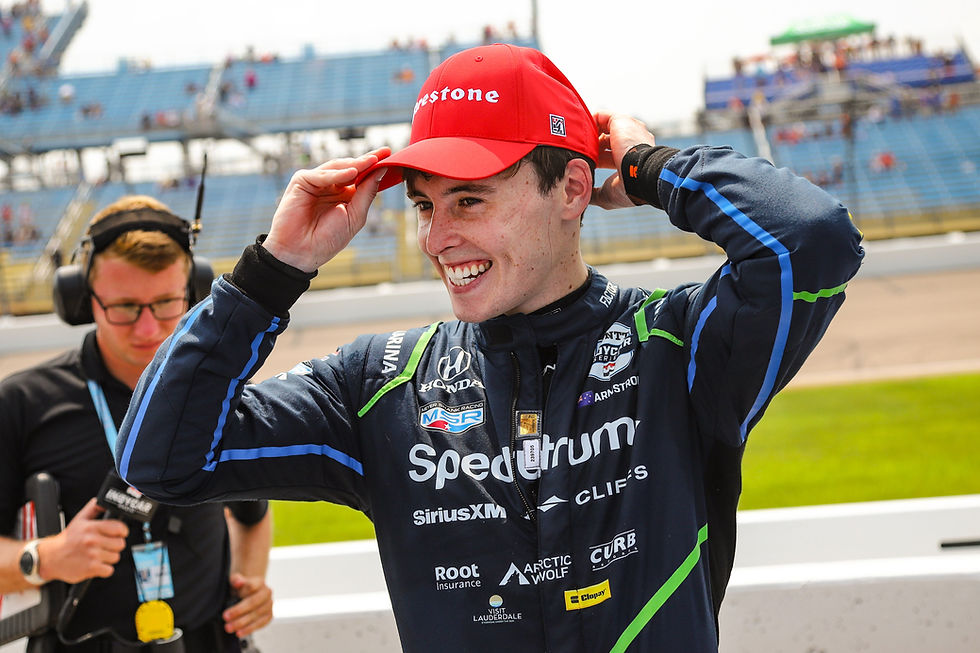
“2024, we made good strides [and it] was better than what people would realise relative to ’25,” he suggests. “We just didn’t have the consistency. And then in ’25, we had the consistency but not the peaks. Consistency is great… it’d be nice to be consistently on the podium. And we’re getting there. Trust me, we’re getting there.
“[But] I can’t be too happy. We need to be winning races before I can be properly happy. It was certainly progress and I can’t be disappointed with that. But I did make a lot of mistakes.
“In Nashville, I was in a podium place for most of the afternoon and I made a mistake and I ended up losing a potential win and podium and two places in the championship all in one. It was like: ‘Alright, maybe we have a lot of work to do here.’”
But however he felt about 2025, it is clear Armstrong has started to come into his own in IndyCar - now in his third complete season and fourth overall. Compared to what he was accustomed to in Europe, where he won races in FIA Formula 2 and FIA Formula 3 and was a member of the Ferrari Driver Academy, he is embracing the amplified role of the driver.
“I feel like the driver here is very much the quarterback of the team,” he says. “I feel like in Europe, the technical director of the team is the boss, whereas over here I feel like the driver will make the final call on whether they want something on the car or not.
“That’s really cool, because as a driver, there’s more responsibility being put on you to understand every single dynamic. You can’t just wing it. The team trusts you to make the right call so you can put your ego aside and try and make the best call for the team.”

The complexities of IndyCar racing have also suited Armstrong’s analytical nous, given how strategic races often are. He enjoys the rawness of the product, of course, but has equally revelled in learning the nuances of how to succeed in cannier ways.
As such, his keenness to fixate on the finer details of the NFL is no coincidence. It is purely a habit from his day-to-day occupation as a racing driver.
“I feel like I’m a bit more of an intellectual racer,” he explains. “I don’t just go balls to the walls and I like to think about it. It’s almost comforting to do homework, even though it wasn’t back in the day.
“We do a lot of work on understanding the rhythm of the race. We have so many strategy meetings through the week, just to make sure we’re all on the same page. And probably more so than anything, it’s for me just to understand how the race should be driven.
“One thing about IndyCar racing is history often repeats itself. And that’s largely because the cars barely change from year to year and the drivers are there for a long time. So for a younger guy like me, it’s important to understand the rhythm of it.
“[Scott] Dixon’s an absolute master at that. He understands the strategy and how to race the race on Lap 3, by reading the situation. So we’ve done a lot of work to try and speed up that learning process, just so I can maximise what we have on the day. And I enjoy that.”
Armstrong has been fortunate to have six-time series champion Dixon - a childhood hero from New Zealand - in his corner from the outset in IndyCar at CGR. Not to mention the wisdom of four-time champions Álex Palou and Dario Franchitti - or teammate Rosenqvist and MSR minority co-owner Hélio Castroneves, a record four-time Indianapolis 500 winner.

“I’ve been surrounded by great people from the beginning here in America and they’ve sped up the learning process. I’m very grateful to have those teammates because you pick up so many things and there hasn’t really been any egos in the room. That’s probably where [the intellectual approach] comes from. There’s no shortage of information coming my way.”
Of course, sharing engineering debriefs with idolised compatriot Dixon has reigned above all else for Armstrong. And there are certainly parallels that could begin to be drawn between the pair stylistically, with their measured, calculated, intelligence-led skillsets on track.
From Armstrong’s side, there is no hiding that he has been keen to emulate some of Dixon’s greatest strengths - including off-track too.
“I think we all have,” Armstrong concedes. “Álex would say the same; we pick up so many things from Scott. He’s always the first guy you ask what his opinion is on the car. He doesn’t exactly give you all the information you need; you need to ask for it. You need to dig in, dig through the data to find it.
“I really like his approach. I even like the fact that he’s not on social media much. If it was up to me, I wouldn’t have social media at all. I have two phones now - one that I have social media on and one that I don’t because I don’t even want to know about it until I need to.”
Attention for Armstrong now turns to rectifying a 2026 season thus far of unfulfilled promise. After five races, he sits 13th in the standings and already 104 points off the championship lead - a deficit that could easily have been markedly slimmer.
Fifth place at Phoenix Raceway remains his best result, closely followed by sixth in Alabama. But in the St. Pete opener, he was in podium contention before running deep in Turn 1, losing multiple positions and falling down the order to 11th after the final pit cycle.

His 10th place in Arlington was bittersweet: a strong recovery drive after suffering a puncture en-route to the grid, where he was supposed to line up from sixth. Most recently, mishaps in pit lane and another puncture confined him to 24th in Long Beach. It has been frustrating given a ceiling loftier than what has been delivered to open the year.
But as May approaches, there is encouraging potential to be harnessed for Armstrong, as one of IndyCar’s leading up-and-comers continues to rise to the fore.
“We want the peaks and we want them consistent. I just don’t want to make the same mistake twice. I hope that I’m just always getting better. IndyCar racing exposes any weakness you have as a driver, whether it’s strategy or raw speed or racecraft or your engineering knowledgeability. So there’s always something to work on.
“I just want to be up front with Álex; I want to be fighting him for a championship. Until I’m there, I’m not going to be too satisfied. I probably sound very pessimistic but that’s the truth and that’s just how it is. I’m in a great situation. We have a great team around me.
“So it’s like: ‘Let’s crack on.’ I’m not 18 anymore; I’m 25 now. So trophies. Let’s get it.”






Comments