
Hydration, fans and ice baths: How Formula 2's drivers are preparing for Austria's heat


“It all starts by drinking a little water,” Trident’s Laurens van Hoepen would say when asked about keeping up with the intense heat.
For Formula 2’s grid in Austria, the challenge begins even before the lights go out.
Formula 2’s upcoming Austrian weekend is set to be a sweaty affair. As such, the FIA have already declared a heat hazard ahead of the race weekend at the Red Bull Ring. This advisory is issued to teams when the air temperatures are forecast to cross the 31°C mark during a race weekend.
This applies to all the races taking place during the weekend, with F2 and Formula 3 supporting Formula One’s showpiece Austrian Grand Prix event.
When a heat hazard is declared, it requires teams and drivers to take further precautionary measures in order to stay safe. Drivers are often accustomed to racing in colder temperatures during race weekends, and a race weekend in hotter temperatures requires them to alter their training regimes and preparation.
But sporting events played under extreme heat conditions are more common across disciplines. Think back to tennis players at the Australian Open, with organisers even drafting an Australian Open Extreme Heat Policy detailing several cautionary measures to ensure safe play.
Likewise, cyclists often prepare for the gruelling Tour de France by acclimatising themselves to the intense heat upto 10 to 14 days before the race, often training in rooms with no fans, and hydrating with electrolytes after an intense session to cool down their bodies.
Even the biggest names in international cricket have to adapt to scorching conditions when playing the Indian Premier League (IPL) in April every year. Teams often focus on player recovery after a game, apart from personalised hydration through Oral Rehydration Solutions (ORS) and other drinks to regain energy.
At the ongoing FIFA World Cup in North America, a three-minute hydration break has been mandated in every game, to ensure footballers across the world can mitigate the scorching heat.
Formula 2 drivers are no different, though. As Trident’s Laurens van Hoepen alluded to ahead of the weekend, “We train for that stuff.”

“We try to have some training with very high temperatures with my trainer, in a way, so as to get used to this kind of condition,” championship leader Gabriele Minì said, speaking to DIVEBOMB ahead of the weekend on his preparation.
If anything, the previous outing in Barcelona served as a perfect opportunity for teams and drivers to get accustomed to the warmer temperatures. The air temperatures hit 30°C during the Saturday sprint and the 31°C mark during Sunday’s Feature Race.
“We are kind of used to it,” van Hoepen remarked, speaking on the intense heat at F2’s previous weekend in Barcelona.
Much like their sporting counterparts, pre-weekend preparation for F2 drivers remains just as intense to maintain fitness and avoid fatigue. “You make sure you're hydrated enough, that you're ready, fit enough to be able to get through this weekend,” the Dutchman acknowledged ahead of the weekend.
With the constant training regimes actively keeping drivers focused on the metronomic cardio, strength training and cooling off, sometimes, the act of standing still in the open can become a challenge.
As Minì remarks, “It's harder, at least for me, when I'm staying still on the grid, and there is no air cooling down. That's very tough.”
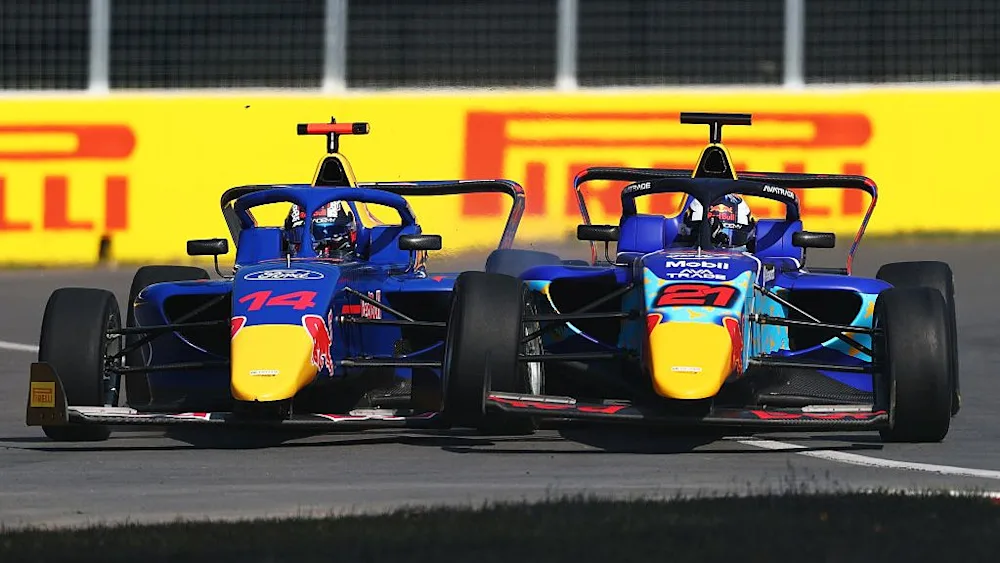
However, there is nothing more challenging than racing an F2 car in the heat, one with a hotter power unit and no power steering.
The challenge only amplifies with no active air conditioning or cooling systems added into the car. Teams are forced to get ingenious and rudimentary with their solutions to keep their drivers cool in the pits.
“We have a couple of fans to help us cool us down in the car to be as cool as possible,” van Hoepen says.
While staying cool inside the car is important, drivers will also have to ensure their tyres do not get too hot and lose optimal grip over the course of a race. “Once you're driving, aside from all the differing techniques in terms of warm-up and being more careful with the tyres when you're driving, it's kind of okay,” he responded, talking about the racing in itself.
Even with all these measures, the heat can take a significant toll on F2’s grid. Drivers are often sitting tight in several layers of fireproof clothing, with little room for movement.
“When I got out of the car, and the heat hit me, it was really, really difficult,” Rodin Motorsport’s Alex Dunne had remarked when F2 went racing in Miami earlier in 2026.

Once again, for F2’s drivers, the post-session recovery is just as important. A 45-minute race in the gruelling heat can often leave drivers exhausted. So, how does F2’s class of 24 keep themselves ready for what comes next during race weekends?
“After sessions, for example, you go straight into an ice bath,” van Hoepen said. “We start the recovery as quick as possible to be ready for the next session. So, there are some things we can do.”
Despite all that drivers plan for a weekend, it’s the simple habits that matter in the long run. “Even afterwards, it’s about being proactive with food and drinks to not suffer from the heat as much as you could, to be honest,” Minì concludes. Drivers often have a cup of ice cream after a podium ceremony, in order to stay cool in the heat.
Even as F2’s championship fight peaks in Austria with a sprint and a Feature Race, surviving the weekend is a larger endurance test for the drivers themselves. “It's just about getting through the suffering (in the heat),” van Hoepen puts it, summing it up even before the weekend has begun.


Comments